13 stories credited to The Atlantic (11 on theatlantic.com, 2 reproduced by other sites)
Latest story Sep 20, 2026 · on ChamberLight since Apr 2026
A story can appear as several articles (copies of the same piece), so counts of stories and of articles differ.
Scores for The Atlantic
Political lean
12 stories · 95% range 29–41 · updated Sep 25, 2026
Originality
11 stories · updated Sep 24, 2026
Writing quality not enough rated stories yet: 6 of 10. How it is measured
Scores last checked Sep 25, 2026.
Stories ChamberLight collected, by month
Stories credited to The Atlantic, by publication date. ChamberLight collects articles that mention the officials it tracks, so this shows its own coverage of this source, not how much the source publishes.
- Stories from The Atlantic
- Shaded: ChamberLight collected no stories, or almost none, from any outlet (a gap in its collection, not in the outlet’s publishing)
Show as a table
| Month | Stories | All outlets |
|---|---|---|
| February 2026 | 2 | 98 (collection gap) |
| March 2026 | 2 | 1,094 |
| April 2026 | 8 | 4,538 |
| May 2026 | 0 | none collected |
| June 2026 | 0 | none collected |
| July 2026 | 0 | none collected |
| August 2026 | 0 | 1 (collection gap) |
| September 2026 | 1 | 1,320 |
Top topics
Share of this source’s stories tagged with each topic. A story can carry several topics, so the shares do not add up to 100%.
- Ethics/Corruption9
69% of 13 stories · 58% across all outlets
- Foreign Policy9
69% of 13 stories · 29% across all outlets
- Budget/Spending6
46% of 13 stories · 31% across all outlets
- Defense/Military4
31% of 13 stories · 25% across all outlets
- Immigration3
23% of 13 stories · 13% across all outlets
- Criminal Justice2
15% of 13 stories · 19% across all outlets
- Economy2
15% of 13 stories · 26% across all outlets
- Technology/Privacy2
15% of 13 stories · 10% across all outlets
The thin mark on each bar is the topic’s share across all outlets.
Who they cover
Party of the officials these stories are mainly about, across all 18 officials named. A story counts once for each official it is mainly about, so the split is over 24 story–official pairs, from 13 stories.
- Republican63% · 15 pairs
- Democrat29% · 7 pairs
- Party not recorded8% · 2 pairs
Most covered
Stories mainly about each official, and their share of the source’s 13 stories.
- 1Donald TrumpR4 stories · 31%
- 2Markwayne MullinR3 stories · 23%
- 3Kristi NoemR2 stories · 15%
- 4Abdul El-Sayed–1 story · 8%
- 5Alexandria Ocasio-CortezD1 story · 8%
- 6Ben ClineR1 story · 8%
- 7Cory BookerD1 story · 8%
- 8David SchweikertR1 story · 8%
- 9James Talarico–1 story · 8%
- 10Jon OssoffD1 story · 8%
+ 8 other officials (8 story–official pairs)
Article tone
ChamberLight’s article analysis assigns each story a tone toward the official it covers. It describes the coverage of that official, not The Atlantic’s stance, and reader votes do not change it. 13 stories.
- Good Look
- 1 (8%)
- Mixed
- 9 (69%)
- Informational
- 0 (0%)
- Bad Look
- 3 (23%)
Related sources
Lean 95% range 30–39 · updated Sep 25, 2026
Similar lean · 3 shared topics
Lean 95% range 29–44 · updated Sep 25, 2026
Similar lean · 3 shared topics
Lean 95% range 31–43 · updated Sep 25, 2026
Similar lean · 2 shared topics
Lean 95% range 28.4–35.7 · updated Sep 25, 2026
Similar lean · 3 shared topics
Lean 95% range 26–33 · updated Sep 25, 2026
Similar lean · 3 shared topics
Lean 95% range 32–50 · updated Sep 25, 2026
Similar lean · 2 shared topics
Challenges to these scores
No one has challenged a score on this page yet. Anyone can; editors publish every outcome here.
Articles served from theatlantic.com
21
Abdul El-Sayed Won't Back Down
He wants to win the Michigan Senate race his way -- as an unabashed progressive populist and a fierce critic of Israel. Abdul El-Sayed certainly enjoys an argument. Our first interview, in a kebab restaurant in Dearborn, Michigan, spun out into a wide-ranging discussion of America's Middle East pol

Trump Voters Are Over It
Tomas Montoya has sold festival foods—funnel cakes, burgers, hot dogs—across the American Southwest for years. But lately, business has been rough. Costs are up, so he’s increased his prices. Employees are begging for hours he can’t give them. In Arizona, where he lives, Montoya pays $6 a gallon to fill up his food trucks with diesel. This summer, he may have to skip the California leg of his festival route because fuel is even more expensive there. “It’s Trump,” Montoya told us outside a popular Hispanic grocery store in Casa Grande, Arizona, much of which sits in one of the most evenly divided House districts in the country. Montoya voted for President Trump in 2024, but now, well, frustrated doesn’t begin to cover how he’s feeling. The president is bragging about the economy, even though everyone Montoya knows is hurting; he promised to stop wars, but started one in Iran. “When Trump opens his mouth, three-quarters of what he says is stories, lies,” Montoya said. He’s planning to vote in the midterm elections this fall. But he may not choose a Republican. You can’t flip a funnel cake in this part of Arizona without spattering someone who sounds just like Montoya—anxious, and a little regretful about how they voted two Novembers ago. These days, a shocking number of the president’s supporters have turned against him. Some of Trump’s fanboys in the libertarian-leaning manosphere have spent the past year baffled by his actions on the Epstein files, immigration, and now Iran. And in the past week, religious conservatives have been criticizing their once-unassailable leader after he posted a photo on social media of himself as Jesus and attacked the pope, calling the first American pontiff “WEAK on Crime.” Some Republican operatives in battleground states told us that they’d rather Trump not campaign too hard for their candidate; others have seen their small-dollar donations plummet. [Read: The manosphere turns on Trump ] Midterm elections are typically rough for an incumbent president’s party. But this year threatens to be brutal. Trump’s approval is lower right now than it was at this point ahead of the 2018 midterm elections, when Democrats won back the House in a historic blue wave. Almost every new poll is a red flag for Republicans: Independents, young voters, and Latinos—groups that were crucial to Trump’s win in 2024—aren’t in the bag anymore. Even non-college-educated white Americans, once the president’s strongest group, have turned on him, according to a CNN polling average. Democratic-leaning voters are 17 points more likely than GOP-aligned voters to say they’re “extremely motivated” to vote in November. Many Trump voters, in other words, have had it. At this point, it seems safe to declare that the historic coalition that powered the president’s second reelection is finished—kaput. The question is whether, with seven months to go until the midterms, any semblance of it can be revived. Casa Grande, a pit stop between Tucson and Phoenix where agricultural fields give way to new subdivisions, is on the northwestern edge of Arizona’s swingy Sixth Congressional District. In 2024, Trump won here by less than a point, after losing the district by less than a point four years earlier. The area is currently represented by Juan Ciscomani, a Republican who narrowly won his two terms in Congress and who outperformed Trump by a slim margin in 2024. Ciscomani is up for reelection again this year, but what we heard from some of his constituents may not give him much reason to be optimistic about his prospects. Shoppers outside the market bemoaned the rising price of everything: gas, meat, store-made chicharrones ($9.29 for a big bag). And they were ready to punish Trump’s party for it. Traci Calvo, a 61-year-old Democrat living on a fixed income, said she’s poorer today than she was in 2024, when she voted for Trump, believing he would bring down prices. High gas prices mean that she is staying home more often—skipping Bible studies at her church, volunteering less, and even missing exercise classes. Trump’s decision to go to war with Iran was her breaking point with the president. “I think that he just wants war,” she said. “He’s made it plain that he’s adversarial with everybody.” She doesn’t plan on voting for Ciscomani, or any other Republican for that matter, in November. The mood among voters was just as grim some 60 miles southeast in Oro Valley, a northern suburb of Tucson known for its scenic mountain views—and home to many conservative voters whom Ciscomani and statewide Republicans rely on. Sitting inside of her car after a shopping spree at a dollar store, Zuriel Reyes told us she feels “shitty” about having voted for Trump in 2024, her first-ever election. “I don’t really trust our government anymore,” the 19-year-old said, taking a bite from a Slim Jim. She’s signed up to go into the Army next year and feels like the president is “putting all our lives in jeopardy with this weird war game that he’s playing.” [Read: Public anger is rising] The conflict with Iran has disappointed plenty of others who once supported the president, including some who are much more firmly planted in MAGA world. On Easter Sunday, Trump’s threat to wipe out “a whole civilization” in Iran drew ire from many onetime Trump devotees, such as Tucker Carlson, Alex Jones, and Megyn Kelly, who subsequently declared on her SiriusXM radio show that she was “sick of this shit.” Earlier this week, when Trump posted the AI image of himself dressed in flowing robes, surrounded by a heavenly glow while healing a sick man, he alienated the one group of Americans that has rarely left his side: Christian conservatives. The picture, declared the Daily Wire reporter Megan Basham, was “OUTRAGEOUS blasphemy.” Joel Webbon, a far-right pastor who believes that women should be stripped of their right to vote, concluded that Trump is “currently demon possessed.” Riley Gaines, an anti-trans activist who has appeared at Trump rallies and whom the president has previously called a “tremendous athlete,” wrote that “God shall not be mocked.” Trump deleted the post and said that the image was “me as a doctor.” But he also doubled down, as he tends to do, when asked to respond to his critics. “I didn’t listen to Riley Gaines,” he told one reporter. “I’m not a big fan of Riley, actually.” Perhaps the storm cloud of negativity hanging over the president explains why his planned appearance in Arizona tomorrow will be so short. From touchdown to wheels up, Trump is scheduled to spend just two hours in Phoenix, we learned, a remarkably quick visit compared with his previous hours-long rallies featuring never-ending parades of MAGA loyalists. (He is also scheduled to appear at an event in Las Vegas today.) Some Republican operatives who expect to soon face highly competitive races want the president in and out of Arizona as quickly as possible. “When Trump comes out for a rally, he dominates the news the day before, the day of, and the day after,” one GOP consultant told us. “It’s a reminder for voters of why they’re angry.” (Though it’s better that Trump visits now, this person added, than in, say, October.) Despite this, all but one of Arizona’s Republican members of Congress, David Schweikert, will attend the event hosted by the conservative youth organization Turning Point USA. The White House spokesperson Kush Desai said Trump will highlight economic accomplishments in Nevada and Arizona. The president has been clear about “temporary disruptions” as a result of the war in Iran, Desai said in a written statement, “but tens of millions of Americans benefitting this tax season from the President’s signature provisions in the Working Families Tax Cuts—no tax on tips, overtime, or Social Security—reflect how the Administration hasn’t lost focus on delivering on our affordability agenda at home.” Ciscomani is scheduled to speak at the Phoenix rally. “Juan is focused on delivering results for Southern Arizona and getting things done. It’s why he was independently ranked the most effective member of Congress from Arizona,” his spokesperson, Daniel Scarpinato, told us in a statement. Trump—or, more accurately, the conditions Trump has helped create—also seems to have affected GOP fundraising. Some donors are giving half the amount that they would normally contribute to Republican candidates and blaming economic instability for the decrease, one Georgia county GOP chair told us. Two Republican consultants from another battleground state told us that small-dollar donations to their candidates plummeted in early March, days after the U.S. and Israel launched strikes across Iran. In races that could be decided by very thin margins, these donations could mean the difference between sending out a final round of mailers to low-propensity voters or not. “If this is a two-week stretch, not a huge deal,” one of the consultants, who requested anonymity to discuss internal campaign dynamics, said. “If we’re still bombing Iran in November? I mean …” [Read: It’s not just Iran. Trump is flailing on multiple fronts.] The ifs are plentiful. Theoretically, if the war in Iran winds down quickly, if gas prices drop, and if food becomes more affordable, some Americans may feel reassured enough to rally behind Republicans once more. It’s not as though many of Trump’s critics are eager to vote for Democrats. “Trump could drop a nuke and I’d still vote Republican,” Kelly said recently. Gaines, after learning that the president doesn’t actually like her, wrote on X that “I love the President” and that she will “continue to support him and the America First agenda.” But the president and his party may find salvaging the broader Trump coalition difficult. In Casa Grande, Montoya told us he’d give Trump three weeks to end the war and fix the economy. In the meantime, he’s eating leftovers more often, putting fewer miles on his food trucks, and setting the air-conditioning higher than he’d like as Arizona temperatures climb. Montoya will also, he added, be researching his options for November.
Trump Voters Are Over It
Tomas Montoya has sold festival foods—funnel cakes, burgers, hot dogs—across the American Southwest for years. But lately, business has been rough. Costs are up, so he’s increased his prices. Employees are begging for hours he can’t give them. In Arizona, where he lives, Montoya pays $6 a gallon to fill up his food trucks with diesel. This summer, he may have to skip the California leg of his festival route because fuel is even more expensive there. “It’s Trump,” Montoya told us outside a popular Hispanic grocery store in Casa Grande, Arizona, much of which sits in one of the most evenly divided House districts in the country. Montoya voted for President Trump in 2024, but now, well, frustrated doesn’t begin to cover how he’s feeling. The president is bragging about the economy, even though everyone Montoya knows is hurting; he promised to stop wars, but started one in Iran. “When Trump opens his mouth, three-quarters of what he says is stories, lies,” Montoya said. He’s planning to vote in the midterm elections this fall. But he may not choose a Republican. You can’t flip a funnel cake in this part of Arizona without spattering someone who sounds just like Montoya—anxious, and a little regretful about how they voted two Novembers ago. These days, a shocking number of the president’s supporters have turned against him. Some of Trump’s fanboys in the libertarian-leaning manosphere have spent the past year baffled by his actions on the Epstein files, immigration, and now Iran. And in the past week, religious conservatives have been criticizing their once-unassailable leader after he posted a photo on social media of himself as Jesus and attacked the pope, calling the first American pontiff “WEAK on Crime.” Some Republican operatives in battleground states told us that they’d rather Trump not campaign too hard for their candidate; others have seen their small-dollar donations plummet. [Read: The manosphere turns on Trump ] Midterm elections are typically rough for an incumbent president’s party. But this year threatens to be brutal. Trump’s approval is lower right now than it was at this point ahead of the 2018 midterm elections, when Democrats won back the House in a historic blue wave. Almost every new poll is a red flag for Republicans: Independents, young voters, and Latinos—groups that were crucial to Trump’s win in 2024—aren’t in the bag anymore. Even non-college-educated white Americans, once the president’s strongest group, have turned on him, according to a CNN polling average. Democratic-leaning voters are 17 points more likely than GOP-aligned voters to say they’re “extremely motivated” to vote in November. Many Trump voters, in other words, have had it. At this point, it seems safe to declare that the historic coalition that powered the president’s second reelection is finished—kaput. The question is whether, with seven months to go until the midterms, any semblance of it can be revived. Casa Grande, a pit stop between Tucson and Phoenix where agricultural fields give way to new subdivisions, is on the northwestern edge of Arizona’s swingy Sixth Congressional District. In 2024, Trump won here by less than a point, after losing the district by less than a point four years earlier. The area is currently represented by Juan Ciscomani, a Republican who narrowly won his two terms in Congress and who outperformed Trump by a slim margin in 2024. Ciscomani is up for reelection again this year, but what we heard from some of his constituents may not give him much reason to be optimistic about his prospects. Shoppers outside the market bemoaned the rising price of everything: gas, meat, store-made chicharrones ($9.29 for a big bag). And they were ready to punish Trump’s party for it. Traci Calvo, a 61-year-old Democrat living on a fixed income, said she’s poorer today than she was in 2024, when she voted for Trump, believing he would bring down prices. High gas prices mean that she is staying home more often—skipping Bible studies at her church, volunteering less, and even missing exercise classes. Trump’s decision to go to war with Iran was her breaking point with the president. “I think that he just wants war,” she said. “He’s made it plain that he’s adversarial with everybody.” She doesn’t plan on voting for Ciscomani, or any other Republican for that matter, in November. The mood among voters was just as grim some 60 miles southeast in Oro Valley, a northern suburb of Tucson known for its scenic mountain views—and home to many conservative voters whom Ciscomani and statewide Republicans rely on. Sitting inside of her car after a shopping spree at a dollar store, Zuriel Reyes told us she feels “shitty” about having voted for Trump in 2024, her first-ever election. “I don’t really trust our government anymore,” the 19-year-old said, taking a bite from a Slim Jim. She’s signed up to go into the Army next year and feels like the president is “putting all our lives in jeopardy with this weird war game that he’s playing.” [Read: Public anger is rising] The conflict with Iran has disappointed plenty of others who once supported the president, including some who are much more firmly planted in MAGA world. On Easter Sunday, Trump’s threat to wipe out “a whole civilization” in Iran drew ire from many onetime Trump devotees, such as Tucker Carlson, Alex Jones, and Megyn Kelly, who subsequently declared on her SiriusXM radio show that she was “sick of this shit.” Earlier this week, when Trump posted the AI image of himself dressed in flowing robes, surrounded by a heavenly glow while healing a sick man, he alienated the one group of Americans that has rarely left his side: Christian conservatives. The picture, declared the Daily Wire reporter Megan Basham, was “OUTRAGEOUS blasphemy.” Joel Webbon, a far-right pastor who believes that women should be stripped of their right to vote, concluded that Trump is “currently demon possessed.” Riley Gaines, an anti-trans activist who has appeared at Trump rallies and whom the president has previously called a “tremendous athlete,” wrote that “God shall not be mocked.” Trump deleted the post and said that the image was “me as a doctor.” But he also doubled down, as he tends to do, when asked to respond to his critics. “I didn’t listen to Riley Gaines,” he told one reporter. “I’m not a big fan of Riley, actually.” Perhaps the storm cloud of negativity hanging over the president explains why his planned appearance in Arizona tomorrow will be so short. From touchdown to wheels up, Trump is scheduled to spend just two hours in Phoenix, we learned, a remarkably quick visit compared with his previous hours-long rallies featuring never-ending parades of MAGA loyalists. (He is also scheduled to appear at an event in Las Vegas today.) Some Republican operatives who expect to soon face highly competitive races want the president in and out of Arizona as quickly as possible. “When Trump comes out for a rally, he dominates the news the day before, the day of, and the day after,” one GOP consultant told us. “It’s a reminder for voters of why they’re angry.” (Though it’s better that Trump visits now, this person added, than in, say, October.) Despite this, all but one of Arizona’s Republican members of Congress, David Schweikert, will attend the event hosted by the conservative youth organization Turning Point USA. The White House spokesperson Kush Desai said Trump will highlight economic accomplishments in Nevada and Arizona. The president has been clear about “temporary disruptions” as a result of the war in Iran, Desai said in a written statement, “but tens of millions of Americans benefitting this tax season from the President’s signature provisions in the Working Families Tax Cuts—no tax on tips, overtime, or Social Security—reflect how the Administration hasn’t lost focus on delivering on our affordability agenda at home.” Ciscomani is scheduled to speak at the Phoenix rally. “Juan is focused on delivering results for Southern Arizona and getting things done. It’s why he was independently ranked the most effective member of Congress from Arizona,” his spokesperson, Daniel Scarpinato, told us in a statement. Trump—or, more accurately, the conditions Trump has helped create—also seems to have affected GOP fundraising. Some donors are giving half the amount that they would normally contribute to Republican candidates and blaming economic instability for the decrease, one Georgia county GOP chair told us. Two Republican consultants from another battleground state told us that small-dollar donations to their candidates plummeted in early March, days after the U.S. and Israel launched strikes across Iran. In races that could be decided by very thin margins, these donations could mean the difference between sending out a final round of mailers to low-propensity voters or not. “If this is a two-week stretch, not a huge deal,” one of the consultants, who requested anonymity to discuss internal campaign dynamics, said. “If we’re still bombing Iran in November? I mean …” [Read: It’s not just Iran. Trump is flailing on multiple fronts.] The ifs are plentiful. Theoretically, if the war in Iran winds down quickly, if gas prices drop, and if food becomes more affordable, some Americans may feel reassured enough to rally behind Republicans once more. It’s not as though many of Trump’s critics are eager to vote for Democrats. “Trump could drop a nuke and I’d still vote Republican,” Kelly said recently. Gaines, after learning that the president doesn’t actually like her, wrote on X that “I love the President” and that she will “continue to support him and the America First agenda.” But the president and his party may find salvaging the broader Trump coalition difficult. In Casa Grande, Montoya told us he’d give Trump three weeks to end the war and fix the economy. In the meantime, he’s eating leftovers more often, putting fewer miles on his food trucks, and setting the air-conditioning higher than he’d like as Arizona temperatures climb. Montoya will also, he added, be researching his options for November.
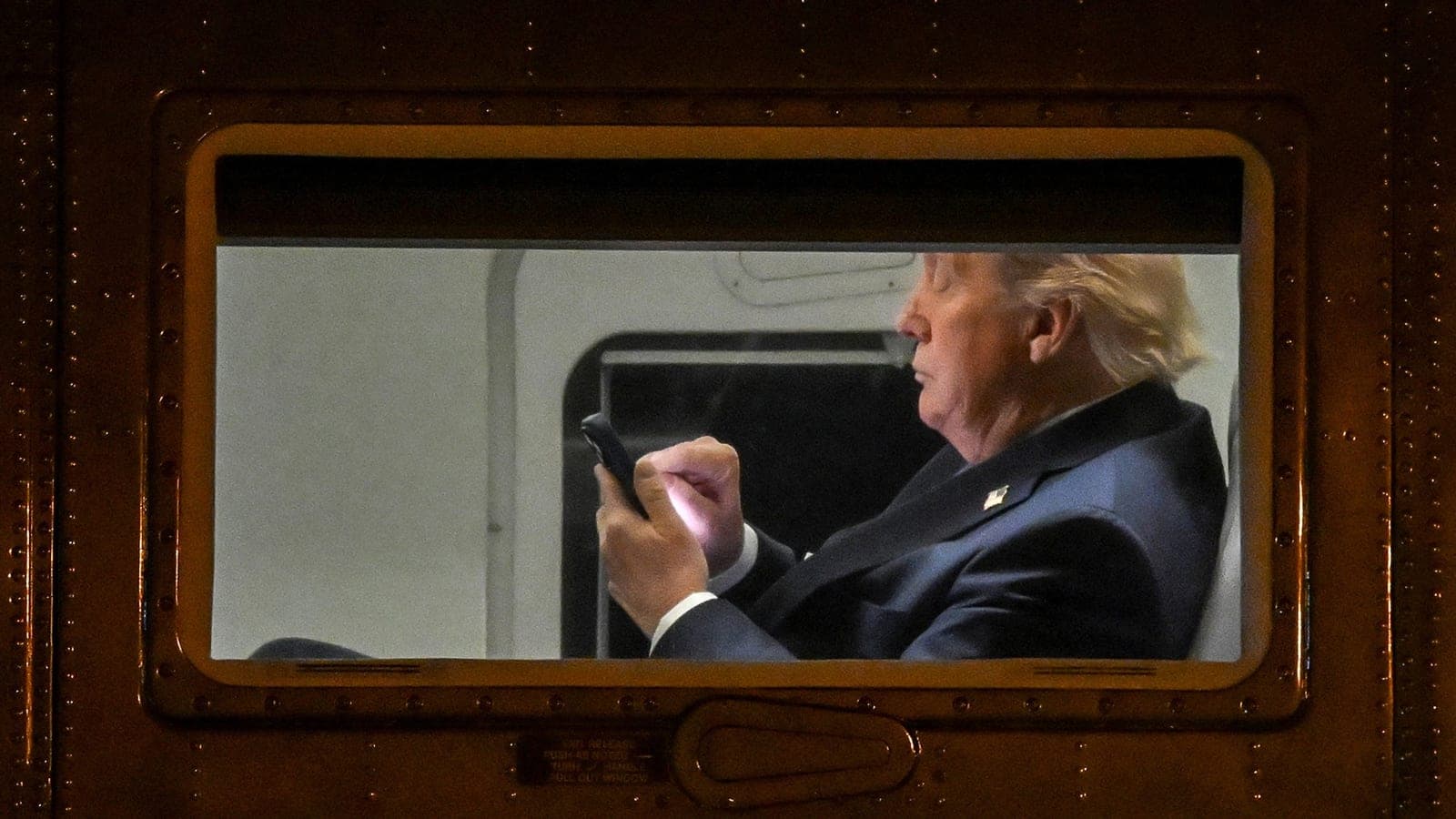
Trump’s Latest Meltdown
On many recent nights, Donald Trump has been posting obsessively on his Truth Social site into the wee hours. The president, of course, has never been one for a solid night’s sleep—or restrained and temperate commentary on social media—but his emotional state seems to be fraying: This weekend, he attacked Pope Leo XIV, presented himself as Jesus Christ, and then jabbed at his phone until dawn. Judging from those posts, the commander in chief is in distress. No one can say for sure what is causing the president’s bizarre behavior. Perhaps Trump’s narcissistic insistence that he is always successful in everything he undertakes is feeling the sting and strain of multiple public failures, including the collapse of his campaign to dislodge the Iranian regime, plummeting approval ratings, the decline of the U.S. economy, and, on Sunday, the crushing defeat of one of his favorite fellow authoritarians, Hungary’s Viktor Orbán. But whatever is driving this decline in Trump’s self-control, Americans must not shrug off the president’s latest implosion. They should recover their ability to be outraged; more to the point, they must demand that their elected representatives ask questions about the course of the war and whether Trump still has the capacity to fulfill his constitutional duty as commander in chief. Too much is at risk to dismiss his outbursts as just another idiosyncrasy: U.S. forces have been at war for almost six weeks, and China is reportedly helping Iran rearm. Even if all other problems, including the economy, were holding steady—and they are not—America cannot keep ignoring the dysfunction of the commander in chief, the sole steward of the codes to a massive nuclear arsenal. [David A. Graham: The parable of the president] Trump has always gotten lost in his own public statements, splashing about like a poor swimmer trying to reach the shore of a fast-moving river. But the president is now flailing in blacker and deeper waters. Genocidal threats against the the Iranians, with whom America is at war, are bad enough, but his defenders will excuse them as part of the Trumpian bulldozer approach to international negotiation; aiming long screeds at the pope, as if he, too, is an enemy of the United States, is not only unhinged but entirely pointless. Trump’s fusillade against the first American pope was not only politically incomprehensible—20 percent of Americans are Catholics, and most of them voted for Trump—but it was yet more evidence that the president is sinking into rage and confusion. Why was Trump angry with Pope Leo? For the same reason that Trump ever gets mad at anyone: The Holy Father dared to criticize him. Last week, the president of the United States posted an expletive-filled threat—on Easter Sunday, no less—to destroy the ancient civilization of Iran. His supporters wrote this off as a clever gambit to bring an end to the war (which it has not). Leo called the threat “unacceptable,” blasted the “delusion of omnipotence” that led to the war, and said: “Enough of the idolatry of self and money! Enough of the display of power! Enough of war!” Of course, Trump wasn’t going to take that kind of talk from some former Chicago science teacher just because the guy is now the Bishop of Rome. So a few minutes after nine on Sunday night, Trump posted a salvo of more than 300 words on Truth Social. According to the White House’s official schedule, he had just landed at Joint Base Andrews after his trip to Miami, and was likely posting from the plane. His post was, in every way, bonkers. The president accused the pope of being “Weak on Crime” and “Weak on Nuclear Weapons.” He said that Leo “wasn’t on any list to be Pope” and that he likes Leo’s brother Louis much better because “Louis is all MAGA.” And so it went, sentence after sentence of boorishness and whiny self-regard. Leo was only chosen, you see, to deal with Trump: If not for the 47th president, “Leo wouldn’t be in the Vatican.” The president is not a Catholic (and neither am I), but he claims to be a Christian, and an ordinary follower of Christ might pause a moment before concluding that Trump, personally, motivated the Holy Spirit to guide Rome’s cardinals toward a particular successor to Saint Peter. But Trump wasn’t finished. He had recommendations for the pontiff about how to be a better Vicar of Christ, saying he “should get his act together as Pope, use Common Sense, stop catering to the Radical Left, and focus on being a Great Pope, not a Politician.” Again, Trump is not a Catholic—he has referred to Communion as a “little wine” with some “little crackers”—and his track record both as a president and a person is replete with the seven deadly sins (and probably a few more that haven’t made the list yet). He is also now officially the most unpopular modern president ever, so the pope might understandably pass on accepting either his secular or spiritual advice. This one screed against the leader of a billion and a half Catholics was worrisome enough, but for Trump, it was just the beginning of a long night. Only 45 minutes after flaming the pope, Trump—now back at the White House—posted an AI-generated image of himself as (apparently) Jesus Christ, healing a sick man while soldiers and nurses and other worshipful white people gaze in awe and military jets fly overhead. You have to see the image to really grasp its weirdness, and to take in how offensive, even heretical, it might be to Christians of any mainstream denomination. (Trump has since taken that post down, claiming that he thought it depicted him as wearing a doctor’s outfit—a denial that is not only laughable, but is also hardly reassuring about his cognitive health. “I do make people better,” he said yesterday, “and make people a lot better.”) Five minutes after this sacrilegious nonsense, Trump posted a mock-up of a Trump Tower on the moon. (Sure, why not.) Twenty minutes after that, at 10:10 p.m., Trump shared a silly meme about how Bernie Sanders, Chuck Schumer, and Joe Biden all look old after so many years in office, unlike himself. Twelve minutes later, he posted a clip from Newsmax’s Rob Carson Show. Twenty minutes later, he posted yet another Newsmax clip from the same show. Relative calm then overtook Trump’s phone until 12:43 a.m., when he announced that the U.S. Navy would be blockading Iranian ports in the morning—as if it were just another stray factoid to share in his news feed. Then, a bit more than two hours later—at 2:35 a.m.—he posted a link to a right-wing news site that approved of his Iran actions. At almost the same time, he posted another news story from the site about the Biden family and Ukraine. Two minutes later, he posted an article about Eric Swalwell leaving the California governor’s race. A few minutes later, he posted the same Biden story, again. [Ali Breland: Iran out-trolled the troller in chief] Within another minute, Trump posted a link about an appeals court ruling that he could keep building his beloved ballroom until April 17. Finally, after a brief pause, he wrapped things up by posting a laudatory article from the New York Post—at 4:10 a.m., not long before dawn. This is not the behavior of a stable, healthy leader. Pope Leo, for his part, said he has “no fear” of the administration and will continue to preach the messages of the Gospel. The rest of us, however, should be very worried about a commander in chief who is trying to govern the country between social-media binges, who attacks religious leaders in narcissistic frenzy, and who imagines himself as a deity. If an elderly parent did such things, most people would be concerned. The president doing such things is far more alarming. The American people must not look away, as they have done so often in the past. They must pay attention to the president’s deterioration, and insist that the House and Senate start acting like functioning branches of the government by asking the White House to explain what is happening, without insults or evasions, before the eyes of the country and the world.

The State That Could Decide Trump’s Gerrymandering War
Updated on April 10 at 6:55 p.m. ET Democrats in Virginia desperately want permission from voters to gerrymander the state beyond recognition. They also want Virginians to know how profoundly sorry they are to have to ask. “I believe that people should choose their representatives. Representatives shouldn’t choose their people,” State Senator Creigh Deeds declared on Friday, as he stood flanked by a dozen young Democrats at the University of Virginia. This is typically the main argument against gerrymandering, but for Deeds, it was just the windup to a pitch for his party to cast aside its highfalutin principles and start hurling spitballs back at Republicans. “We’ve been pushed,” he lamented, “into a situation not of our own choosing.” The situation to which Deeds so gravely alluded is the all-out redistricting war that Republicans started last summer in Texas. At President Trump’s behest, state lawmakers redrew congressional lines to bolster the GOP’s narrow House majority. Democrats, initially aghast but quickly emboldened, responded by matching Republicans with an equally aggressive gerrymander in California, which voters approved overwhelmingly in November. The battleground expanded from there, as Republicans added seats in North Carolina, Ohio, and Missouri. With new opportunities to gain an edge dwindling, the two parties are waging an expensive campaign in Virginia that could prove decisive. The congressional map that Democrats have proposed is, in its ways, even more audacious than those enacted in either Texas or California. They’re asking voters to temporarily set aside a bipartisan redistricting system they approved just six years ago. Under their proposal, Democrats would be favored to win all but one of Virginia’s 11 House seats—a huge shift from the current districts, which are currently split between six Democrats and five Republicans. The boldness of Virginia’s plan stands out all the more in light of the reticence of neighboring Maryland, a stronger Democratic bastion where the senate president rebuffed a push from national leaders and Governor Wes Moore to draw a map that could have given Democrats the lone remaining House seat they don’t currently hold. Just how far Democrats would reach in Virginia was the subject of weeks of internal debate within the party. Some had pushed for a slightly more restrained proposal that would have given Democrats the upper hand in nine of the 11 House seats. But advocates of a maximalist approach prevailed, and now Virginia voters will decide in an April 21 referendum whether to use the new maps this fall. The party has unified behind the 10–1 proposal—even if some Democrats seem to be bringing a touch of shame to their campaign. “Nobody wants to do this. I don’t want to do this,” Michelle Maldonado, a Democratic member of the Virginia House of Delegates, told me after delivering a pep talk to campaign volunteers near her home in Manassas. But, like Deeds, she cited as a rationale Trump’s demand for Republicans to carve into Democratic seats wherever they had the power to do so. “We can’t sit back and wait.” Democrats confronted the same ethical qualms last fall in California, another state where voters had previously acted to remove politics from redistricting. But that campaign took place in a far bluer state at a time when anger among rank-and-file Democrats over the GOP’s Texas gerrymander was raw and fresh. Five months later, the Republican redistricting campaigns have stalled in states such as Indiana and Kansas, where GOP lawmakers rejected pressure from Trump to redraw their maps. The Florida legislature will meet later this month to consider gerrymandering proposals, but there too, many Republicans have become skittish. [Read: The state that handed Trump his biggest defeat yet] The GOP’s struggles are welcome news for Democrats nationally, but they have complicated the “Yes” campaign in Virginia, where polls are close and some left-leaning voters are questioning whether their party really needed to gerrymander so audaciously. Deeds, who was the Democrats’ nominee for governor in 2009, is one of Virginia’s longest-serving state legislators. He said he’s tried to explain the stakes to Democratic critics, with mixed success. “Sometimes I’ve been able to convince them otherwise,” Deeds told me. But other skeptics of the plan, he acknowledged, haven’t budged. “Ultimately,” Deeds said, “if this isn’t successful, I think it will be because of people like that.” Perhaps the biggest risk for Virginia Democrats is that their cutthroat approach to redistricting will wake up a state Republican Party that they thoroughly trounced in November. Abigail Spanberger won the governorship by 15 points and the largest raw-vote margin in state history. But Republicans have been heartened by strong early-voting turnout in conservative areas, along with a landslide victory in a legislative election last month. (The result was a rare overperformance by Republicans in a special election during Trump’s second term, which Democrats have been dominating across the country.) Democrats “have overreached,” Eric Cantor, the former House majority leader who is helping lead the opposition to the amendment, told me. “There’s no doubt that gives us an advantage.” Representative Ben Cline, a fourth-term Republican whose conservative district would become a Democratic-leaning battleground in the proposed map, has launched another group to defeat the referendum. “Virginia had a Republican governor less than three months ago, but Democrats now want to take 91 percent of the House seats. That’s insane,” he told me. A narrow majority of likely Virginia voters favored the redistricting amendment in a poll released last week by The Washington Post and George Mason University’s Schar School. But the same survey found that Republicans and other opponents of the measure were more enthusiastic about voting. “People understand the hypocrisy and are really angry,” Cantor said. Turnout for an April election “is a tough thing,” he added. “But when you’re angry, I think you win the turnout.” Democratic ads have featured Spanberger and former President Obama urging voters to fight back against Republican efforts “to steal enough seats in Congress to rig the next election and wield unchecked power for two more years.” But opponents have tried to muddy the debate by reminding voters of Obama’s long history of campaigning against gerrymandering. Civil-rights leaders accused a dark-money group of engaging in a racist misinformation campaign by sending mailers to Black voters invoking the civil-rights movement and implying that Obama opposes the redistricting amendment. “It’s despicable,” Maldonado said. (The chair of the committee that sent the mailers, a Republican former state legislator who is Black, has defended the tactic.) With tens of millions of dollars already spent on TV ads, Democrats have dwarfed Republicans in fundraising so far. But turnout has been robust across Virginia, even exceeding the early vote in the fall governor’s race. At the early-voting site in Waynesboro, a small city west of Charlottesville near Shenandoah National Park, cars pulled into the parking lot every couple of minutes on a recent Thursday afternoon. The area is a conservative part of Cline’s district, and most people I interviewed were voting no. Voters expressed more than the usual amount of disgust with both parties. “They’ve all let the power go to their head,” George Trent, a 56-year-old Trump voter who opposed the amendment, told me. J. Strickland, a 71-year-old independent who leans Republican and “reluctantly” backed Trump in 2024, told me he voted no because if the amendment passed, “Democrats would control the entire state.” Strickland, who did not want his first name used while talking about politics, said the whole gerrymandering war made a strong case for term limits in Congress. “This two-party system is crazy,” Strickland said. “Both parties are fighting against themselves.” As they did in California, Democrats are trying to reassure voters about the redistricting amendment by emphasizing that it’s temporary. The new maps would be used through 2030, after which the state would return to a system in which a bipartisan commission draws House districts after the decennial census. Supporters have also noted that unlike Republican gerrymandering efforts that have won approval only from state legislatures, California and Virginia have each put their redistricting proposals before the voters, as state law required in both cases. [Read: ‘California is allowed to hit back’ ] Opponents of the Virginia amendment doubt the claims that these new maps are only a short-term response. Republicans have made no such promises about their own mid-decade redistricting plans, and because of population trends, blue states are likely to lose seats to GOP-controlled states after the 2030 census, putting more pressure on Democrats to maximize their advantage where they can. A Supreme Court ruling rolling back the Voting Rights Act, which could happen later this spring, would allow Republicans in southern states to draw themselves even more seats in the next few years. If gerrymandering is a tough sell in Virginia, Democrats are also offering voters a simpler rationale for supporting the amendment. This, they tell them, is your chance to fight back against Trump, to “level the playing field” against the president’s many attempts to accumulate power for himself and for his party. The various messages from the “Yes” campaign have a choose-your-own-outrage feel to them. In addition to running commercials with Obama and Spanberger, the “Yes” campaign has released ads featuring military veterans warning about Trump’s threat to democracy. Another ad warns about the prospect of a national abortion ban if Republicans accrue even more power. At the University of Virginia, “Yes” campaigners were using their own Trump-related controversy as motivation: the ouster last summer of UVA’s president, James Ryan, who resigned under pressure from the Justice Department in a dispute over DEI policies. During a press conference last week, Semony Shah, the president of UVA’s University Democrats, cast the referendum as an opportunity for students to stop what she called “federal overreach” into the university. “These are things that frustrate students, because their voices weren’t accounted for. Their voices weren’t heard,” Shah told me afterward. “This,” she said, “is your way to make your voice heard.” Democrats acknowledged the strong start that Republican areas of the state have had in early voting, but they told me turnout was picking up among their target constituencies. The campaign is planning a surge of rallies and canvassing events this weekend, timed for the expansion of early voting to dozens more satellite locations across Virginia. At the canvass launch in Manassas, Maldonado warned volunteers that they might encounter concerned and even angry voters who were “worried that this is a power grab by Democrats.” The door-knockers themselves seemed more confident, suggesting that the party’s pearl-clutching over gerrymandering was not as widespread as politicians like Deeds and Maldonado feared. Dylan Salgado, a 24-year-old digital fundraiser from Loudoun County, told me he’s been canvassing regularly since early voting started. I asked him if he had encountered Democrats who planned to vote against the amendment out of a principled opposition to gerrymandering. “I haven’t found someone who’s said that yet,” Salgado replied, “which makes me think we have it in the bag.” This article originally misspelled Dylan Salgado’s last name.

The $97 Million Utah Warehouse ICE Bought for $145 Million
The empty warehouse on the outskirts of Salt Lake City had a lot of potential but no buyers. Built in 2022, it was one of the largest warehouses in the area, with 833,000 square feet of space—14 football fields under one roof. The surrounding industrial zone had been promoted by the state as “Utah’s Inland Port,” a logistics hub smack-dab in the middle of a desert but only a few minutes to the freeway and the international airport. Demand for big warehouses had softened, however, and the property remained vacant, a white elephant by the shores of the Great Salt Lake. Then, suddenly, on March 11, the Department of Homeland Security snapped it up for $145.4 million—paying nearly 50 percent more than the property’s 2025 assessed value to a private investment fund controlled by a subsidiary of Germany’s Deutsche Bank. The deal went through six days after President Trump announced his decision to remove Kristi Noem as DHS secretary. Noem and her team had been racing to buy up industrial properties as part of a $38 billion overhaul of the ICE detention system in an effort to supercharge Trump’s mass-deportation campaign. DHS officials described the acquisitions as a crucial step to meeting the White House’s goal of 1 million deportations a year, after ICE carried out fewer than half that many during Trump’s first year back in office. The warehouses would be reconfigured and remodeled into megajails, with capacity for up to 10,000 detainees each. Noem’s replacement, former Senator Markwayne Mullin of Oklahoma, took control of the department on March 24 and ordered a pause on conversion plans for the warehouse in Salt Lake City as well as for 10 others scattered across the country, seeking to defuse backlash from local jurisdictions. Many local leaders say that they were blindsided by DHS’s acquisitions and don’t want giant immigration jails in their communities. Some have made clear that they are willing to fight the government’s plans. Lauren Bis, a spokesperson for DHS, characterized the pause as a logical part of Mullin’s transition process, which requires “reviewing agency policies and proposals” and making sure that the department works with community leaders. “We want to be good partners,” Bis told me. There are also legal challenges. The administration is facing lawsuits across its new portfolio of industrial properties, including in Michigan and New Jersey. In Maryland, a federal judge halted renovation work at a warehouse that ICE purchased in January. In Social Circle, Georgia, where ICE bought a 1-million-square-foot building in a county that Trump won by more than 70 percent, angry local officials have refused to connect the site to water and sewer lines. ICE has already canceled plans for new detention centers in New Hampshire and Mississippi because of opposition from Republican leaders. Officials at DHS and ICE told me that the administration has been taken aback by opposition from Republicans, whom they expected to be more supportive of the president’s deportation push. It didn’t help that the government conducted its warehouse-shopping spree around the same time that Renee Good and Alex Pretti were killed in Minneapolis—and right at the moment when Americans were seeing daily images of chaos and violent clashes between protesters and immigration agents. The warehouses triggered fears about how immigrants would be treated and possible impacts on nearby communities, along with broader worries that the warehouses could be used to hold U.S. citizens. As one ICE official told me, “People’s heads started going wild with this.” The warehouse purchases in Utah and other states are now part of an internal investigation at DHS into acquisitions and contracts made by Noem and Corey Lewandowski, her top adviser and alleged lover in an extramarital affair that both have denied. Complaints about Lewandowski’s role in DHS contracts intensified last summer after he implemented a policy requiring Noem’s approval on any expenditure of more than $100,000. The measure, depicted as an extension of DOGE-style cost cutting, came as the administration got a virtual blank check from Congress—$170 billion for immigration enforcement in the One Big Beautiful Bill Act. DHS officials and contractors told me that the $100,000 requirement created a bureaucratic bottleneck and fueled suspicions that Lewandowski was exploiting his position for personal profit. Lewandowski, who worked as an unpaid “special government employee,” denies those allegations and has claimed that Noem’s added scrutiny helped save billions for taxpayers. [Read: The first couple of a dysfunctional DHS] But a bargain-hunting ethos was noticeably absent in DHS’s warehouse acquisitions. The department paid an average of 11 to 13 percent above market value for the first 10 properties it purchased for ICE, according to a report by the commercial-real-estate firm CoStar. The firm published its report prior to the $145 million deal for the Utah building, which tax assessors valued last year at $97 million. It was DHS’s costliest purchase yet, and none of the other DHS acquisitions reviewed by CoStar had a gap that wide between purchase price and comparable properties. I called commercial-real-estate brokers and appraisers in Salt Lake City to ask whether the transaction seemed like an outlier. Sales of similar warehouse properties in the area suggested that it was: A building with about 1 million square feet built in the same area in 2022 had been acquired by Walmart last March for $112 million, CoStar records show, below its assessed value of $119 million. Another 1-million-square-foot property built in 2023 sold last year for $122 million, roughly the same as its assessed value, even though it sits on a 75-acre plot—larger than the parcel bought by DHS. That property, purchased by an investor, already had a tenant, which generally increases the sale price, according to two brokers and an appraiser I spoke with, who did not want to be quoted by name, because the DHS warehouse purchase is so contentious in Salt Lake City. They cautioned that many industrial properties sell for more than their assessed value, and that owner-occupants—which DHS will be—tend to be willing to pay more than investors. But the sale price, which works out to more than $174 a square foot, is far higher than the going market rate. “It’s just crazy,” one broker told me. Another quipped, “This is not something I would want to stand before a judge and have to defend.” The DHS and ICE officials I asked about the purchase told me that they had little insight into the transaction, but they described the Utah site as a key addition to their broader makeover of the immigration detention system. The Utah warehouse would give the government a large detention facility in the Rocky Mountain region, which would allow ICE to send detainees there from Colorado, Idaho, and other western states, officials with knowledge of the plans told me. Most immigration detention sites are in the South—especially Texas and Louisiana—and the goal of the ICE overhaul is to have fewer locations but with a more even distribution across the country. ICE officials said last year that they want to build a “hub and spoke” system modeled after e-commerce retailers such as Amazon. The process has been guided more by logistical considerations than by worries about political backlash, according to officials familiar with the plans at DHS and ICE. One person with knowledge of the Utah purchase told me that the warehouse had been appraised prior to the sale at roughly $130 million—more than 30 percent above its tax assessment. The seller had added office space and made about $10 million in improvements to the site, and the rest of the amount went to closing costs and fees, the person said. DHS was a motivated buyer and eager to close the deal quickly. DHS public-affairs officials did not respond to my questions about the appraisal and the company that conducted it. Spenser Heaps As a reliably red state in the American West, Utah may look like a perfect place for an ICE megajail. But the politics of immigration enforcement are fraught there too, local officials and real-estate brokers told me. The Church of Jesus Christ of Latter-Day Saints (which provided much of the original scrubland for the Inland Port) is welcoming of immigrants and has helped settle generations of refugees and international converts to the Mormon faith. Like other affluent cities in Rocky Mountain states, Salt Lake City is a blue island in a sparsely populated red sea. Salt Lake City Mayor Erin Mendenhall, a Democrat, has said that the city’s opposition is currently focused on ICE’s potential utility consumption and strain on local services. City officials said yesterday that the government hasn’t told them what it projects its needs will be but that a facility constructed to hold goods would need “significant” upgrades, including new sewage lines and pumping capacity, to hold large numbers of people. One city official I spoke with, who was not authorized to discuss preliminary negotiations with ICE, told me that a detention center for 7,500 to 10,000 people has a projected water use of 1 to 2 million gallons a day. The city’s entire daily consumption is about 40 million gallons, the official said, and the broader Salt Lake area is bracing for worsening drought after a winter of meager snowfall. The state of Utah opened a new prison with space for about 3,000 inmates not far from the ICE-warehouse site, the official said, and the facility consumes about 450,000 gallons daily. Brigham Daniels, a land-use expert at the University of Utah, told me that local jurisdictions are not obligated to accommodate the federal government’s water-use plans if scarce resources are threatened. But, he said, the government could find alternative methods for supplying large volumes of water to the site by purchasing water rights from the state or from a different jurisdiction. The city would be on shakier legal ground if it refused to allow that water to reach the warehouse. “It’s one thing to say, We don’t have that water for you,” Daniels said. “It’s another thing to say, We won’t deliver it.” The city has also raised concerns about the potential threat to the Great Salt Lake, which already competes for water against farms, lawns, and golf courses. The dry bed at the edges of the shrinking lake periodically swirls up into clouds of toxic dust laced with heavy metals. The Trump administration included $1 billion in the president’s budget request to Congress this week to improve management of the lake and route more water into the basin. “This is an Environmental hazard that must be worked on, IMMEDIATELY—It is of tremendous interest to me,” the president wrote on social media in February. Daniels said that the ICE warehouse would not necessarily be in a zero-sum competition with the lake, because most water that is used indoors can be treated and safely discharged. [Read: Kristi Noem is gone. Now mass deportations can really begin.] The urgent need that drove Noem and Lewandowski to acquire the warehouses has faded somewhat lately. In the two months since the “border czar” Tom Homan announced a more “targeted” approach to ICE enforcement, with a clearer focus on criminals, the average daily number of detainees in ICE custody has declined from 70,000 to about 60,000, two ICE officials told me. Even so, expanding the detention system remains a priority for the department. Homan has repeatedly said that ICE needs capacity for at least 100,000 detainees if it’s going to achieve Trump’s 1-million-deportations goal. During his confirmation hearing, Mullin was asked whether he would commit to making sure that ICE had local support before it opened a large detention center in a community. Mullin said that he wanted to “build relationships and work in that manner.” He has also said that he wants a quieter, less confrontational approach than the one Noem and Lewandowski promoted. But the money for mass deportation has already been appropriated by Congress. ICE is in the process of doubling the number of immigration officers on U.S. streets, and recent federal-court rulings have backed the administration’s push to hold far more immigrants in custody while they fight deportation. Trump’s removal campaign may be regrouping and seeking a lower profile to allow the ICE workforce to catch its breath. But the administration now owns more than 7.5 million square feet of new detention space, and it has all the money it needs to fill it. Marie-Rose Sheinerman contributed reporting.
The $97 Million Utah Warehouse ICE Bought for $145 Million
The empty warehouse on the outskirts of Salt Lake City had a lot of potential but no buyers. Built in 2022, it was one of the largest warehouses in the area, with 833,000 square feet of space—14 football fields under one roof. The surrounding industrial zone had been promoted by the state as “Utah’s Inland Port,” a logistics hub smack-dab in the middle of a desert but only a few minutes to the freeway and the international airport. Demand for big warehouses had softened, however, and the property remained vacant, a white elephant by the shores of the Great Salt Lake. Then, suddenly, on March 11, the Department of Homeland Security snapped it up for $145.4 million—paying nearly 50 percent more than the property’s 2025 assessed value to a private investment fund controlled by a subsidiary of Germany’s Deutsche Bank. The deal went through six days after President Trump announced his decision to remove Kristi Noem as DHS secretary. Noem and her team had been racing to buy up industrial properties as part of a $38 billion overhaul of the ICE detention system in an effort to supercharge Trump’s mass-deportation campaign. DHS officials described the acquisitions as a crucial step to meeting the White House’s goal of 1 million deportations a year, after ICE carried out fewer than half that many during Trump’s first year back in office. The warehouses would be reconfigured and remodeled into megajails, with capacity for up to 10,000 detainees each. Noem’s replacement, former Senator Markwayne Mullin of Oklahoma, took control of the department on March 24 and ordered a pause on conversion plans for the warehouse in Salt Lake City as well as for 10 others scattered across the country, seeking to defuse backlash from local jurisdictions. Many local leaders say that they were blindsided by DHS’s acquisitions and don’t want giant immigration jails in their communities. Some have made clear that they are willing to fight the government’s plans. Lauren Bis, a spokesperson for DHS, characterized the pause as a logical part of Mullin’s transition process, which requires “reviewing agency policies and proposals” and making sure that the department works with community leaders. “We want to be good partners,” Bis told me. There are also legal challenges. The administration is facing lawsuits across its new portfolio of industrial properties, including in Michigan and New Jersey. In Maryland, a federal judge halted renovation work at a warehouse that ICE purchased in January. In Social Circle, Georgia, where ICE bought a 1-million-square-foot building in a county that Trump won by more than 70 percent, angry local officials have refused to connect the site to water and sewer lines. ICE has already canceled plans for new detention centers in New Hampshire and Mississippi because of opposition from Republican leaders. Officials at DHS and ICE told me that the administration has been taken aback by opposition from Republicans, whom they expected to be more supportive of the president’s deportation push. It didn’t help that the government conducted its warehouse-shopping spree around the same time that Renee Good and Alex Pretti were killed in Minneapolis—and right at the moment when Americans were seeing daily images of chaos and violent clashes between protesters and immigration agents. The warehouses triggered fears about how immigrants would be treated and possible impacts on nearby communities, along with broader worries that the warehouses could be used to hold U.S. citizens. As one ICE official told me, “People’s heads started going wild with this.” The warehouse purchases in Utah and other states are now part of an internal investigation at DHS into acquisitions and contracts made by Noem and Corey Lewandowski, her top adviser and alleged lover in an extramarital affair that both have denied. Complaints about Lewandowski’s role in DHS contracts intensified last summer after he implemented a policy requiring Noem’s approval on any expenditure of more than $100,000. The measure, depicted as an extension of DOGE-style cost cutting, came as the administration got a virtual blank check from Congress—$170 billion for immigration enforcement in the One Big Beautiful Bill Act. DHS officials and contractors told me that the $100,000 requirement created a bureaucratic bottleneck and fueled suspicions that Lewandowski was exploiting his position for personal profit. Lewandowski, who worked as an unpaid “special government employee,” denies those allegations and has claimed that Noem’s added scrutiny helped save billions for taxpayers. [Read: The first couple of a dysfunctional DHS] But a bargain-hunting ethos was noticeably absent in DHS’s warehouse acquisitions. The department paid an average of 11 to 13 percent above market value for the first 10 properties it purchased for ICE, according to a report by the commercial-real-estate firm CoStar. The firm published its report prior to the $145 million deal for the Utah building, which tax assessors valued last year at $97 million. It was DHS’s costliest purchase yet, and none of the other DHS acquisitions reviewed by CoStar had a gap that wide between purchase price and comparable properties. I called commercial-real-estate brokers and appraisers in Salt Lake City to ask whether the transaction seemed like an outlier. Sales of similar warehouse properties in the area suggested that it was: A building with about 1 million square feet built in the same area in 2022 had been acquired by Walmart last March for $112 million, CoStar records show, below its assessed value of $119 million. Another 1-million-square-foot property built in 2023 sold last year for $122 million, roughly the same as its assessed value, even though it sits on a 75-acre plot—larger than the parcel bought by DHS. That property, purchased by an investor, already had a tenant, which generally increases the sale price, according to two brokers and an appraiser I spoke with, who did not want to be quoted by name, because the DHS warehouse purchase is so contentious in Salt Lake City. They cautioned that many industrial properties sell for more than their assessed value, and that owner-occupants—which DHS will be—tend to be willing to pay more than investors. But the sale price, which works out to more than $174 a square foot, is far higher than the going market rate. “It’s just crazy,” one broker told me. Another quipped, “This is not something I would want to stand before a judge and have to defend.” The DHS and ICE officials I asked about the purchase told me that they had little insight into the transaction, but they described the Utah site as a key addition to their broader makeover of the immigration detention system. The Utah warehouse would give the government a large detention facility in the Rocky Mountain region, which would allow ICE to send detainees there from Colorado, Idaho, and other western states, officials with knowledge of the plans told me. Most immigration detention sites are in the South—especially Texas and Louisiana—and the goal of the ICE overhaul is to have fewer locations but with a more even distribution across the country. ICE officials said last year that they want to build a “hub and spoke” system modeled after e-commerce retailers such as Amazon. The process has been guided more by logistical considerations than by worries about political backlash, according to officials familiar with the plans at DHS and ICE. One person with knowledge of the Utah purchase told me that the warehouse had been appraised prior to the sale at roughly $130 million—more than 30 percent above its tax assessment. The seller had added office space and made about $10 million in improvements to the site, and the rest of the amount went to closing costs and fees, the person said. DHS was a motivated buyer and eager to close the deal quickly. DHS public-affairs officials did not respond to my questions about the appraisal and the company that conducted it. Spenser Heaps As a reliably red state in the American West, Utah may look like a perfect place for an ICE megajail. But the politics of immigration enforcement are fraught there too, local officials and real-estate brokers told me. The Church of Jesus Christ of Latter-Day Saints (which provided much of the original scrubland for the Inland Port) is welcoming of immigrants and has helped settle generations of refugees and international converts to the Mormon faith. Like other affluent cities in Rocky Mountain states, Salt Lake City is a blue island in a sparsely populated red sea. Salt Lake City Mayor Erin Mendenhall, a Democrat, has said that the city’s opposition is currently focused on ICE’s potential utility consumption and strain on local services. City officials said yesterday that the government hasn’t told them what it projects its needs will be but that a facility constructed to hold goods would need “significant” upgrades, including new sewage lines and pumping capacity, to hold large numbers of people. One city official I spoke with, who was not authorized to discuss preliminary negotiations with ICE, told me that a detention center for 7,500 to 10,000 people has a projected water use of 1 to 2 million gallons a day. The city’s entire daily consumption is about 40 million gallons, the official said, and the broader Salt Lake area is bracing for worsening drought after a winter of meager snowfall. The state of Utah opened a new prison with space for about 3,000 inmates not far from the ICE-warehouse site, the official said, and the facility consumes about 450,000 gallons daily. Brigham Daniels, a land-use expert at the University of Utah, told me that local jurisdictions are not obligated to accommodate the federal government’s water-use plans if scarce resources are threatened. But, he said, the government could find alternative methods for supplying large volumes of water to the site by purchasing water rights from the state or from a different jurisdiction. The city would be on shakier legal ground if it refused to allow that water to reach the warehouse. “It’s one thing to say, We don’t have that water for you,” Daniels said. “It’s another thing to say, We won’t deliver it.” The city has also raised concerns about the potential threat to the Great Salt Lake, which already competes for water against farms, lawns, and golf courses. The dry bed at the edges of the shrinking lake periodically swirls up into clouds of toxic dust laced with heavy metals. The Trump administration included $1 billion in the president’s budget request to Congress this week to improve management of the lake and route more water into the basin. “This is an Environmental hazard that must be worked on, IMMEDIATELY—It is of tremendous interest to me,” the president wrote on social media in February. Daniels said that the ICE warehouse would not necessarily be in a zero-sum competition with the lake, because most water that is used indoors can be treated and safely discharged. [Read: Kristi Noem is gone. Now mass deportations can really begin.] The urgent need that drove Noem and Lewandowski to acquire the warehouses has faded somewhat lately. In the two months since the “border czar” Tom Homan announced a more “targeted” approach to ICE enforcement, with a clearer focus on criminals, the average daily number of detainees in ICE custody has declined from 70,000 to about 60,000, two ICE officials told me. Even so, expanding the detention system remains a priority for the department. Homan has repeatedly said that ICE needs capacity for at least 100,000 detainees if it’s going to achieve Trump’s 1-million-deportations goal. During his confirmation hearing, Mullin was asked whether he would commit to making sure that ICE had local support before it opened a large detention center in a community. Mullin said that he wanted to “build relationships and work in that manner.” He has also said that he wants a quieter, less confrontational approach than the one Noem and Lewandowski promoted. But the money for mass deportation has already been appropriated by Congress. ICE is in the process of doubling the number of immigration officers on U.S. streets, and recent federal-court rulings have backed the administration’s push to hold far more immigrants in custody while they fight deportation. Trump’s removal campaign may be regrouping and seeking a lower profile to allow the ICE workforce to catch its breath. But the administration now owns more than 7.5 million square feet of new detention space, and it has all the money it needs to fill it. Marie-Rose Sheinerman contributed reporting.

Venezuela Seems to Be Going … Well?
In the days after U.S. troops hustled Nicolás Maduro onto an aircraft in the dead of night, President Trump’s critics were aghast. Not only had the president bypassed Congress in launching an audacious operation to oust a foreign leader, but he was potentially thrusting the United States into a foreign quagmire akin to the counterinsurgent wars he’d once promised to end—ones that had resulted in mass migration, violent chaos, and civil conflict. Venezuela, Democrats and geopolitical analysts warned, could be Iraq 2.0. Three months later, life in Venezuela has returned to normal, whatever normal is in a nation that has been gripped by turmoil and economic calamity for years. Caraqueños, as the capital’s residents are known, told me that the streets are quiet. The state has backed off its practice of making widespread arbitrary arrests. Government services and the bleak economic conditions that Venezuelans have been living under haven’t improved much, but there is a sense of optimism that Maduro’s departure brings the possibility of better days. Oil revenue is increasing. And Washington’s handpicked interim authorities, led by Maduro’s vice president, Delcy Rodríguez, have rolled out a succession of investor-friendly measures devised by their new North American patrons. By the metrics the president cares about most—accessing oil and avoiding a protracted, politically damaging conflagration—Trump’s Venezuelan adventure is working. Three months isn’t much time to draw firm conclusions, and much could still go wrong for the United States, the regime, and the Venezuelan people. But for now, the aftermath of the January 3 operation, according to the Trumpian blueprint, is running close to clockwork. A recent poll appears to bear this out. The survey, from AtlasIntel and Bloomberg, shows that nearly 80 percent of Venezuelans think their country is the same or better off now than under Maduro; 54 percent said that greater U.S. influence is positive; 52 percent say that the country’s civil liberties have increased. Trump could only wish for such favorable numbers at home. With the relative success in Venezuela has come confidence—perhaps too much. Trump’s gambit in Latin America has emboldened the president to trust his instincts on other global targets. Less than two months after the raid on Caracas, he launched a massive military operation against Iran, which has gone anything but smoothly. (In his prime-time address last Wednesday, Trump praised the congenial local “joint-venture partners” helping him achieve his desired outcome in Venezuela and suggested that that was his model for Tehran.) Within weeks of the start of the Iran war, Trump was publicly ruminating that he wants to see Havana capitulate as Caracas did. “Some of our worst concerns didn’t come true, but it’s only successful on Trump’s terms, and getting away with it doesn’t make it right,” Representative Seth Moulton of Massachusetts, a Democrat and a Marine veteran who’d fought in Iraq, told me about Venezuela. “It makes it the new normal, and that should terrify every American, because it will encourage the president to try to do it again.” [Read: Trump’s eye is already on Cuba ] The conspicuous caveat in Venezuela, of course, is the lack of democratic rights for millions of Venezuelans. For years, Secretary of State Marco Rubio and other proponents of replacing Latin America’s leftist strongmen made representative government a central goal. Today, Venezuela remains ruled by unelected leaders—different ones, proceeding cautiously for now, but cut from the same authoritarian cloth. Trump-administration officials told me that they are steering Venezuela toward elections by late 2027 and slowly introducing potentially combustible factors, such as the return of the opposition leader María Corina Machado. Whether their bet that a more gradual transition can deliver democracy and avoid the pitfalls that wholesale political change brought in Iraq, Libya, and Egypt remains to be seen. “When you look back at all the foreign-policy disasters in U.S. history, this definitely ranks as a success, for now at least,” Phil Gunson, an International Crisis Group analyst who has lived in Caracas for more than 25 years, told me. But Gunson compares post-Maduro Venezuela to an unexploded bomb. “The chaos which the Trump administration neatly dodged on January 3 is still there,” he added, referring to the possibility for upheaval and armed conflict. “It could still happen.” Democratic outrage was not just over Maduro’s ouster, which Trump justified as a simple law-enforcement operation to execute a U.S. warrant on drug-trafficking charges. It was also because of how the administration had treated lawmakers in briefings beforehand, denying plans to use the military to seize Maduro and rejecting the suggestion that air strikes on suspected drug-trafficking boats were a prelude to acting against the Venezuelan leader. (Those strikes were probably illegal, many experts in military and national-security law told me.) Some of the most pointed critiques came from Democratic lawmakers who had fought in Iraq and Afghanistan, conflicts that many veterans now view as a waste of lives and resources. Senator Ruben Gallego of Arizona, writing on social media on January 3, said that he had seen his fellow Marines die and civilians killed in what he called the “unjustified war” in Iraq and that he faulted Trump for starting another potential misadventure. I understood those concerns. As a correspondent in Baghdad, I’d watched Iraq struggle to emerge from the devastating insurgency unleashed by the 2003 invasion. In its rush to rid Iraq of threats from Saddam Hussein’s Baath Party, the George W. Bush administration crippled the country’s institutions and paved the way for two decades of civil bloodletting. In Libya, during the 2011 revolution, I’d witnessed how the Obama administration’s failure to appreciate Libyans’ pent-up grievances and the country’s lack of cohesion helped create a failed state that persists today. No two countries are the same, and Latin America is not the Middle East. But regime change as a formula has a bad recent history. Several Latin America experts, including those who held senior roles in the Biden and Obama administrations, told me that they support the Trump administration’s decision to work with existing Venezuelan authorities and to prioritize the reconstruction of the country’s energy sector. But they questioned the administration’s decision to set aside the results of the 2024 election, which had been won by the democratic opposition, and instead keep the interim authorities in charge until a new vote takes place. And they faulted the Trump administration for its failure to lay out a timeline for political reforms and elections, something they said undermines Venezuelans’ belief that democracy is an integral part of the U.S. agenda. What many misjudged in January was the pliancy of Maduro’s lieutenants, first among them Rodríguez, and their readiness to work with the same Yankee government that has been an ever-present boogeyman in their long anti-imperialist struggle. That acquiescence is most visible in Venezuela’s petroleum sector. Trump referred to oil 19 times during his morning press conference after Maduro’s capture. Venezuela has the world’s largest proven oil reserves. But a mix of sanctions, corruption, and mismanagement has kept its production far below its 1990s peak. Rodríguez, at Washington’s behest, has overseen rapid steps to loosen nationalist policies imposed under Chavismo, the leftist movement named for Maduro’s predecessor, Hugo Chávez. The National Assembly, controlled by Maduro and Rodriguez’s party, has passed reforms enabling foreign investors to work in Venezuela under more favorable terms. After the U.S. Treasury Department’s approval of measures that allow companies to do business with Venezuela’s state-owned energy company without running afoul of sanctions, Italy’s Eni and Spain’s Repsol announced new deals. [Read: The hostile corporate takeover of an entire country] The Trump administration’s management of Venezuela has widened. It started with regular phone calls between Rubio and Rodríguez. It now includes vetting regime spending requests from oil revenues, which are deposited in a U.S. account. American officials—including Energy Secretary Chris Wright, Interior Secretary Doug Burgum, and General Francis Donovan, the head of U.S. Southern Command—have visited Caracas. Last week, the State Department announced that the U.S. embassy in Caracas, empty since 2019, had officially resumed operations. For the Trump administration, the arrangement is pretty ideal: pliant local authorities running what resembles a private business with little institutional or democratic resistance in implementing the will of global investors. Burgum, speaking at an oil conference last month, recounted the discussion he and mining executives had had in Caracas with Rodríguez and her brother, Jorge, about proposed mining legislation. “Delcy said to the U.S. executives, ‘Well, tell us what you want in the bill. We’re introducing it on Saturday,’” Burgum said. “So then they take the feedback. It gets introduced. Her brother is the president of the senate. I said to him, ‘Is the bill going to pass?’ And he had a short answer: ‘Yes.’” Energy experts told me that the scale of production and investment in the oil sector will likely fall short of Trump’s $100 billion goal. They expect output to rise, at best, by about 300,000 barrels a day in the next year or two, from roughly 1 million barrels a day now. The Trump administration will also need to find a way to push Russian and Chinese companies, which currently account for 22 percent of Venezuela’s oil production, out of their current contracts, Francisco Monaldi, director of Rice University’s Latin American energy program, told me. But the biggest obstacle may be international executives’ concern about Venezuela’s overall trajectory. After living through the turbulence of Venezuela’s modern history—Exxon had its holdings seized twice—executives want provisions for international arbitration, clearer royalty and tax regimes, and more information about where the country is headed. One senior administration official, who spoke on the condition of anonymity to share his assessment, told me that the Trump administration had anticipated that economic improvements wouldn’t happen overnight. “This is not a GLP-1 for the Venezuelan economy,” the official said, referring to Ozempic and its equivalents, which produce rapid weight-loss results. Officials say that they know Venezuela is still a long game. The fate of Venezuela has special importance for Rubio, who has made the restoration of democracy in his family’s native Cuba and other parts of Latin America a central part of his political career. Rubio spoke movingly in 2019, when a popular uprising against Maduro appeared to be on the cusp of success, about the freedoms every Venezuelan deserves. Voters who care about Latin America may credit Rubio for removing Maduro if the secretary of state makes another presidential run, but they will also weigh the longer-term outcome for Venezuelans. So far, Rodríguez’s actions suggest an openness to political reform but not a rush to return to democracy. State agents are no longer stopping people on the streets to check their phone for anti-Maduro content, as they were in the initial days after his capture. Surveillance of activists continues, but not arrests at the same scale. The government has overseen the passage of a law providing amnesty to some political prisoners and has established a high-level commission to foster national reconciliation. Rodríguez has also ordered the release of scores of political prisoners, something the Trump administration has identified as a key metric. But watchdog groups say that the government’s release tallies are inflated, and Foro Penal, a respected human-rights organization, reported last month that roughly 500 political prisoners remain behind bars. Many amnesty petitions have been denied, particularly of people linked to Machado or her party. Pro-democracy activists say more action is needed to ensure meaningful change. Last month, Rodríguez ousted one of the most notorious figures of the Maduro era, Defense Minister Vladimir Padrino López. But his replacement has been sanctioned by the United States for human-rights abuses. Rodríguez has also kept in place a figure central to Maduro’s repression campaign, Interior Minister Diosdado Cabello. Like Padrino López, he is under U.S. indictment on drug-trafficking charges. Both men deny the allegations. [Read: Marco Rubio’s empty victory in Venezuela] Rubio has suggested that the prisoner releases—including people who might one day stand for election—are part of a slow but steady march toward democracy, the second of three stages he has laid out for Venezuela: stabilization, recovery, and transition. The emphasis is on slow. U.S. officials have warned Machado against returning to Venezuela too quickly and have elevated opposition figures seen as more open than she is to working with the existing authorities. Those figures include Enrique Márquez, a recently released political prisoner whom Trump invited to the State of the Union address. “One of the reasons they need to do this deliberately is to make sure they’re bringing the system along with them,” the senior U.S. official said. “If you try to layer something new on top of a system, or graft it onto something that already exists, you may very well have organ rejection.” Rebecca Bill Chavez, who served as a senior Pentagon official during the Obama administration and now heads the think tank Inter-American Dialogue, told me that there is something to that argument. Machado’s immediate return could have alienated the armed forces and fractured the state. That said, Chavez said, pushing off elections too long could delegitimize the U.S. project in the eyes of Venezuelans. “We’re so far from out of the woods right now when it comes to basic political freedoms, basic rights,” she added. Three months on, Senator Gallego still believes that Venezuela could become a foreign sinkhole like Iraq. “Even if the initial goal was met in Venezuela, it’s clear the administration is just winging it,” he told me in a statement. “As a Marine who fought in Iraq and lost many friends there, I know how rare it is for things to go this well and how dangerous it is to get stuck in another forever war.” Representative Debbie Wasserman Schultz, a Democrat who represents a district in South Florida, told me that she had been hopeful in January that Maduro’s arrest would lead to a clear transition to democracy. But, she said, the president’s primary motive—which she described as profit rather than liberation—has become all too apparent. She said that Cuban Americans won’t be satisfied with a similarly superficial change in Havana, should Trump make good on threats to impose U.S. will in Cuba too. “I want the old Marco Rubio to be leading an effort to ensure freedom for both Venezuelans and Cubans, the elimination of repression, the release of political prisoners, the ability to live in a free society—not just do the bidding of Donald Trump,” Wasserman Schultz said. Trump has attempted two regime-change operations this year. One, in Iran, isn’t going well. The popular overthrow of the Islamic Republic that Trump hoped for hasn’t occurred, and the choking-off of global commerce at the Strait of Hormuz has no clear solution. The other, which has mostly slipped from Americans’ collective consciousness, seems to be working out. For now, at least.
Venezuela Seems to Be Going … Well?
In the days after U.S. troops hustled Nicolás Maduro onto an aircraft in the dead of night, President Trump’s critics were aghast. Not only had the president bypassed Congress in launching an audacious operation to oust a foreign leader, but he was potentially thrusting the United States into a foreign quagmire akin to the counterinsurgent wars he’d once promised to end—ones that had resulted in mass migration, violent chaos, and civil conflict. Venezuela, Democrats and geopolitical analysts warned, could be Iraq 2.0. Three months later, life in Venezuela has returned to normal, whatever normal is in a nation that has been gripped by turmoil and economic calamity for years. Caraqueños, as the capital’s residents are known, told me that the streets are quiet. The state has backed off its practice of making widespread arbitrary arrests. Government services and the bleak economic conditions that Venezuelans have been living under haven’t improved much, but there is a sense of optimism that Maduro’s departure brings the possibility of better days. Oil revenue is increasing. And Washington’s handpicked interim authorities, led by Maduro’s vice president, Delcy Rodríguez, have rolled out a succession of investor-friendly measures devised by their new North American patrons. By the metrics the president cares about most—accessing oil and avoiding a protracted, politically damaging conflagration—Trump’s Venezuelan adventure is working. Three months isn’t much time to draw firm conclusions, and much could still go wrong for the United States, the regime, and the Venezuelan people. But for now, the aftermath of the January 3 operation, according to the Trumpian blueprint, is running close to clockwork. A recent poll appears to bear this out. The survey, from AtlasIntel and Bloomberg, shows that nearly 80 percent of Venezuelans think their country is the same or better off now than under Maduro; 54 percent said that greater U.S. influence is positive; 52 percent say that the country’s civil liberties have increased. Trump could only wish for such favorable numbers at home. With the relative success in Venezuela has come confidence—perhaps too much. Trump’s gambit in Latin America has emboldened the president to trust his instincts on other global targets. Less than two months after the raid on Caracas, he launched a massive military operation against Iran, which has gone anything but smoothly. (In his prime-time address last Wednesday, Trump praised the congenial local “joint-venture partners” helping him achieve his desired outcome in Venezuela and suggested that that was his model for Tehran.) Within weeks of the start of the Iran war, Trump was publicly ruminating that he wants to see Havana capitulate as Caracas did. “Some of our worst concerns didn’t come true, but it’s only successful on Trump’s terms, and getting away with it doesn’t make it right,” Representative Seth Moulton of Massachusetts, a Democrat and a Marine veteran who’d fought in Iraq, told me about Venezuela. “It makes it the new normal, and that should terrify every American, because it will encourage the president to try to do it again.” [Read: Trump’s eye is already on Cuba ] The conspicuous caveat in Venezuela, of course, is the lack of democratic rights for millions of Venezuelans. For years, Secretary of State Marco Rubio and other proponents of replacing Latin America’s leftist strongmen made representative government a central goal. Today, Venezuela remains ruled by unelected leaders—different ones, proceeding cautiously for now, but cut from the same authoritarian cloth. Trump-administration officials told me that they are steering Venezuela toward elections by late 2027 and slowly introducing potentially combustible factors, such as the return of the opposition leader María Corina Machado. Whether their bet that a more gradual transition can deliver democracy and avoid the pitfalls that wholesale political change brought in Iraq, Libya, and Egypt remains to be seen. “When you look back at all the foreign-policy disasters in U.S. history, this definitely ranks as a success, for now at least,” Phil Gunson, an International Crisis Group analyst who has lived in Caracas for more than 25 years, told me. But Gunson compares post-Maduro Venezuela to an unexploded bomb. “The chaos which the Trump administration neatly dodged on January 3 is still there,” he added, referring to the possibility for upheaval and armed conflict. “It could still happen.” Democratic outrage was not just over Maduro’s ouster, which Trump justified as a simple law-enforcement operation to execute a U.S. warrant on drug-trafficking charges. It was also because of how the administration had treated lawmakers in briefings beforehand, denying plans to use the military to seize Maduro and rejecting the suggestion that air strikes on suspected drug-trafficking boats were a prelude to acting against the Venezuelan leader. (Those strikes were probably illegal, many experts in military and national-security law told me.) Some of the most pointed critiques came from Democratic lawmakers who had fought in Iraq and Afghanistan, conflicts that many veterans now view as a waste of lives and resources. Senator Ruben Gallego of Arizona, writing on social media on January 3, said that he had seen his fellow Marines die and civilians killed in what he called the “unjustified war” in Iraq and that he faulted Trump for starting another potential misadventure. I understood those concerns. As a correspondent in Baghdad, I’d watched Iraq struggle to emerge from the devastating insurgency unleashed by the 2003 invasion. In its rush to rid Iraq of threats from Saddam Hussein’s Baath Party, the George W. Bush administration crippled the country’s institutions and paved the way for two decades of civil bloodletting. In Libya, during the 2011 revolution, I’d witnessed how the Obama administration’s failure to appreciate Libyans’ pent-up grievances and the country’s lack of cohesion helped create a failed state that persists today. No two countries are the same, and Latin America is not the Middle East. But regime change as a formula has a bad recent history. Several Latin America experts, including those who held senior roles in the Biden and Obama administrations, told me that they support the Trump administration’s decision to work with existing Venezuelan authorities and to prioritize the reconstruction of the country’s energy sector. But they questioned the administration’s decision to set aside the results of the 2024 election, which had been won by the democratic opposition, and instead keep the interim authorities in charge until a new vote takes place. And they faulted the Trump administration for its failure to lay out a timeline for political reforms and elections, something they said undermines Venezuelans’ belief that democracy is an integral part of the U.S. agenda. What many misjudged in January was the pliancy of Maduro’s lieutenants, first among them Rodríguez, and their readiness to work with the same Yankee government that has been an ever-present boogeyman in their long anti-imperialist struggle. That acquiescence is most visible in Venezuela’s petroleum sector. Trump referred to oil 19 times during his morning press conference after Maduro’s capture. Venezuela has the world’s largest proven oil reserves. But a mix of sanctions, corruption, and mismanagement has kept its production far below its 1990s peak. Rodríguez, at Washington’s behest, has overseen rapid steps to loosen nationalist policies imposed under Chavismo, the leftist movement named for Maduro’s predecessor, Hugo Chávez. The National Assembly, controlled by Maduro and Rodriguez’s party, has passed reforms enabling foreign investors to work in Venezuela under more favorable terms. After the U.S. Treasury Department’s approval of measures that allow companies to do business with Venezuela’s state-owned energy company without running afoul of sanctions, Italy’s Eni and Spain’s Repsol announced new deals. [Read: The hostile corporate takeover of an entire country] The Trump administration’s management of Venezuela has widened. It started with regular phone calls between Rubio and Rodríguez. It now includes vetting regime spending requests from oil revenues, which are deposited in a U.S. account. American officials—including Energy Secretary Chris Wright, Interior Secretary Doug Burgum, and General Francis Donovan, the head of U.S. Southern Command—have visited Caracas. Last week, the State Department announced that the U.S. embassy in Caracas, empty since 2019, had officially resumed operations. For the Trump administration, the arrangement is pretty ideal: pliant local authorities running what resembles a private business with little institutional or democratic resistance in implementing the will of global investors. Burgum, speaking at an oil conference last month, recounted the discussion he and mining executives had had in Caracas with Rodríguez and her brother, Jorge, about proposed mining legislation. “Delcy said to the U.S. executives, ‘Well, tell us what you want in the bill. We’re introducing it on Saturday,’” Burgum said. “So then they take the feedback. It gets introduced. Her brother is the president of the senate. I said to him, ‘Is the bill going to pass?’ And he had a short answer: ‘Yes.’” Energy experts told me that the scale of production and investment in the oil sector will likely fall short of Trump’s $100 billion goal. They expect output to rise, at best, by about 300,000 barrels a day in the next year or two, from roughly 1 million barrels a day now. The Trump administration will also need to find a way to push Russian and Chinese companies, which currently account for 22 percent of Venezuela’s oil production, out of their current contracts, Francisco Monaldi, director of Rice University’s Latin American energy program, told me. But the biggest obstacle may be international executives’ concern about Venezuela’s overall trajectory. After living through the turbulence of Venezuela’s modern history—Exxon had its holdings seized twice—executives want provisions for international arbitration, clearer royalty and tax regimes, and more information about where the country is headed. One senior administration official, who spoke on the condition of anonymity to share his assessment, told me that the Trump administration had anticipated that economic improvements wouldn’t happen overnight. “This is not a GLP-1 for the Venezuelan economy,” the official said, referring to Ozempic and its equivalents, which produce rapid weight-loss results. Officials say that they know Venezuela is still a long game. The fate of Venezuela has special importance for Rubio, who has made the restoration of democracy in his family’s native Cuba and other parts of Latin America a central part of his political career. Rubio spoke movingly in 2019, when a popular uprising against Maduro appeared to be on the cusp of success, about the freedoms every Venezuelan deserves. Voters who care about Latin America may credit Rubio for removing Maduro if the secretary of state makes another presidential run, but they will also weigh the longer-term outcome for Venezuelans. So far, Rodríguez’s actions suggest an openness to political reform but not a rush to return to democracy. State agents are no longer stopping people on the streets to check their phone for anti-Maduro content, as they were in the initial days after his capture. Surveillance of activists continues, but not arrests at the same scale. The government has overseen the passage of a law providing amnesty to some political prisoners and has established a high-level commission to foster national reconciliation. Rodríguez has also ordered the release of scores of political prisoners, something the Trump administration has identified as a key metric. But watchdog groups say that the government’s release tallies are inflated, and Foro Penal, a respected human-rights organization, reported last month that roughly 500 political prisoners remain behind bars. Many amnesty petitions have been denied, particularly of people linked to Machado or her party. Pro-democracy activists say more action is needed to ensure meaningful change. Last month, Rodríguez ousted one of the most notorious figures of the Maduro era, Defense Minister Vladimir Padrino López. But his replacement has been sanctioned by the United States for human-rights abuses. Rodríguez has also kept in place a figure central to Maduro’s repression campaign, Interior Minister Diosdado Cabello. Like Padrino López, he is under U.S. indictment on drug-trafficking charges. Both men deny the allegations. [Read: Marco Rubio’s empty victory in Venezuela] Rubio has suggested that the prisoner releases—including people who might one day stand for election—are part of a slow but steady march toward democracy, the second of three stages he has laid out for Venezuela: stabilization, recovery, and transition. The emphasis is on slow. U.S. officials have warned Machado against returning to Venezuela too quickly and have elevated opposition figures seen as more open than she is to working with the existing authorities. Those figures include Enrique Márquez, a recently released political prisoner whom Trump invited to the State of the Union address. “One of the reasons they need to do this deliberately is to make sure they’re bringing the system along with them,” the senior U.S. official said. “If you try to layer something new on top of a system, or graft it onto something that already exists, you may very well have organ rejection.” Rebecca Bill Chavez, who served as a senior Pentagon official during the Obama administration and now heads the think tank Inter-American Dialogue, told me that there is something to that argument. Machado’s immediate return could have alienated the armed forces and fractured the state. That said, Chavez said, pushing off elections too long could delegitimize the U.S. project in the eyes of Venezuelans. “We’re so far from out of the woods right now when it comes to basic political freedoms, basic rights,” she added. Three months on, Senator Gallego still believes that Venezuela could become a foreign sinkhole like Iraq. “Even if the initial goal was met in Venezuela, it’s clear the administration is just winging it,” he told me in a statement. “As a Marine who fought in Iraq and lost many friends there, I know how rare it is for things to go this well and how dangerous it is to get stuck in another forever war.” Representative Debbie Wasserman Schultz, a Democrat who represents a district in South Florida, told me that she had been hopeful in January that Maduro’s arrest would lead to a clear transition to democracy. But, she said, the president’s primary motive—which she described as profit rather than liberation—has become all too apparent. She said that Cuban Americans won’t be satisfied with a similarly superficial change in Havana, should Trump make good on threats to impose U.S. will in Cuba too. “I want the old Marco Rubio to be leading an effort to ensure freedom for both Venezuelans and Cubans, the elimination of repression, the release of political prisoners, the ability to live in a free society—not just do the bidding of Donald Trump,” Wasserman Schultz said. Trump has attempted two regime-change operations this year. One, in Iran, isn’t going well. The popular overthrow of the Islamic Republic that Trump hoped for hasn’t occurred, and the choking-off of global commerce at the Strait of Hormuz has no clear solution. The other, which has mostly slipped from Americans’ collective consciousness, seems to be working out. For now, at least.

The Anger Trailing Congress Around the Country
For a brief moment last week, Congress started to do something productive. The Senate, after weeks of bickering and fruitless negotiations, unanimously approved legislation to fund most of the Department of Homeland Security, taking a small but meaningful step toward resolving one of the many crises that have sprung up like targets in a game of whack-a-mole during President Trump’s second term. All that stood between tens of thousands of federal employees and their paychecks was a similar vote in the House. But House Republicans would not agree. Instead of considering the DHS bill, Speaker Mike Johnson denounced the bipartisan compromise and then sent the entire chamber home for a two-week Easter recess. The move all but guaranteed that the government’s third-largest department would remain unfunded indefinitely as the nation wages war against Iran. Meanwhile, as lawmakers enjoy time with their families—or jet off on vacations and taxpayer-financed junkets overseas—millions of Americans are struggling with a spike in gas prices caused by the war. “It’s a failure of everyone,” Representative David Schweikert, a Republican who represents a politically divided district in Arizona, told us. Public anger is rising rapidly. The president’s approval ratings—which were already anemic—have sunk to new lows, and Republicans are facing the prospect of an electoral wipeout in this fall’s midterm elections. The GOP’s hold on the House majority has appeared precarious for months, but now its more comfortable advantage in the Senate may be in jeopardy too. Even TMZ is channeling the national discontent: The website known for trailing celebrities has begun hounding members of Congress, encouraging its readers to send in photos and video of lawmakers fleeing Washington, D.C., and living it up while the public servants responsible for protecting the homeland go unpaid. Back in their districts, members of Congress—particularly swing-seat Republicans—seem to be in hiding. Hardly any are holding town halls or other well-publicized events that could put them face-to-face with frustrated voters. We contacted the offices of more than a dozen House Republicans in tight reelection races this year. Only Schweikert responded. No one else would agree to interviews about what they were hearing from constituents, nor would they disclose the events they were holding to solicit public feedback. (One of those members, Representative Derrick Van Orden of Wisconsin, was spotted by TMZ on a trip to Scotland with several colleagues.) A spokesperson for Representative Mariannette Miller-Meeks of Iowa, a Republican who won her last campaign by just 799 votes, referred us to a Facebook post in which Miller-Meeks called for Congress to return to the Capitol and “resolve this impasse.” “Our office does not share the congresswoman’s schedule,” the spokesperson said, “but she will be busy and has several exciting events planned in the case that Congress remains out of session.” Trump did alleviate one pain point for the public last week by declaring that he would go around Congress to pay TSA agents, a move that reduced the snaking lines at airport-security checkpoints across the country. Wait times had stretched to hours as missed paychecks thinned the ranks of on-duty TSA agents, causing staffing shortages. Yet the president’s unilateral action, though welcomed by lawmakers and air travelers alike, addressed only the most visible part of a crisis that has dragged on for weeks. Thousands of DHS employees, including members of the Coast Guard and FEMA, and administrative staff, have worked without pay for more than a month—and that’s after they missed paychecks during the larger 43-day government shutdown last fall. (Because most DHS employees are deemed “essential,” relatively few of them have been furloughed, and therefore most have had to report for duty during the funding lapse.) In Congress, the dispute over DHS funding has centered on ICE and Trump’s mass-deportation campaign. After federal agents fatally shot two U.S. citizens in Minneapolis earlier this year, Democrats said they would not agree to fully fund DHS without reforms to the way that ICE operates. They’ve demanded that ICE agents wear body cameras and not masks, and have asked for requirements that agents seek judicial warrants before entering private homes in search of undocumented immigrants. The two parties appeared to be making progress toward an agreement early last week before Trump scuttled the talks by insisting that Republicans tie any DHS-funding deal to passage of the unrelated SAVE America Act, an elections bill that Democrats staunchly oppose. [Read: A serious Senate debate about an unserious bill ] Trump briefly considered a rarely used move to force Congress back into session, but on Wednesday he urged Republicans to ensure long-term DHS funding without Democratic votes. Such a process would circumvent the Senate filibuster, but it could take weeks or even months to enact. In response, Johnson and Senate Majority Leader John Thune issued a statement agreeing to the president’s demand and saying that Congress would act “in the coming days” to end the shutdown. Schweikert’s House district in and around Scottsdale, Arizona, is one of the wealthiest and most highly educated in the nation. But its voters are livid at Congress. In interviews this week outside grocery stores, gas stations, and at the airport, many told us they were scrimping on food—cutting back on pricier meats and fruits—and others said they had changed their driving habits because of gas prices that are nearing $5 a gallon in some locations. Retirees, and those close to retirement, told us they are anxiously riding the volatility of financial markets amid the war. Erica Squires and her sister Christina made trade-offs as they shopped for Easter goodies for their niece and nephew at Walmart. Grass filler, which they typically use to stuff Easter baskets, had just about doubled in price, they said, and basket prices were up too. They skipped both and opted to surprise the kids with a prefilled mermaid-themed gift for $15.97 and a lawn-mower bubble toy: “It was actually cheaper than making a basket,” Christina said. The Squireses also are intentional about buying gas. They opted to fill up at the Walmart in Scottsdale, where they paid about $4.20 a gallon—less than in other parts of town. And rather than driving solo to visit their sister in a far-flung Phoenix suburb, they are now carpooling. Erica gave up shopping at a natural-grocery store because of rising prices. While they are hustling to make ends meet, the sisters told us, they don’t see Congress doing anything to make their lives better. If anything, they said, lawmakers are making it worse. Asked how they felt about Congress at this moment, Erica—a freelance digital marketer who voted for Trump in 2016 (and the libertarian Chase Oliver in 2024)—dryly replied, “Aren’t they not doing their job right now? They’re on vacation while we’re over here driving five miles to get cheaper gas.” Others we encountered felt the same way. One young Democrat who works as a health-care administrator said his girlfriend’s luxury car has been sitting at home for the past month because it needs premium gas, which is almost $6 a gallon. He blames Congress: “It’s ridiculous.” A middle-aged woman whose truck sported a Don’t tread on me sticker matter-of-factly summed up her feelings about the country’s lawmakers: “Everything is terrible.” At Phoenix Sky Harbor International Airport, officials had set up a donation site for unpaid TSA employees at its Compassion Corner, where people and businesses could donate items including nonperishable food, diapers, and gift cards of $20 or less for groceries and gas. The airport collected more than 3,700 gift cards and 1,800 food and household items, an airport spokesperson told us. The collection could open back up if a long-term funding measure for TSA does not pass. [Read: American aviation is near collapse] The security lines had dissipated yesterday, a day after TSA employees began receiving back pay. Passenger frustration had not. Layton Martin, a Republican from Phoenix who was flying to Salt Lake City, told us that members of Congress were playing with the livelihoods of government employees for their own political benefit. “They’re having, like, an ego party,” the 28-year-old fitness trainer said. “It seems very childish.” Martin’s rent is up $300 compared with last year, he said; his cost to fly to Salt Lake was double the normal price, and his friends can’t find jobs. Schweikert, the Republican who represents Scottsdale in Congress, seemed just as frustrated. He told us that he views the DHS shutdown as a symptom of a larger unwillingness by Congress to tackle the nation’s structural problems. (He frequently warns that the Medicare trust fund could be insolvent in fewer than seven years, for example.) “I’m in a 50–50 district and I keep introducing bills to try to stabilize the debt, and I can’t even get a co-sponsor,” Schweikert told us. His constituents, he said, complain that their wages haven’t kept up with inflation, so they are poorer today than they were five years ago and are stressed about rising housing costs and making car payments. Schweikert said he would have been happy to stay in Washington over the Easter break if it had looked as though a funding deal was possible, but the votes weren’t there. He placed blame on everyone—“Republicans, Democrats, leadership”—who refused to sit down and keep negotiating. “One side is using their rage at DHS to raise money and the other side—my side—is often terrified to actually have detailed, mathematically honest conversations about population and immigration.” Schweikert insisted that he is still working during the break, attending both community and political events. He’s not campaigning for reelection, however. Instead, he’s making a bid for governor. When he announced his candidacy for governor last fall, the eight-term lawmaker deemed Congress “unsavable.”
The Anger Trailing Congress Around the Country
For a brief moment last week, Congress started to do something productive. The Senate, after weeks of bickering and fruitless negotiations, unanimously approved legislation to fund most of the Department of Homeland Security, taking a small but meaningful step toward resolving one of the many crises that have sprung up like targets in a game of whack-a-mole during President Trump’s second term. All that stood between tens of thousands of federal employees and their paychecks was a similar vote in the House. But House Republicans would not agree. Instead of considering the DHS bill, Speaker Mike Johnson denounced the bipartisan compromise and then sent the entire chamber home for a two-week Easter recess. The move all but guaranteed that the government’s third-largest department would remain unfunded indefinitely as the nation wages war against Iran. Meanwhile, as lawmakers enjoy time with their families—or jet off on vacations and taxpayer-financed junkets overseas—millions of Americans are struggling with a spike in gas prices caused by the war. “It’s a failure of everyone,” Representative David Schweikert, a Republican who represents a politically divided district in Arizona, told us. Public anger is rising rapidly. The president’s approval ratings—which were already anemic—have sunk to new lows, and Republicans are facing the prospect of an electoral wipeout in this fall’s midterm elections. The GOP’s hold on the House majority has appeared precarious for months, but now its more comfortable advantage in the Senate may be in jeopardy too. Even TMZ is channeling the national discontent: The website known for trailing celebrities has begun hounding members of Congress, encouraging its readers to send in photos and video of lawmakers fleeing Washington, D.C., and living it up while the public servants responsible for protecting the homeland go unpaid. Back in their districts, members of Congress—particularly swing-seat Republicans—seem to be in hiding. Hardly any are holding town halls or other well-publicized events that could put them face-to-face with frustrated voters. We contacted the offices of more than a dozen House Republicans in tight reelection races this year. Only Schweikert responded. No one else would agree to interviews about what they were hearing from constituents, nor would they disclose the events they were holding to solicit public feedback. (One of those members, Representative Derrick Van Orden of Wisconsin, was spotted by TMZ on a trip to Scotland with several colleagues.) A spokesperson for Representative Mariannette Miller-Meeks of Iowa, a Republican who won her last campaign by just 799 votes, referred us to a Facebook post in which Miller-Meeks called for Congress to return to the Capitol and “resolve this impasse.” “Our office does not share the congresswoman’s schedule,” the spokesperson said, “but she will be busy and has several exciting events planned in the case that Congress remains out of session.” Trump did alleviate one pain point for the public last week by declaring that he would go around Congress to pay TSA agents, a move that reduced the snaking lines at airport-security checkpoints across the country. Wait times had stretched to hours as missed paychecks thinned the ranks of on-duty TSA agents, causing staffing shortages. Yet the president’s unilateral action, though welcomed by lawmakers and air travelers alike, addressed only the most visible part of a crisis that has dragged on for weeks. Thousands of DHS employees, including members of the Coast Guard and FEMA, and administrative staff, have worked without pay for more than a month—and that’s after they missed paychecks during the larger 43-day government shutdown last fall. (Because most DHS employees are deemed “essential,” relatively few of them have been furloughed, and therefore most have had to report for duty during the funding lapse.) In Congress, the dispute over DHS funding has centered on ICE and Trump’s mass-deportation campaign. After federal agents fatally shot two U.S. citizens in Minneapolis earlier this year, Democrats said they would not agree to fully fund DHS without reforms to the way that ICE operates. They’ve demanded that ICE agents wear body cameras and not masks, and have asked for requirements that agents seek judicial warrants before entering private homes in search of undocumented immigrants. The two parties appeared to be making progress toward an agreement early last week before Trump scuttled the talks by insisting that Republicans tie any DHS-funding deal to passage of the unrelated SAVE America Act, an elections bill that Democrats staunchly oppose. [Read: A serious Senate debate about an unserious bill ] Trump briefly considered a rarely used move to force Congress back into session, but on Wednesday he urged Republicans to ensure long-term DHS funding without Democratic votes. Such a process would circumvent the Senate filibuster, but it could take weeks or even months to enact. In response, Johnson and Senate Majority Leader John Thune issued a statement agreeing to the president’s demand and saying that Congress would act “in the coming days” to end the shutdown. Schweikert’s House district in and around Scottsdale, Arizona, is one of the wealthiest and most highly educated in the nation. But its voters are livid at Congress. In interviews this week outside grocery stores, gas stations, and at the airport, many told us they were scrimping on food—cutting back on pricier meats and fruits—and others said they had changed their driving habits because of gas prices that are nearing $5 a gallon in some locations. Retirees, and those close to retirement, told us they are anxiously riding the volatility of financial markets amid the war. Erica Squires and her sister Christina made trade-offs as they shopped for Easter goodies for their niece and nephew at Walmart. Grass filler, which they typically use to stuff Easter baskets, had just about doubled in price, they said, and basket prices were up too. They skipped both and opted to surprise the kids with a prefilled mermaid-themed gift for $15.97 and a lawn-mower bubble toy: “It was actually cheaper than making a basket,” Christina said. The Squireses also are intentional about buying gas. They opted to fill up at the Walmart in Scottsdale, where they paid about $4.20 a gallon—less than in other parts of town. And rather than driving solo to visit their sister in a far-flung Phoenix suburb, they are now carpooling. Erica gave up shopping at a natural-grocery store because of rising prices. While they are hustling to make ends meet, the sisters told us, they don’t see Congress doing anything to make their lives better. If anything, they said, lawmakers are making it worse. Asked how they felt about Congress at this moment, Erica—a freelance digital marketer who voted for Trump in 2016 (and the libertarian Chase Oliver in 2024)—dryly replied, “Aren’t they not doing their job right now? They’re on vacation while we’re over here driving five miles to get cheaper gas.” Others we encountered felt the same way. One young Democrat who works as a health-care administrator said his girlfriend’s luxury car has been sitting at home for the past month because it needs premium gas, which is almost $6 a gallon. He blames Congress: “It’s ridiculous.” A middle-aged woman whose truck sported a Don’t tread on me sticker matter-of-factly summed up her feelings about the country’s lawmakers: “Everything is terrible.” At Phoenix Sky Harbor International Airport, officials had set up a donation site for unpaid TSA employees at its Compassion Corner, where people and businesses could donate items including nonperishable food, diapers, and gift cards of $20 or less for groceries and gas. The airport collected more than 3,700 gift cards and 1,800 food and household items, an airport spokesperson told us. The collection could open back up if a long-term funding measure for TSA does not pass. [Read: American aviation is near collapse] The security lines had dissipated yesterday, a day after TSA employees began receiving back pay. Passenger frustration had not. Layton Martin, a Republican from Phoenix who was flying to Salt Lake City, told us that members of Congress were playing with the livelihoods of government employees for their own political benefit. “They’re having, like, an ego party,” the 28-year-old fitness trainer said. “It seems very childish.” Martin’s rent is up $300 compared with last year, he said; his cost to fly to Salt Lake was double the normal price, and his friends can’t find jobs. Schweikert, the Republican who represents Scottsdale in Congress, seemed just as frustrated. He told us that he views the DHS shutdown as a symptom of a larger unwillingness by Congress to tackle the nation’s structural problems. (He frequently warns that the Medicare trust fund could be insolvent in fewer than seven years, for example.) “I’m in a 50–50 district and I keep introducing bills to try to stabilize the debt, and I can’t even get a co-sponsor,” Schweikert told us. His constituents, he said, complain that their wages haven’t kept up with inflation, so they are poorer today than they were five years ago and are stressed about rising housing costs and making car payments. Schweikert said he would have been happy to stay in Washington over the Easter break if it had looked as though a funding deal was possible, but the votes weren’t there. He placed blame on everyone—“Republicans, Democrats, leadership”—who refused to sit down and keep negotiating. “One side is using their rage at DHS to raise money and the other side—my side—is often terrified to actually have detailed, mathematically honest conversations about population and immigration.” Schweikert insisted that he is still working during the break, attending both community and political events. He’s not campaigning for reelection, however. Instead, he’s making a bid for governor. When he announced his candidacy for governor last fall, the eight-term lawmaker deemed Congress “unsavable.”
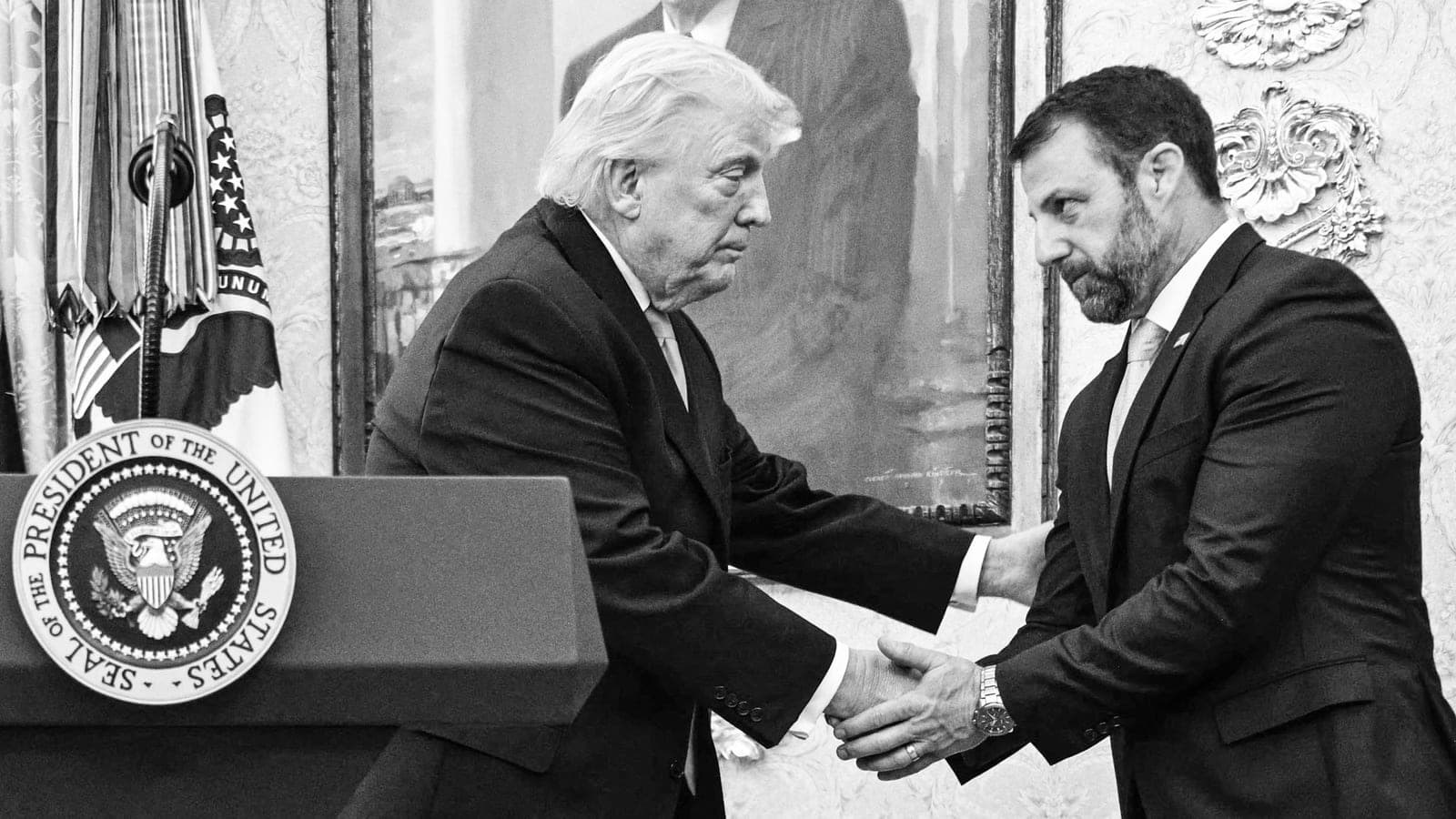
Kristi Noem is Gone. Now Mass Deportations Can Really Begin.
Markwayne Mullin cultivated a reputation in Congress as a brawler, but he sounded more like a peacemaker as he was sworn in this week as secretary of the Department of Homeland Security. “I don’t care what color your state is. I don’t care if you’re red or you’re blue,” Mullin, a former mixed-martial-arts fighter, said during the brief Oval Office ceremony, with President Trump looking over his shoulder. “My job is to be secretary of Homeland and to protect everybody the same.” Mullin’s conciliatory tone has concerned some of the most ardent supporters of Trump’s immigration crackdown. They worry that the president has lost his nerve after the killings of Renee Good and Alex Pretti in January, and that firing Kristi Noem signaled a retreat from his promise to conduct the largest mass-deportation campaign in U.S. history. Some Trump opponents have a similar view; they are hopeful that the civic resistance displayed in Minneapolis stopped the administration’s authoritarian march in its tracks. Although Mullin gives Trump a different face at DHS, his arrival doesn’t change the administration’s overarching goal—enshrined into law last July by the One Big Beautiful Bill Act—to remove 1 million people a year from the United States. Noem fell short of that during her tenure at DHS (U.S. Immigration and Customs Enforcement completed about 400,000 deportations last year), but she didn’t have the full kit of mass-deportation tools at her disposal, and her team was internally divided and often dysfunctional. Mullin inherits a rapidly expanding immigration-enforcement apparatus at DHS, amped up by $170 billion in additional funding. Since Valentine’s Day, the Transportation Security Administration and several other DHS agencies have been shut down amid a bitter fight over ICE’s tactics. Early this morning, after Trump said he’d order Mullin to pay TSA staff, senators reached a deal that would fund everything in the department with the exception of ICE and Border Patrol. The deal, which now goes to the House, does not include the changes Democrats have demanded to ICE tactics. The lack of an annual budget will hardly be a roadblock to mass deportations. ICE’s Enforcement and Removal Operations, the branch of the agency focused on arrests and deportations, has an annual budget of $5.3 billion, but the OBBBA provided nearly six times that much—$30 billion—in operating funds. The shutdown, in other words, hasn’t been a fight about money or about stopping Trump’s mass-deportation plan. It’s been about whether ICE officers can continue to wear masks while they’re carrying out the mass-deportation plan that Congress has already paid for. The spending spree is now Mullin’s to manage. He’s getting a new fleet of deportation aircraft and nearly a dozen warehouses that ICE plans to convert into megajails, some with capacity for 10,000 detainees. ICE is hiring and training 12,000 officers and agents, more than doubling the size of its workforce. It has signed roughly 800 new agreements with county sheriffs and local police departments willing to assist with immigration enforcement. And the Trump administration has won fresh legal victories from two appellate courts that have backed new measures to keep immigrants in ICE detention while their cases are pending. The potential pool of immigrants ICE can hold in custody—making them easier to deport—is now much larger. Mullin said during his confirmation hearing that he doesn’t want DHS to be in the headlines every day—the same stance embraced by Tom Homan, the White House border czar. Homan has said that he’s been talking with Mullin several times a day, and DHS officials I’ve spoken with expect the mentorship to continue as the new secretary—who has never worked in federal law enforcement or led a federal agency—transitions into the role. The Homan approach to mass deportation is not as loud and flashy as the one employed by Noem; her chief adviser, Corey Lewandowski; and their roving field marshal, the Border Patrol commander Greg Bovino. But it may prove to be more effective at delivering what Trump wants. When Trump sent Homan to take over in Minneapolis and remediate the political damage left by Noem’s team, Homan steered ICE back to “targeted enforcement,” developing lists of people to find and arrest rather than using the more indiscriminate tactics promoted by Bovino, who retired this week. Homan, who ran ICE during Trump’s first term and promoted the family-separation policy at the border, once received a service medal from President Obama, and has learned to tailor his message to whatever audience he’s addressing. Last year, he aggressively attacked Democrats for having so-called sanctuary-city policies, but since taking over in Minneapolis, he’s been calm and measured in his public statements, emphasizing a focus on immigrants with criminal records while assuring conservatives that “no one is off the table.” [Read: Kristi Noem bought 11 warehouses to use as ICE jails. Now what? ] Homan’s tactical shift would give ICE a lower profile while aiming to make it easier for local jurisdictions and their police departments to cooperate on immigration enforcement. That’s what Mullin seemed to be referring to when he told senators at his confirmation hearing that he wanted ICE to operate more like a “transport” agency that could go around collecting deportees from the jails of local jurisdictions partnering with ICE. Chad Wolf, who served as acting Homeland Security secretary at the end of Trump’s first term, told me that the president clearly signaled that he wants a “new approach” when he sent Homan to Minneapolis and replaced Noem with Mullin. “The overall policy goals, resources, and the law are likely to stay largely the same,” Wolf said, “but the way they carry out immigration enforcement may look different.” Noem and her staff were belligerent toward Democrats and also toward reporters, many of whom were skeptical of their methods and claims. The department blocked the release of immigration data, weakened internal oversight, and drew complaints from lawmakers of both parties who said that Noem’s team ignored them. Mullin, who comes from the dealmaking world of Congress, has started off differently. When it came time for Senator Ruben Gallego of Arizona, a Democrat, to question Mullin during the confirmation hearing, Gallego greeted him with “Hello, neighbor”—their Senate offices are nearly adjacent—and Mullin replied, “Hey, brother.” Two Democrats, Senator John Fetterman of Pennsylvania and Senator Martin Heinrich of New Mexico, voted to confirm Mullin, but Gallego did not. I asked him on Wednesday how he thought Mullin would do in the job. “I know he’s a good guy, but at the end of the day, what he does with DHS, or doesn’t do with DHS, is what worries me,” Gallego told me. “I don’t know who is actually going to be in charge of DHS.” Gallego was referring to Stephen Miller, the White House homeland-security adviser. Gallego said that Miller continues pushing the administration in an extreme direction, citing Miller’s trip to Texas this week to urge Republicans to challenge a 44-year-old Supreme Court decision that upheld education rights for all children, regardless of immigration status. I asked Gallego whether he thought Mullin would take orders from Miller. “I think he’s going to take orders from the president,” Gallego said. [Read: The wrath of Stephen Miller] Noem’s rocky 14-month tenure at DHS was marked by two phases. During the first phase, last spring, before DHS got the infusion of new money, Noem led a shock-and-awe campaign aimed mostly at scaring people into leaving. Working off plans formulated by Miller, she spent heavily on ads urging “self-deportation,” while the White House deployed the FBI, the Marshals Service, and other federal law-enforcement agencies to help ICE. By last May, when it was clear that this approach wouldn’t come close to meeting the White House’s goal of 1 million deportations, Noem and Miller were turning up pressure on the ICE workforce. They set a quota of 3,000 arrests a day and threatened to fire ICE officials who fell short, telling them to sweep up laborers in parking lots. This fueled resentment among overtaxed rank-and-file ICE officers—and still didn’t deliver the deportation numbers Miller wanted. Noem sent Bovino and his Border Patrol agents into Los Angeles last June, and viral social-media clips of agents raiding Home Depot parking lots soon followed. [Read: Trump loves ICE. Its workforce has never been so miserable.] Noem’s second phase started after Trump signed the spending bill on July 4, 2025, as Lewandowski implemented a policy requiring the secretary’s approval on every DHS contract worth more than $100,000. The enormous amount of money flowing across Noem’s desk led to complaints of bottlenecks and worsening bureaucracy, and raised suspicions that Lewandowski was grifting off the contracts. He has denied any wrongdoing. Mullin said that he will rescind the contract-review policy and told senators, “I’m not a micromanager.” But the divided leadership structure that devolved into rivalries during Noem’s tenure remains in place, with Homan as border czar and Miller viewed as the shadow secretary who operates more like an actual czar. Miller continues to hold daily 10 a.m. conference calls with DHS leaders and the heads of other federal agencies to demand updates on the machinery of mass deportation: the pace of ICE hiring, the number of daily arrests, the status of key contracts. Noem reportedly told a colleague, “Everything I’ve done, I’ve done at the direction of the president and Stephen,” according to an Axios report in late January. Andrea Flores, a former immigration adviser to Joe Biden, told me that the White House has remained steadfast in its mass-deportation goals and has been “putting the infrastructure in place to signal that arrests will continue to grow.” Homan is a key messenger, Flores said, and Miller is the one setting the agenda. “The DHS-secretary role appears to be the least influential member of the president’s immigration-policy team,” she said. Trump officials continue to push an extreme agenda at DHS and across the federal government, Flores said, noting that the administration will present oral arguments next week to the Supreme Court in its effort to limit birthright citizenship.

Democrats Are Exorcising the Ghost of Iraq
The speech that arguably won Barack Obama the presidency was delivered six years before he ran for the White House and four years before he reached Congress. In October 2002, Obama, then a state senator from Illinois, delivered a blistering speech against the impending war in Iraq. “I don’t oppose war in all circumstances,” he declared at a Chicago rally. “What I do oppose is a dumb war.” Years later, that stance would distinguish Obama from Hillary Clinton, the initial front-runner in the 2008 Democratic primary. The two contenders were largely in accord on domestic policy, which made their differences on foreign policy loom large. Clinton, like most Senate Democrats, had voted to authorize the Iraq War. But with that decision now deeply unpopular on the left, Obama leaned into his early opposition. His campaign produced supercuts of his anti-war sentiments over the years and even filmed supporters reciting the lines of his 2002 speech, in one of the earliest examples of viral video in American politics. The contrast proved consequential. Surveys showed that Democratic voters upset by the war broke for Obama, who narrowly edged out Clinton and went on to win the White House. [David Frum: Can’t stop it, so lead it] Today’s Democrats appear to have learned from Obama’s example and the Iraq debacle. On March 2, Senator Jon Ossoff of Georgia, a swing-state politician and potential presidential contender, announced his campaign for reelection and delivered a broadside against another Middle Eastern war. “Eight months ago, President Trump lied to the country when he falsely claimed to have obliterated Iran’s nuclear program,” Ossoff told supporters. “Now he says he’s taken the United States to war for regime change without evidence of imminent threat, without having exhausted diplomacy, without clear objectives or a plan for the aftermath, and without the consent of Congress.” Ossoff’s speech was powerful, but it was most notable for not being noteworthy. Numerous high-profile Democratic politicians, including moderates in purple states and some considering a run for the presidency, have expressed similar sentiments. Senator Ruben Gallego of Arizona, a veteran of the Iraq War, has repeatedly dubbed the Iran campaign “a dumb war,” echoing Obama, and warned about America being pulled back into the Middle East. California Governor Gavin Newsom accused Trump of “engaging in an illegal, dangerous war that will risk the lives of our American service members and our friends without justification to the American people.” Senator Cory Booker of New Jersey, a past and likely future presidential candidate, called this week for the withdrawal of U.S. forces “from this reckless and unauthorized war of choice with Iran.” The progressive standard-bearer Alexandria Ocasio-Cortez predicted that Trump’s bombing would prove “catastrophic,” while on the other end of the party’s ideological spectrum, even Democratic candidates endorsed by AIPAC, the pro-Israel lobby group, distanced themselves from the war. The contrast with the Democratic Party of yesteryear could not be more apparent. Back in 2002, Democrats with White House aspirations felt compelled to authorize the Iraq War, even if they would later turn against it. Many of these politicians had witnessed decisive interventions in places such as Kosovo, Bosnia, and the first Gulf War that had salutary outcomes and ended without devolving into quagmires. Influenced by this experience, Senators John Kerry, Hillary Clinton, and Joe Biden—the Democratic nominees for president in 2004, 2016, and 2020—all voted to back the invasion of Iraq. Today the dynamic has flipped, and presidential contenders are tripping over themselves to repudiate Trump’s war. Because so many have staked out opposition, these politicians are unlikely to be the next Obama. But they are ensuring that they will not be the next Hillary Clinton, a promising potential president whose support for a disastrous Middle Eastern war sabotaged her candidacy. [Franklin Foer: Trump is betraying Iran’s pro-democracy protesters] The reasons for this reversal are not just hindsight. Ever since Donald Trump assumed office, American politics has become polarized around his personality, with feelings about the president often dictating opinions about his policies. As a result, it has become very difficult for Republicans to oppose his agenda—and toxic for Democrats to support it. Moreover, unlike the Bush administration in 2002, the Trump administration has made little effort to sell the nation or the international community on its intervention, making military action less popular and easier for a poll-conscious politician to reject. Back in 2003, some 60 percent of Americans supported the invasion of Iraq, including about 40 percent of Democrats, creating significant cross-pressures on ambitious liberal elected officials. Today nearly all polls show that most Americans oppose the current campaign in Iran, and that an overwhelming majority reject a prospective ground invasion. When it comes to Democrats in particular, the numbers are laughably lopsided. A YouGov poll released this week found that 81 percent of Democrats believe that war with Iran is “not justified.” Just 7 percent disagreed. In short, both the ghosts of the past and the polls of the present have conspired to push the Democratic Party in a staunchly anti-war direction. And given that wars tend to lose popularity the longer they drag on, this is likely the most popular the Iran war will ever be among Democrats. If the conflict turns out to be a success for Trump, his opposition will have to account for its nay-saying. But most Democratic elected officials seem to prefer taking that bet over the alternative. Obama’s argument didn’t just carry the day in his primary; it reshaped his party entirely.
Democrats Are Exorcising the Ghost of Iraq
The speech that arguably won Barack Obama the presidency was delivered six years before he ran for the White House and four years before he reached Congress. In October 2002, Obama, then a state senator from Illinois, delivered a blistering speech against the impending war in Iraq. “I don’t oppose war in all circumstances,” he declared at a Chicago rally. “What I do oppose is a dumb war.” Years later, that stance would distinguish Obama from Hillary Clinton, the initial front-runner in the 2008 Democratic primary. The two contenders were largely in accord on domestic policy, which made their differences on foreign policy loom large. Clinton, like most Senate Democrats, had voted to authorize the Iraq War. But with that decision now deeply unpopular on the left, Obama leaned into his early opposition. His campaign produced supercuts of his anti-war sentiments over the years and even filmed supporters reciting the lines of his 2002 speech, in one of the earliest examples of viral video in American politics. The contrast proved consequential. Surveys showed that Democratic voters upset by the war broke for Obama, who narrowly edged out Clinton and went on to win the White House. [David Frum: Can’t stop it, so lead it] Today’s Democrats appear to have learned from Obama’s example and the Iraq debacle. On March 2, Senator Jon Ossoff of Georgia, a swing-state politician and potential presidential contender, announced his campaign for reelection and delivered a broadside against another Middle Eastern war. “Eight months ago, President Trump lied to the country when he falsely claimed to have obliterated Iran’s nuclear program,” Ossoff told supporters. “Now he says he’s taken the United States to war for regime change without evidence of imminent threat, without having exhausted diplomacy, without clear objectives or a plan for the aftermath, and without the consent of Congress.” Ossoff’s speech was powerful, but it was most notable for not being noteworthy. Numerous high-profile Democratic politicians, including moderates in purple states and some considering a run for the presidency, have expressed similar sentiments. Senator Ruben Gallego of Arizona, a veteran of the Iraq War, has repeatedly dubbed the Iran campaign “a dumb war,” echoing Obama, and warned about America being pulled back into the Middle East. California Governor Gavin Newsom accused Trump of “engaging in an illegal, dangerous war that will risk the lives of our American service members and our friends without justification to the American people.” Senator Cory Booker of New Jersey, a past and likely future presidential candidate, called this week for the withdrawal of U.S. forces “from this reckless and unauthorized war of choice with Iran.” The progressive standard-bearer Alexandria Ocasio-Cortez predicted that Trump’s bombing would prove “catastrophic,” while on the other end of the party’s ideological spectrum, even Democratic candidates endorsed by AIPAC, the pro-Israel lobby group, distanced themselves from the war. The contrast with the Democratic Party of yesteryear could not be more apparent. Back in 2002, Democrats with White House aspirations felt compelled to authorize the Iraq War, even if they would later turn against it. Many of these politicians had witnessed decisive interventions in places such as Kosovo, Bosnia, and the first Gulf War that had salutary outcomes and ended without devolving into quagmires. Influenced by this experience, Senators John Kerry, Hillary Clinton, and Joe Biden—the Democratic nominees for president in 2004, 2016, and 2020—all voted to back the invasion of Iraq. Today the dynamic has flipped, and presidential contenders are tripping over themselves to repudiate Trump’s war. Because so many have staked out opposition, these politicians are unlikely to be the next Obama. But they are ensuring that they will not be the next Hillary Clinton, a promising potential president whose support for a disastrous Middle Eastern war sabotaged her candidacy. [Franklin Foer: Trump is betraying Iran’s pro-democracy protesters] The reasons for this reversal are not just hindsight. Ever since Donald Trump assumed office, American politics has become polarized around his personality, with feelings about the president often dictating opinions about his policies. As a result, it has become very difficult for Republicans to oppose his agenda—and toxic for Democrats to support it. Moreover, unlike the Bush administration in 2002, the Trump administration has made little effort to sell the nation or the international community on its intervention, making military action less popular and easier for a poll-conscious politician to reject. Back in 2003, some 60 percent of Americans supported the invasion of Iraq, including about 40 percent of Democrats, creating significant cross-pressures on ambitious liberal elected officials. Today nearly all polls show that most Americans oppose the current campaign in Iran, and that an overwhelming majority reject a prospective ground invasion. When it comes to Democrats in particular, the numbers are laughably lopsided. A YouGov poll released this week found that 81 percent of Democrats believe that war with Iran is “not justified.” Just 7 percent disagreed. In short, both the ghosts of the past and the polls of the present have conspired to push the Democratic Party in a staunchly anti-war direction. And given that wars tend to lose popularity the longer they drag on, this is likely the most popular the Iran war will ever be among Democrats. If the conflict turns out to be a success for Trump, his opposition will have to account for its nay-saying. But most Democratic elected officials seem to prefer taking that bet over the alternative. Obama’s argument didn’t just carry the day in his primary; it reshaped his party entirely.
Democrats Are Exorcising the Ghost of Iraq
The speech that arguably won Barack Obama the presidency was delivered six years before he ran for the White House and four years before he reached Congress. In October 2002, Obama, then a state senator from Illinois, delivered a blistering speech against the impending war in Iraq. “I don’t oppose war in all circumstances,” he declared at a Chicago rally. “What I do oppose is a dumb war.” Years later, that stance would distinguish Obama from Hillary Clinton, the initial front-runner in the 2008 Democratic primary. The two contenders were largely in accord on domestic policy, which made their differences on foreign policy loom large. Clinton, like most Senate Democrats, had voted to authorize the Iraq War. But with that decision now deeply unpopular on the left, Obama leaned into his early opposition. His campaign produced supercuts of his anti-war sentiments over the years and even filmed supporters reciting the lines of his 2002 speech, in one of the earliest examples of viral video in American politics. The contrast proved consequential. Surveys showed that Democratic voters upset by the war broke for Obama, who narrowly edged out Clinton and went on to win the White House. [David Frum: Can’t stop it, so lead it] Today’s Democrats appear to have learned from Obama’s example and the Iraq debacle. On March 2, Senator Jon Ossoff of Georgia, a swing-state politician and potential presidential contender, announced his campaign for reelection and delivered a broadside against another Middle Eastern war. “Eight months ago, President Trump lied to the country when he falsely claimed to have obliterated Iran’s nuclear program,” Ossoff told supporters. “Now he says he’s taken the United States to war for regime change without evidence of imminent threat, without having exhausted diplomacy, without clear objectives or a plan for the aftermath, and without the consent of Congress.” Ossoff’s speech was powerful, but it was most notable for not being noteworthy. Numerous high-profile Democratic politicians, including moderates in purple states and some considering a run for the presidency, have expressed similar sentiments. Senator Ruben Gallego of Arizona, a veteran of the Iraq War, has repeatedly dubbed the Iran campaign “a dumb war,” echoing Obama, and warned about America being pulled back into the Middle East. California Governor Gavin Newsom accused Trump of “engaging in an illegal, dangerous war that will risk the lives of our American service members and our friends without justification to the American people.” Senator Cory Booker of New Jersey, a past and likely future presidential candidate, called this week for the withdrawal of U.S. forces “from this reckless and unauthorized war of choice with Iran.” The progressive standard-bearer Alexandria Ocasio-Cortez predicted that Trump’s bombing would prove “catastrophic,” while on the other end of the party’s ideological spectrum, even Democratic candidates endorsed by AIPAC, the pro-Israel lobby group, distanced themselves from the war. The contrast with the Democratic Party of yesteryear could not be more apparent. Back in 2002, Democrats with White House aspirations felt compelled to authorize the Iraq War, even if they would later turn against it. Many of these politicians had witnessed decisive interventions in places such as Kosovo, Bosnia, and the first Gulf War that had salutary outcomes and ended without devolving into quagmires. Influenced by this experience, Senators John Kerry, Hillary Clinton, and Joe Biden—the Democratic nominees for president in 2004, 2016, and 2020—all voted to back the invasion of Iraq. Today the dynamic has flipped, and presidential contenders are tripping over themselves to repudiate Trump’s war. Because so many have staked out opposition, these politicians are unlikely to be the next Obama. But they are ensuring that they will not be the next Hillary Clinton, a promising potential president whose support for a disastrous Middle Eastern war sabotaged her candidacy. [Franklin Foer: Trump is betraying Iran’s pro-democracy protesters] The reasons for this reversal are not just hindsight. Ever since Donald Trump assumed office, American politics has become polarized around his personality, with feelings about the president often dictating opinions about his policies. As a result, it has become very difficult for Republicans to oppose his agenda—and toxic for Democrats to support it. Moreover, unlike the Bush administration in 2002, the Trump administration has made little effort to sell the nation or the international community on its intervention, making military action less popular and easier for a poll-conscious politician to reject. Back in 2003, some 60 percent of Americans supported the invasion of Iraq, including about 40 percent of Democrats, creating significant cross-pressures on ambitious liberal elected officials. Today nearly all polls show that most Americans oppose the current campaign in Iran, and that an overwhelming majority reject a prospective ground invasion. When it comes to Democrats in particular, the numbers are laughably lopsided. A YouGov poll released this week found that 81 percent of Democrats believe that war with Iran is “not justified.” Just 7 percent disagreed. In short, both the ghosts of the past and the polls of the present have conspired to push the Democratic Party in a staunchly anti-war direction. And given that wars tend to lose popularity the longer they drag on, this is likely the most popular the Iran war will ever be among Democrats. If the conflict turns out to be a success for Trump, his opposition will have to account for its nay-saying. But most Democratic elected officials seem to prefer taking that bet over the alternative. Obama’s argument didn’t just carry the day in his primary; it reshaped his party entirely.
Democrats Are Exorcising the Ghost of Iraq
The speech that arguably won Barack Obama the presidency was delivered six years before he ran for the White House and four years before he reached Congress. In October 2002, Obama, then a state senator from Illinois, delivered a blistering speech against the impending war in Iraq. “I don’t oppose war in all circumstances,” he declared at a Chicago rally. “What I do oppose is a dumb war.” Years later, that stance would distinguish Obama from Hillary Clinton, the initial front-runner in the 2008 Democratic primary. The two contenders were largely in accord on domestic policy, which made their differences on foreign policy loom large. Clinton, like most Senate Democrats, had voted to authorize the Iraq War. But with that decision now deeply unpopular on the left, Obama leaned into his early opposition. His campaign produced supercuts of his anti-war sentiments over the years and even filmed supporters reciting the lines of his 2002 speech, in one of the earliest examples of viral video in American politics. The contrast proved consequential. Surveys showed that Democratic voters upset by the war broke for Obama, who narrowly edged out Clinton and went on to win the White House. [David Frum: Can’t stop it, so lead it] Today’s Democrats appear to have learned from Obama’s example and the Iraq debacle. On March 2, Senator Jon Ossoff of Georgia, a swing-state politician and potential presidential contender, announced his campaign for reelection and delivered a broadside against another Middle Eastern war. “Eight months ago, President Trump lied to the country when he falsely claimed to have obliterated Iran’s nuclear program,” Ossoff told supporters. “Now he says he’s taken the United States to war for regime change without evidence of imminent threat, without having exhausted diplomacy, without clear objectives or a plan for the aftermath, and without the consent of Congress.” Ossoff’s speech was powerful, but it was most notable for not being noteworthy. Numerous high-profile Democratic politicians, including moderates in purple states and some considering a run for the presidency, have expressed similar sentiments. Senator Ruben Gallego of Arizona, a veteran of the Iraq War, has repeatedly dubbed the Iran campaign “a dumb war,” echoing Obama, and warned about America being pulled back into the Middle East. California Governor Gavin Newsom accused Trump of “engaging in an illegal, dangerous war that will risk the lives of our American service members and our friends without justification to the American people.” Senator Cory Booker of New Jersey, a past and likely future presidential candidate, called this week for the withdrawal of U.S. forces “from this reckless and unauthorized war of choice with Iran.” The progressive standard-bearer Alexandria Ocasio-Cortez predicted that Trump’s bombing would prove “catastrophic,” while on the other end of the party’s ideological spectrum, even Democratic candidates endorsed by AIPAC, the pro-Israel lobby group, distanced themselves from the war. The contrast with the Democratic Party of yesteryear could not be more apparent. Back in 2002, Democrats with White House aspirations felt compelled to authorize the Iraq War, even if they would later turn against it. Many of these politicians had witnessed decisive interventions in places such as Kosovo, Bosnia, and the first Gulf War that had salutary outcomes and ended without devolving into quagmires. Influenced by this experience, Senators John Kerry, Hillary Clinton, and Joe Biden—the Democratic nominees for president in 2004, 2016, and 2020—all voted to back the invasion of Iraq. Today the dynamic has flipped, and presidential contenders are tripping over themselves to repudiate Trump’s war. Because so many have staked out opposition, these politicians are unlikely to be the next Obama. But they are ensuring that they will not be the next Hillary Clinton, a promising potential president whose support for a disastrous Middle Eastern war sabotaged her candidacy. [Franklin Foer: Trump is betraying Iran’s pro-democracy protesters] The reasons for this reversal are not just hindsight. Ever since Donald Trump assumed office, American politics has become polarized around his personality, with feelings about the president often dictating opinions about his policies. As a result, it has become very difficult for Republicans to oppose his agenda—and toxic for Democrats to support it. Moreover, unlike the Bush administration in 2002, the Trump administration has made little effort to sell the nation or the international community on its intervention, making military action less popular and easier for a poll-conscious politician to reject. Back in 2003, some 60 percent of Americans supported the invasion of Iraq, including about 40 percent of Democrats, creating significant cross-pressures on ambitious liberal elected officials. Today nearly all polls show that most Americans oppose the current campaign in Iran, and that an overwhelming majority reject a prospective ground invasion. When it comes to Democrats in particular, the numbers are laughably lopsided. A YouGov poll released this week found that 81 percent of Democrats believe that war with Iran is “not justified.” Just 7 percent disagreed. In short, both the ghosts of the past and the polls of the present have conspired to push the Democratic Party in a staunchly anti-war direction. And given that wars tend to lose popularity the longer they drag on, this is likely the most popular the Iran war will ever be among Democrats. If the conflict turns out to be a success for Trump, his opposition will have to account for its nay-saying. But most Democratic elected officials seem to prefer taking that bet over the alternative. Obama’s argument didn’t just carry the day in his primary; it reshaped his party entirely.

Inside the Fight Over the Epstein Files
Early last year, Republicans from the House Judiciary Committee were invited to a private dinner at the Justice Department. Representative Thomas Massie of Kentucky remembers asking his then girlfriend, now wife, what he should ask Attorney General Pam Bondi. She suggested he bring up Jeffrey Epstein. At first, he waved off the suggestion. But as he sat at the long formal table, set with formal china and surrounded by top Justice officials, he changed his mind. “‘I saw you release the ‘Phase 1’ of the Epstein files,” Massie remembers asking Bondi at the April 28 dinner. “When do you think we might get ‘Phase 2’?’” Bondi looked him in the eyes, Massie said, and explained that all that was left to be released was material she considered “child pornography” and that there was nothing more there. He didn’t follow up then, but her answer didn’t sit right. “I suspected there was stuff that needed to come out,” he told me. After the Justice Department announced in July that it would not share any more records, Representative Ro Khanna of California held a morning strategy meeting with his staff and asked for ideas for new bills. Sarah Drory, a young communications staffer who had never before spoken up in this meeting, had a suggestion: “What about a bill to release the Epstein files?” The room was silent. Drory saw her more senior colleagues exchange confused or dismissive looks. One declared Epstein “a social-media thing.” On her walk home late that night, she called her boyfriend, second-guessing her suggestion. “Is that crazy?” she remembers asking him—and herself. Three days later, Khanna introduced an amendment in the Rules Committee requiring the Department of Justice to release the Epstein files to gauge support and was surprised when a Republican congressman from South Carolina voted for it. After that vote, Massie called Khanna, and they discussed a long-shot idea late into the night: Could they convince other Republicans to do the same? Khanna’s staff and consultants tried to talk him out of pursuing such legislation, explaining that it could make him look like a conspiracy theorist, instead of his desired image as a “serious economics guy.” But Khanna explained to his staff that the topic of Epstein kept coming up, especially when he appeared on podcasts or visited the more conservative parts of his district. He recalled a young man delivering a long rant at a recent town hall about how he didn’t trust the government because it was “protecting pedophiles” by not releasing the Epstein files or holding more people accountable. In that moment, Khanna told me, he realized that standing up for Epstein’s victims—and against the wealthy or powerful—was a way to build trust. “You have to convince people that the government actually works,” Khanna said. I have been reporting on Epstein—his criminal investigations, his network of powerful friends, and his hundreds, possibly thousands, of young victims—for almost a decade. I’ve chronicled the many false starts and dashed hopes for accountability following Epstein’s second arrest in July 2019, his death while in custody, and the efforts to bring others in his network to justice. I have spent years trying to figure out what, if anything, Donald Trump knew about Epstein’s abuse of young women, and whether the president was at all involved. On this question and many others, I was repeatedly told: “The story is over.” But over the past several months, something extraordinary has happened: An unlikely duo of lawmakers—a progressive from Silicon Valley and a conservative from Kentucky—partnered with a group of Epstein survivors and a few female Republican lawmakers to successfully push for legislation mandating the release of the so-called Epstein files. It was the most significant act of defiance by Republicans in Congress against the president in his second term, and it transformed what had been treated as a fringe conspiracy theory into a populist rallying cry. The release of the files over the past two months has led to new criminal investigations outside of the United States. In Britain, Andrew Mountbatten-Windsor, the former prince, and Peter Mandelson, the former U.K. ambassador to the United States, were arrested but haven’t been charged; in Norway, Thorbjørn Jagland, the former prime minister, was charged with “gross corruption.” More than a dozen other prominent people have stepped down from lucrative jobs or lost honorary titles or positions. This is the story, drawn from interviews with more than 40 people over the past eight months, of the unlikely coalition that came together to force some measure of accountability—and of what it hopes to accomplish next. The sheer volume of records collected over several decades—and the hundreds if not thousands of people who may have information about Epstein and his criminal enterprise but have not been questioned by law enforcement—is both mind-boggling and tragic. Hundreds of prosecutors and other law-enforcement personnel were diverted from investigations to help review the documents before their release, which cost taxpayers millions of dollars. But Justice Department officials have suggested that they are done investigating Epstein’s alleged co-conspirators and have no plans to pursue additional federal charges. That stance—coupled with the department’s extensive and inconsistent redactions in the documents—has prompted even more suspicion. And no one faces more insistent questions about what he might be trying to hide than the president. Martin Buereau / AFP / Getty Trump does not detail—even privately—what precisely in the files might be so embarrassing to him and those close to him, four administration officials told me and my colleague Jonathan Lemire. Marjorie Taylor Greene, the former representative from Georgia, has said that when the president angrily tried to persuade her to vote against the legislation, he argued that “his friends would get hurt” with the wide release of records, something he has repeated in other private conversations. What the president has clearly said, often in a barking tone, is that he wants his aides and allies to make the whole thing “go away.” One official described the president as “seething.” [Read: Inside the White House’s Epstein strategy] Trump’s name appears tens of thousands of times across the files, although many of those mentions are in media reports that Epstein circulated or messages discussing his presidency. But the high number surprised White House staff members who told us they were unprepared for the release. “That freaked out people,” another administration official told us. “Nobody really knew what was coming.” At least six Cabinet members or senior administration officials were in contact with Epstein—and, according to the documents, had closer and longer relationships with him than had been previously or widely known. All have denied wrongdoing, and law-enforcement agencies haven’t made any allegations against them or the president. In any administration, most top officials go through a grueling vetting process, FBI background checks and security-clearance reviews. It is unclear whether these relationships with Epstein were raised at any point. Every agency involved declined to answer my questions. Trump has not been interviewed by authorities, despite his very public history with Epstein and Ghislaine Maxwell, who is serving a 20-year prison sentence for conspiring with Epstein to traffic and abuse minor victims. The DOJ declined to answer detailed questions for this article. Those close to the president insist no one is panicking, but the official acknowledged: “Anytime we are talking about Epstein, we are losing.” Trump has urged federal prosecutors to continue to investigate Democrats with ties to Epstein, especially Bill and Hillary Clinton, who deny any wrongdoing or knowledge of Epstein’s conduct. The Clintons are providing videotaped depositions to the House Oversight Committee this week in New York. Trump and others have expressed concern that this effort could set a precedent for Trump to be subpoenaed to testify under oath about Epstein, four people familiar with the situation told us. “Everyone’s looking for an off-ramp,” the administration official told us. Trump has also called his allies in recent weeks to ask about Bondi’s job performance, an acknowledgment that things have not gone according to plan. A White House official told me that the president continues to support the attorney general and that there has been no recent change in that support. Trump has offered shifting accounts of his friendship with Epstein and when exactly it ended, but he has long maintained that he “had no idea” about Epstein’s criminal activity. The White House has stated that Trump barred Epstein from his Mar-a-Lago club in Palm Beach, Florida, “for being a creep,” although it won’t say when that happened. But among the unredacted files provided to members of Congress is an email from one of Epstein’s attorneys recounting a 2009 conversation in which he says Trump claims that Epstein, who was sometimes a guest at the club, had never been asked to leave. The year before, Epstein had pleaded guilty to two prostitution charges, including soliciting a minor. Attempting to piece through the files that are public can be disorienting, especially given the administration's extreme reluctance to engage on questions on the matter. Included in the new files is a report that a former Palm Beach police chief told the FBI that Trump called him in 2006, after learning that Epstein was under investigation. “Thank goodness you’re stopping him, everyone has known he’s been doing this,” Trump reportedly said, adding that Maxwell should also be investigated. [Read: So this is why Trump didn’t want to release the Epstein files] Nine people familiar with information that was submitted to the FBI and DOJ in recent years told me they were alarmed that many documents—including those that they say include references to Trump—were not made public. The DOJ, the FBI, and the White House declined to respond to my questions about this, but on Wednesday, the DOJ posted on X that it is “currently reviewing files” to see if additional material should be published. The department previously said that some documents “contain untrue and sensationalist claims against President Trump.” The department released a presentation from last year that includes a slide titled PROMINENT NAMES that features 11 men who have been accused of misconduct. Trump is the first person listed, along with an accusation that he assaulted a minor. It is unclear to what extent this claim and others have been vetted or verified, and the White House declined to answer my questions on the matter. This week, the journalist Roger Sollenberger, NPR, and The New York Times identified documents related to an allegation of sexual misconduct involving Trump and a minor that were not released by the DOJ, or in some cases, were released and then were deleted from the DOJ website. House Democrats told me on Wednesday that their review of a wider collection of unredacted material available to members of Congress appears to confirm that reporting. Trump has not been accused by law enforcement of wrongdoing related to Epstein, and he has never been interviewed by authorities, despite his years of friendship with Epstein and Maxwell and his prominence within the files. The White House declined to answer many of my questions about Trump and Epstein. Instead, Abigail Jackson, a White House spokesperson, sent me a statement: “By releasing thousands of pages of documents, cooperating with the House Oversight Committee’s subpoena request, and President Trump recently calling for further investigations into Epstein’s Democrat friends, the Trump Administration has done more for the victims than Democrats ever have.” During Trump’s first term, Alexander Acosta, his secretary of labor, was forced to resign over his role in offering Epstein a lenient plea deal in 2008 after a federal investigation into Epstein’s abuse of dozens of young women and minors. Epstein spent minimal time in jail and allegedly continued to abuse multiple victims during his supervised release. A DOJ review later found that Acosta had exercised “poor judgment” but had not committed professional misconduct. Trump’s experience with Acosta did not appear to affect his second-term choices of Cabinet members and senior officials. None has faced repercussions for their dealings with Epstein. A White House official told me in a statement that “President Trump has assembled the greatest and most effective cabinet in history and he maintains confidence in them.” During her testimony before Congress, Bondi was asked if any administration officials have been questioned by the Justice Department about their ties to Epstein. She didn’t directly answer. As the House moved toward a vote on releasing the Epstein files last summer and fall, the White House and top Trump allies launched an effort to forestall it that lawmakers told me was unprecedented in its intensity and scope. Massie called it a “360-pressure campaign,” one felt not just by him and his staff but anyone associated with him. One tactic he had not experienced before: Some of his key staff members were suddenly offered more prestigious jobs in the Trump administration or more lucrative jobs in the private sector—the idea being that if Massie no longer had a full staff, he couldn’t pursue ambitious legislation. Massie recalled asking an employee who, a few weeks before the vote, had received an employment offer that would double his salary: “Did it ever occur to you that they might be offering you this job to basically make me less effective?” He said the young man sheepishly replied: “That’s what my mom said.” He turned down the offer and finished writing the bill. [Read: ‘They’re delusional if they think this is going to go away’] Much of the White House’s effort was directed at the Republican women in Congress who expressed support for the law, especially representatives Greene, Nancy Mace of South Carolina, and Lauren Boebert of Colorado. Massie started a group text with these Republican allies called “Bravehearts.” Greene was among the first of the Republican women to advocate for the release of the Epstein files, and she helped lead the effort that fall. Epstein survivors who met with her told me that she was among the few members of Congress who asked meaningful follow-up questions seeking to understand the history of the case and the roles of other alleged co-conspirators. Greene was often brought to tears by what she learned. “I never in my life thought I would hug Marjorie Taylor Greene,” one Epstein victim told me. “But she was genuine, and she followed the facts.” In a meeting with Epstein victims, Mace—who has spoken on the House floor about surviving sexual assault—revealed her frustration with House Speaker Mike Johnson trying to quiet the issue. In November, Boebert was summoned to the White House’s Situation Room to discuss her support for the bill with Bondi, FBI Director Kash Patel, and others, an unusual setting that raised questions about what the White House thought was in the files. On a sunny morning in early September, two news conferences took place on the U.S. Capitol grounds to promote the proposed law. One event was held by Massie and Khanna, who invited Greene to speak and tried to keep the legislation from being dismissed as an anti-Trump effort. The other was organized by Epstein survivors and World Without Exploitation, a nonprofit that supports victims of trafficking. A crowd of thousands attended both, some bringing gifts of friendship bracelets and flowers for the victims, others carrying signs that said Believe Women and Release the Files! Several people told me that they had traveled from across the country to be there. No one had anticipated the size of the crowd, and the Capitol Police scrambled to enforce order. As I moved through the crowd that morning I was surprised by the number of elderly people gathered, including many in wheelchairs or walking with canes. Some told me that the public reckoning over Epstein’s sexual abuse had compelled them to reflect on their own experiences and share painful memories they had hidden away for decades. “Frankly, we were young. You didn’t talk about it,” one elderly woman from West Virginia told me, with tears in her eyes. When the vote was finally held in the House on November 18, just one member voted against the release of the files. The Senate followed, voting unanimously, and Trump signed the bill into law. The next month, the Justice Department began slowly releasing what would eventually add up to more than 3 million documents. Democrats have had their own crisis over the Epstein files: How do they separate themselves from the party’s elder statesmen and wealthy donors who have been revealed to have been close to Epstein? During Joe Biden’s four years in office, the Justice Department did not pursue releasing records related to Epstein and lawmakers did not pursue legislative action. Democrats in Congress told me that their party leadership sought to dissuade them from pursuing the effort in recent months, changing their stance only after feeling public pressure and seeing internal polling. Last month the House Oversight Committee scheduled a vote to hold Bill and Hillary Clinton in contempt of Congress for refusing to testify about their relationships with Epstein and Maxwell. The former president and former secretary of state worked the phones, calling Democratic lawmakers to discuss Epstein, according to four people familiar with the conversations, some of whom found the effort problematic. The calls reflected a generational divide within the party, with younger Democrats unwilling to look away from the Clintons’ connections with Epstein and Maxwell, arguing that transparency is needed to rebuild trust with voters. Bill Clinton has said he traveled multiple times on Epstein’s plane in the early 2000s. In an interview last year Maxwell told the Justice Department that “President Clinton was my friend” and that she was involved in creating the Clinton Global Initiative. She attended Chelsea Clinton’s 2010 wedding with Tom Waitt, a tech billionaire and major donor to the Clinton Foundation; Hillary Clinton said Maxwell came as “the plus-one, the guest of someone who was invited.” Yesterday Hillary Clinton testified for six hours under oath and told lawmakers that she had “no idea” about Epstein and Maxwell’s criminal activities, does not remember encountering Epstein, and “never flew on his plane or visited his island, homes, or offices.” She alleged that Republicans’ efforts to get her to testify were meant to “distract attention from President Trump’s actions and to cover them up.” The Clintons have not been charged with any wrongdoing by law enforcement in the Epstein matter. Before the Clintons agreed to videotaped depositions with the committee, nine Democrats voted with Republicans to refer Bill Clinton for a full House vote for contempt of Congress. I talked with Khanna before he walked in to vote, and he likened the experience to a Hindu text in which a prince faces a choice to kill one of his family members to uphold justice. “All the Epstein files should come out,” he said, “and if those files implicate Bill Clinton, so be it.” Massie and Khanna told me their Epstein work has come at a great cost: Several big donors have cut ties, and those losses haven’t been made up, despite a rush of small-dollar donations. Massie faces a difficult Republican primary in Kentucky against a Trump-backed challenger. And then there are the security threats. Nearly everyone I spoke with for this story told me that their public efforts to get the files released have made them fear for their safety. Across several conversations I had with Massie over the past three months, he would matter-of-factly muse about the risk he believes he is taking. “I’ve pissed off enough billionaires who are clearly amoral people that I might have shortened my expected lifespan,” he told me. Massie and Khanna’s critics—and even some of their supportive colleagues—note that the two have used the effort to raise their national profiles. The White House labeled Massie and Khanna “attention-seeking,” and House Speaker Emerita Nancy Pelosi once called their effort “a distraction.” There are indications that Khanna might try to run for president in 2028, an ambition that he doesn’t deny, and he has started doing more national fundraising and holding events in key swing states. Massie has tied his upcoming election to a larger question about the nation’s future and his party’s devotion to one man: “If the country’s savable, I’ll win my reelection,” he said. “And if it’s not, I don’t need to be there.” Hanging over the Epstein files has been the loss of Virginia Roberts Giuffre, one of Epstein’s most vocal victims, who died by suicide last spring. Giuffre was an early organizer of efforts to call for the release of information related to Epstein. Her family has told me that they believe the toll of her abuse by Epstein, Maxwell, and others—along with the harassment that accompanied her public advocacy—became “so heavy that it became unbearable.” [Read: Virginia Giuffre’s family was shocked that Trump described her as ‘stolen’] When Bondi testified under oath to Congress about the Epstein investigation earlier this month, she urged anyone who had been hurt or abused to contact the FBI. Sitting just a few feet behind her were some of the witnesses to Epstein’s crimes, some carrying small images of themselves as teenagers when they were first abused by the late financier. When a lawmaker asked these victims to stand and raise their hands if they had reached out to the Justice Department to offer testimony and evidence, every hand shot up—some defiantly, some shaking from nerves. He then asked how many of their offers had been ignored or denied. Again, every single hand went up. “Ms. Bondi, it looks like you have some more witnesses to talk to,” he said. The attorney general never turned around. Tom Williams / CQ-Roll Call / Getty Sky Roberts, Giuffre’s brother, told me he is now more certain than ever that there is a government “cover-up in real time.” "Which one is it?” Roberts said. “Are you investigating? Are you not?” On Tuesday, Giuffre’s family attended Trump’s State of the Union address to Congress, along with more than a dozen of Epstein’s victims who were guests of Democrats. They used their presence to remind lawmakers—and the American public—of the crimes that many in power sought to ignore. For the first time, they were in the president’s line of sight, but he made no mention of them. The question is how long the president, and others in positions of power, can continue looking away. Jonathan Lemire, Isabel Ruehl, and Marie-Rose Sheinerman contributed to this report. *Illustration sources: Nathan Posner / Anadolu / Getty; Bill Clark / CQ-Roll Call / Getty; Jon Elswick / AP.
Inside the Fight Over the Epstein Files
Early last year, Republicans from the House Judiciary Committee were invited to a private dinner at the Justice Department. Representative Thomas Massie of Kentucky remembers asking his then girlfriend, now wife, what he should ask Attorney General Pam Bondi. She suggested he bring up Jeffrey Epstein. At first, he waved off the suggestion. But as he sat at the long formal table, set with formal china and surrounded by top Justice officials, he changed his mind. “‘I saw you release the ‘Phase 1’ of the Epstein files,” Massie remembers asking Bondi at the April 28 dinner. “When do you think we might get ‘Phase 2’?’” Bondi looked him in the eyes, Massie said, and explained that all that was left to be released was material she considered “child pornography” and that there was nothing more there. He didn’t follow up then, but her answer didn’t sit right. “I suspected there was stuff that needed to come out,” he told me. After the Justice Department announced in July that it would not share any more records, Representative Ro Khanna of California held a morning strategy meeting with his staff and asked for ideas for new bills. Sarah Drory, a young communications staffer who had never before spoken up in this meeting, had a suggestion: “What about a bill to release the Epstein files?” The room was silent. Drory saw her more senior colleagues exchange confused or dismissive looks. One declared Epstein “a social-media thing.” On her walk home late that night, she called her boyfriend, second-guessing her suggestion. “Is that crazy?” she remembers asking him—and herself. Three days later, Khanna introduced an amendment in the Rules Committee requiring the Department of Justice to release the Epstein files to gauge support and was surprised when a Republican congressman from South Carolina voted for it. After that vote, Massie called Khanna, and they discussed a long-shot idea late into the night: Could they convince other Republicans to do the same? Khanna’s staff and consultants tried to talk him out of pursuing such legislation, explaining that it could make him look like a conspiracy theorist, instead of his desired image as a “serious economics guy.” But Khanna explained to his staff that the topic of Epstein kept coming up, especially when he appeared on podcasts or visited the more conservative parts of his district. He recalled a young man delivering a long rant at a recent town hall about how he didn’t trust the government because it was “protecting pedophiles” by not releasing the Epstein files or holding more people accountable. In that moment, Khanna told me, he realized that standing up for Epstein’s victims—and against the wealthy or powerful—was a way to build trust. “You have to convince people that the government actually works,” Khanna said. I have been reporting on Epstein—his criminal investigations, his network of powerful friends, and his hundreds, possibly thousands, of young victims—for almost a decade. I’ve chronicled the many false starts and dashed hopes for accountability following Epstein’s second arrest in July 2019, his death while in custody, and the efforts to bring others in his network to justice. I have spent years trying to figure out what, if anything, Donald Trump knew about Epstein’s abuse of young women, and whether the president was at all involved. On this question and many others, I was repeatedly told: “The story is over.” But over the past several months, something extraordinary has happened: An unlikely duo of lawmakers—a progressive from Silicon Valley and a conservative from Kentucky—partnered with a group of Epstein survivors and a few female Republican lawmakers to successfully push for legislation mandating the release of the so-called Epstein files. It was the most significant act of defiance by Republicans in Congress against the president in his second term, and it transformed what had been treated as a fringe conspiracy theory into a populist rallying cry. The release of the files over the past two months has led to new criminal investigations outside of the United States. In Britain, Andrew Mountbatten-Windsor, the former prince, and Peter Mandelson, the former U.K. ambassador to the United States, were arrested but haven’t been charged; in Norway, Thorbjørn Jagland, the former prime minister, was charged with “gross corruption.” More than a dozen other prominent people have stepped down from lucrative jobs or lost honorary titles or positions. This is the story, drawn from interviews with more than 40 people over the past eight months, of the unlikely coalition that came together to force some measure of accountability—and of what it hopes to accomplish next. The sheer volume of records collected over several decades—and the hundreds if not thousands of people who may have information about Epstein and his criminal enterprise but have not been questioned by law enforcement—is both mind-boggling and tragic. Hundreds of prosecutors and other law-enforcement personnel were diverted from investigations to help review the documents before their release, which cost taxpayers millions of dollars. But Justice Department officials have suggested that they are done investigating Epstein’s alleged co-conspirators and have no plans to pursue additional federal charges. That stance—coupled with the department’s extensive and inconsistent redactions in the documents—has prompted even more suspicion. And no one faces more insistent questions about what he might be trying to hide than the president. Martin Buereau / AFP / Getty Trump does not detail—even privately—what precisely in the files might be so embarrassing to him and those close to him, four administration officials told me and my colleague Jonathan Lemire. Marjorie Taylor Greene, the former representative from Georgia, has said that when the president angrily tried to persuade her to vote against the legislation, he argued that “his friends would get hurt” with the wide release of records, something he has repeated in other private conversations. What the president has clearly said, often in a barking tone, is that he wants his aides and allies to make the whole thing “go away.” One official described the president as “seething.” [Read: Inside the White House’s Epstein strategy] Trump’s name appears tens of thousands of times across the files, although many of those mentions are in media reports that Epstein circulated or messages discussing his presidency. But the high number surprised White House staff members who told us they were unprepared for the release. “That freaked out people,” another administration official told us. “Nobody really knew what was coming.” At least six Cabinet members or senior administration officials were in contact with Epstein—and, according to the documents, had closer and longer relationships with him than had been previously or widely known. All have denied wrongdoing, and law-enforcement agencies haven’t made any allegations against them or the president. In any administration, most top officials go through a grueling vetting process, FBI background checks and security-clearance reviews. It is unclear whether these relationships with Epstein were raised at any point. Every agency involved declined to answer my questions. Trump has not been interviewed by authorities, despite his very public history with Epstein and Ghislaine Maxwell, who is serving a 20-year prison sentence for conspiring with Epstein to traffic and abuse minor victims. The DOJ declined to answer detailed questions for this article. Those close to the president insist no one is panicking, but the official acknowledged: “Anytime we are talking about Epstein, we are losing.” Trump has urged federal prosecutors to continue to investigate Democrats with ties to Epstein, especially Bill and Hillary Clinton, who deny any wrongdoing or knowledge of Epstein’s conduct. The Clintons are providing videotaped depositions to the House Oversight Committee this week in New York. Trump and others have expressed concern that this effort could set a precedent for Trump to be subpoenaed to testify under oath about Epstein, four people familiar with the situation told us. “Everyone’s looking for an off-ramp,” the administration official told us. Trump has also called his allies in recent weeks to ask about Bondi’s job performance, an acknowledgment that things have not gone according to plan. A White House official told me that the president continues to support the attorney general and that there has been no recent change in that support. Trump has offered shifting accounts of his friendship with Epstein and when exactly it ended, but he has long maintained that he “had no idea” about Epstein’s criminal activity. The White House has stated that Trump barred Epstein from his Mar-a-Lago club in Palm Beach, Florida, “for being a creep,” although it won’t say when that happened. But among the unredacted files provided to members of Congress is an email from one of Epstein’s attorneys recounting a 2009 conversation in which he says Trump claims that Epstein, who was sometimes a guest at the club, had never been asked to leave. The year before, Epstein had pleaded guilty to two prostitution charges, including soliciting a minor. Attempting to piece through the files that are public can be disorienting, especially given the administration's extreme reluctance to engage on questions on the matter. Included in the new files is a report that a former Palm Beach police chief told the FBI that Trump called him in 2006, after learning that Epstein was under investigation. “Thank goodness you’re stopping him, everyone has known he’s been doing this,” Trump reportedly said, adding that Maxwell should also be investigated. [Read: So this is why Trump didn’t want to release the Epstein files] Nine people familiar with information that was submitted to the FBI and DOJ in recent years told me they were alarmed that many documents—including those that they say include references to Trump—were not made public. The DOJ, the FBI, and the White House declined to respond to my questions about this, but on Wednesday, the DOJ posted on X that it is “currently reviewing files” to see if additional material should be published. The department previously said that some documents “contain untrue and sensationalist claims against President Trump.” The department released a presentation from last year that includes a slide titled PROMINENT NAMES that features 11 men who have been accused of misconduct. Trump is the first person listed, along with an accusation that he assaulted a minor. It is unclear to what extent this claim and others have been vetted or verified, and the White House declined to answer my questions on the matter. This week, the journalist Roger Sollenberger, NPR, and The New York Times identified documents related to an allegation of sexual misconduct involving Trump and a minor that were not released by the DOJ, or in some cases, were released and then were deleted from the DOJ website. House Democrats told me on Wednesday that their review of a wider collection of unredacted material available to members of Congress appears to confirm that reporting. Trump has not been accused by law enforcement of wrongdoing related to Epstein, and he has never been interviewed by authorities, despite his years of friendship with Epstein and Maxwell and his prominence within the files. The White House declined to answer many of my questions about Trump and Epstein. Instead, Abigail Jackson, a White House spokesperson, sent me a statement: “By releasing thousands of pages of documents, cooperating with the House Oversight Committee’s subpoena request, and President Trump recently calling for further investigations into Epstein’s Democrat friends, the Trump Administration has done more for the victims than Democrats ever have.” During Trump’s first term, Alexander Acosta, his secretary of labor, was forced to resign over his role in offering Epstein a lenient plea deal in 2008 after a federal investigation into Epstein’s abuse of dozens of young women and minors. Epstein spent minimal time in jail and allegedly continued to abuse multiple victims during his supervised release. A DOJ review later found that Acosta had exercised “poor judgment” but had not committed professional misconduct. Trump’s experience with Acosta did not appear to affect his second-term choices of Cabinet members and senior officials. None has faced repercussions for their dealings with Epstein. A White House official told me in a statement that “President Trump has assembled the greatest and most effective cabinet in history and he maintains confidence in them.” During her testimony before Congress, Bondi was asked if any administration officials have been questioned by the Justice Department about their ties to Epstein. She didn’t directly answer. As the House moved toward a vote on releasing the Epstein files last summer and fall, the White House and top Trump allies launched an effort to forestall it that lawmakers told me was unprecedented in its intensity and scope. Massie called it a “360-pressure campaign,” one felt not just by him and his staff but anyone associated with him. One tactic he had not experienced before: Some of his key staff members were suddenly offered more prestigious jobs in the Trump administration or more lucrative jobs in the private sector—the idea being that if Massie no longer had a full staff, he couldn’t pursue ambitious legislation. Massie recalled asking an employee who, a few weeks before the vote, had received an employment offer that would double his salary: “Did it ever occur to you that they might be offering you this job to basically make me less effective?” He said the young man sheepishly replied: “That’s what my mom said.” He turned down the offer and finished writing the bill. [Read: ‘They’re delusional if they think this is going to go away’] Much of the White House’s effort was directed at the Republican women in Congress who expressed support for the law, especially representatives Greene, Nancy Mace of South Carolina, and Lauren Boebert of Colorado. Massie started a group text with these Republican allies called “Bravehearts.” Greene was among the first of the Republican women to advocate for the release of the Epstein files, and she helped lead the effort that fall. Epstein survivors who met with her told me that she was among the few members of Congress who asked meaningful follow-up questions seeking to understand the history of the case and the roles of other alleged co-conspirators. Greene was often brought to tears by what she learned. “I never in my life thought I would hug Marjorie Taylor Greene,” one Epstein victim told me. “But she was genuine, and she followed the facts.” In a meeting with Epstein victims, Mace—who has spoken on the House floor about surviving sexual assault—revealed her frustration with House Speaker Mike Johnson trying to quiet the issue. In November, Boebert was summoned to the White House’s Situation Room to discuss her support for the bill with Bondi, FBI Director Kash Patel, and others, an unusual setting that raised questions about what the White House thought was in the files. On a sunny morning in early September, two news conferences took place on the U.S. Capitol grounds to promote the proposed law. One event was held by Massie and Khanna, who invited Greene to speak and tried to keep the legislation from being dismissed as an anti-Trump effort. The other was organized by Epstein survivors and World Without Exploitation, a nonprofit that supports victims of trafficking. A crowd of thousands attended both, some bringing gifts of friendship bracelets and flowers for the victims, others carrying signs that said Believe Women and Release the Files! Several people told me that they had traveled from across the country to be there. No one had anticipated the size of the crowd, and the Capitol Police scrambled to enforce order. As I moved through the crowd that morning I was surprised by the number of elderly people gathered, including many in wheelchairs or walking with canes. Some told me that the public reckoning over Epstein’s sexual abuse had compelled them to reflect on their own experiences and share painful memories they had hidden away for decades. “Frankly, we were young. You didn’t talk about it,” one elderly woman from West Virginia told me, with tears in her eyes. When the vote was finally held in the House on November 18, just one member voted against the release of the files. The Senate followed, voting unanimously, and Trump signed the bill into law. The next month, the Justice Department began slowly releasing what would eventually add up to more than 3 million documents. Democrats have had their own crisis over the Epstein files: How do they separate themselves from the party’s elder statesmen and wealthy donors who have been revealed to have been close to Epstein? During Joe Biden’s four years in office, the Justice Department did not pursue releasing records related to Epstein and lawmakers did not pursue legislative action. Democrats in Congress told me that their party leadership sought to dissuade them from pursuing the effort in recent months, changing their stance only after feeling public pressure and seeing internal polling. Last month the House Oversight Committee scheduled a vote to hold Bill and Hillary Clinton in contempt of Congress for refusing to testify about their relationships with Epstein and Maxwell. The former president and former secretary of state worked the phones, calling Democratic lawmakers to discuss Epstein, according to four people familiar with the conversations, some of whom found the effort problematic. The calls reflected a generational divide within the party, with younger Democrats unwilling to look away from the Clintons’ connections with Epstein and Maxwell, arguing that transparency is needed to rebuild trust with voters. Bill Clinton has said he traveled multiple times on Epstein’s plane in the early 2000s. In an interview last year Maxwell told the Justice Department that “President Clinton was my friend” and that she was involved in creating the Clinton Global Initiative. She attended Chelsea Clinton’s 2010 wedding with Tom Waitt, a tech billionaire and major donor to the Clinton Foundation; Hillary Clinton said Maxwell came as “the plus-one, the guest of someone who was invited.” Yesterday Hillary Clinton testified for six hours under oath and told lawmakers that she had “no idea” about Epstein and Maxwell’s criminal activities, does not remember encountering Epstein, and “never flew on his plane or visited his island, homes, or offices.” She alleged that Republicans’ efforts to get her to testify were meant to “distract attention from President Trump’s actions and to cover them up.” The Clintons have not been charged with any wrongdoing by law enforcement in the Epstein matter. Before the Clintons agreed to videotaped depositions with the committee, nine Democrats voted with Republicans to refer Bill Clinton for a full House vote for contempt of Congress. I talked with Khanna before he walked in to vote, and he likened the experience to a Hindu text in which a prince faces a choice to kill one of his family members to uphold justice. “All the Epstein files should come out,” he said, “and if those files implicate Bill Clinton, so be it.” Massie and Khanna told me their Epstein work has come at a great cost: Several big donors have cut ties, and those losses haven’t been made up, despite a rush of small-dollar donations. Massie faces a difficult Republican primary in Kentucky against a Trump-backed challenger. And then there are the security threats. Nearly everyone I spoke with for this story told me that their public efforts to get the files released have made them fear for their safety. Across several conversations I had with Massie over the past three months, he would matter-of-factly muse about the risk he believes he is taking. “I’ve pissed off enough billionaires who are clearly amoral people that I might have shortened my expected lifespan,” he told me. Massie and Khanna’s critics—and even some of their supportive colleagues—note that the two have used the effort to raise their national profiles. The White House labeled Massie and Khanna “attention-seeking,” and House Speaker Emerita Nancy Pelosi once called their effort “a distraction.” There are indications that Khanna might try to run for president in 2028, an ambition that he doesn’t deny, and he has started doing more national fundraising and holding events in key swing states. Massie has tied his upcoming election to a larger question about the nation’s future and his party’s devotion to one man: “If the country’s savable, I’ll win my reelection,” he said. “And if it’s not, I don’t need to be there.” Hanging over the Epstein files has been the loss of Virginia Roberts Giuffre, one of Epstein’s most vocal victims, who died by suicide last spring. Giuffre was an early organizer of efforts to call for the release of information related to Epstein. Her family has told me that they believe the toll of her abuse by Epstein, Maxwell, and others—along with the harassment that accompanied her public advocacy—became “so heavy that it became unbearable.” [Read: Virginia Giuffre’s family was shocked that Trump described her as ‘stolen’] When Bondi testified under oath to Congress about the Epstein investigation earlier this month, she urged anyone who had been hurt or abused to contact the FBI. Sitting just a few feet behind her were some of the witnesses to Epstein’s crimes, some carrying small images of themselves as teenagers when they were first abused by the late financier. When a lawmaker asked these victims to stand and raise their hands if they had reached out to the Justice Department to offer testimony and evidence, every hand shot up—some defiantly, some shaking from nerves. He then asked how many of their offers had been ignored or denied. Again, every single hand went up. “Ms. Bondi, it looks like you have some more witnesses to talk to,” he said. The attorney general never turned around. Tom Williams / CQ-Roll Call / Getty Sky Roberts, Giuffre’s brother, told me he is now more certain than ever that there is a government “cover-up in real time.” "Which one is it?” Roberts said. “Are you investigating? Are you not?” On Tuesday, Giuffre’s family attended Trump’s State of the Union address to Congress, along with more than a dozen of Epstein’s victims who were guests of Democrats. They used their presence to remind lawmakers—and the American public—of the crimes that many in power sought to ignore. For the first time, they were in the president’s line of sight, but he made no mention of them. The question is how long the president, and others in positions of power, can continue looking away. Jonathan Lemire, Isabel Ruehl, and Marie-Rose Sheinerman contributed to this report. *Illustration sources: Nathan Posner / Anadolu / Getty; Bill Clark / CQ-Roll Call / Getty; Jon Elswick / AP.
Inside the Fight Over the Epstein Files
Early last year, Republicans from the House Judiciary Committee were invited to a private dinner at the Justice Department. Representative Thomas Massie of Kentucky remembers asking his then girlfriend, now wife, what he should ask Attorney General Pam Bondi. She suggested he bring up Jeffrey Epstein. At first, he waved off the suggestion. But as he sat at the long formal table, set with formal china and surrounded by top Justice officials, he changed his mind. “‘I saw you release the ‘Phase 1’ of the Epstein files,” Massie remembers asking Bondi at the April 28 dinner. “When do you think we might get ‘Phase 2’?’” Bondi looked him in the eyes, Massie said, and explained that all that was left to be released was material she considered “child pornography” and that there was nothing more there. He didn’t follow up then, but her answer didn’t sit right. “I suspected there was stuff that needed to come out,” he told me. After the Justice Department announced in July that it would not share any more records, Representative Ro Khanna of California held a morning strategy meeting with his staff and asked for ideas for new bills. Sarah Drory, a young communications staffer who had never before spoken up in this meeting, had a suggestion: “What about a bill to release the Epstein files?” The room was silent. Drory saw her more senior colleagues exchange confused or dismissive looks. One declared Epstein “a social-media thing.” On her walk home late that night, she called her boyfriend, second-guessing her suggestion. “Is that crazy?” she remembers asking him—and herself. Three days later, Khanna introduced an amendment in the Rules Committee requiring the Department of Justice to release the Epstein files to gauge support and was surprised when a Republican congressman from South Carolina voted for it. After that vote, Massie called Khanna, and they discussed a long-shot idea late into the night: Could they convince other Republicans to do the same? Khanna’s staff and consultants tried to talk him out of pursuing such legislation, explaining that it could make him look like a conspiracy theorist, instead of his desired image as a “serious economics guy.” But Khanna explained to his staff that the topic of Epstein kept coming up, especially when he appeared on podcasts or visited the more conservative parts of his district. He recalled a young man delivering a long rant at a recent town hall about how he didn’t trust the government because it was “protecting pedophiles” by not releasing the Epstein files or holding more people accountable. In that moment, Khanna told me, he realized that standing up for Epstein’s victims—and against the wealthy or powerful—was a way to build trust. “You have to convince people that the government actually works,” Khanna said. I have been reporting on Epstein—his criminal investigations, his network of powerful friends, and his hundreds, possibly thousands, of young victims—for almost a decade. I’ve chronicled the many false starts and dashed hopes for accountability following Epstein’s second arrest in July 2019, his death while in custody, and the efforts to bring others in his network to justice. I have spent years trying to figure out what, if anything, Donald Trump knew about Epstein’s abuse of young women, and whether the president was at all involved. On this question and many others, I was repeatedly told: “The story is over.” But over the past several months, something extraordinary has happened: An unlikely duo of lawmakers—a progressive from Silicon Valley and a conservative from Kentucky—partnered with a group of Epstein survivors and a few female Republican lawmakers to successfully push for legislation mandating the release of the so-called Epstein files. It was the most significant act of defiance by Republicans in Congress against the president in his second term, and it transformed what had been treated as a fringe conspiracy theory into a populist rallying cry. The release of the files over the past two months has led to new criminal investigations outside of the United States. In Britain, Andrew Mountbatten-Windsor, the former prince, and Peter Mandelson, the former U.K. ambassador to the United States, were arrested but haven’t been charged; in Norway, Thorbjørn Jagland, the former prime minister, was charged with “gross corruption.” More than a dozen other prominent people have stepped down from lucrative jobs or lost honorary titles or positions. This is the story, drawn from interviews with more than 40 people over the past eight months, of the unlikely coalition that came together to force some measure of accountability—and of what it hopes to accomplish next. The sheer volume of records collected over several decades—and the hundreds if not thousands of people who may have information about Epstein and his criminal enterprise but have not been questioned by law enforcement—is both mind-boggling and tragic. Hundreds of prosecutors and other law-enforcement personnel were diverted from investigations to help review the documents before their release, which cost taxpayers millions of dollars. But Justice Department officials have suggested that they are done investigating Epstein’s alleged co-conspirators and have no plans to pursue additional federal charges. That stance—coupled with the department’s extensive and inconsistent redactions in the documents—has prompted even more suspicion. And no one faces more insistent questions about what he might be trying to hide than the president. Martin Buereau / AFP / Getty Trump does not detail—even privately—what precisely in the files might be so embarrassing to him and those close to him, four administration officials told me and my colleague Jonathan Lemire. Marjorie Taylor Greene, the former representative from Georgia, has said that when the president angrily tried to persuade her to vote against the legislation, he argued that “his friends would get hurt” with the wide release of records, something he has repeated in other private conversations. What the president has clearly said, often in a barking tone, is that he wants his aides and allies to make the whole thing “go away.” One official described the president as “seething.” [Read: Inside the White House’s Epstein strategy] Trump’s name appears tens of thousands of times across the files, although many of those mentions are in media reports that Epstein circulated or messages discussing his presidency. But the high number surprised White House staff members who told us they were unprepared for the release. “That freaked out people,” another administration official told us. “Nobody really knew what was coming.” At least six Cabinet members or senior administration officials were in contact with Epstein—and, according to the documents, had closer and longer relationships with him than had been previously or widely known. All have denied wrongdoing, and law-enforcement agencies haven’t made any allegations against them or the president. In any administration, most top officials go through a grueling vetting process, FBI background checks and security-clearance reviews. It is unclear whether these relationships with Epstein were raised at any point. Every agency involved declined to answer my questions. Trump has not been interviewed by authorities, despite his very public history with Epstein and Ghislaine Maxwell, who is serving a 20-year prison sentence for conspiring with Epstein to traffic and abuse minor victims. The DOJ declined to answer detailed questions for this article. Those close to the president insist no one is panicking, but the official acknowledged: “Anytime we are talking about Epstein, we are losing.” Trump has urged federal prosecutors to continue to investigate Democrats with ties to Epstein, especially Bill and Hillary Clinton, who deny any wrongdoing or knowledge of Epstein’s conduct. The Clintons are providing videotaped depositions to the House Oversight Committee this week in New York. Trump and others have expressed concern that this effort could set a precedent for Trump to be subpoenaed to testify under oath about Epstein, four people familiar with the situation told us. “Everyone’s looking for an off-ramp,” the administration official told us. Trump has also called his allies in recent weeks to ask about Bondi’s job performance, an acknowledgment that things have not gone according to plan. A White House official told me that the president continues to support the attorney general and that there has been no recent change in that support. Trump has offered shifting accounts of his friendship with Epstein and when exactly it ended, but he has long maintained that he “had no idea” about Epstein’s criminal activity. The White House has stated that Trump barred Epstein from his Mar-a-Lago club in Palm Beach, Florida, “for being a creep,” although it won’t say when that happened. But among the unredacted files provided to members of Congress is an email from one of Epstein’s attorneys recounting a 2009 conversation in which he says Trump claims that Epstein, who was sometimes a guest at the club, had never been asked to leave. The year before, Epstein had pleaded guilty to two prostitution charges, including soliciting a minor. Attempting to piece through the files that are public can be disorienting, especially given the administration's extreme reluctance to engage on questions on the matter. Included in the new files is a report that a former Palm Beach police chief told the FBI that Trump called him in 2006, after learning that Epstein was under investigation. “Thank goodness you’re stopping him, everyone has known he’s been doing this,” Trump reportedly said, adding that Maxwell should also be investigated. [Read: So this is why Trump didn’t want to release the Epstein files] Nine people familiar with information that was submitted to the FBI and DOJ in recent years told me they were alarmed that many documents—including those that they say include references to Trump—were not made public. The DOJ, the FBI, and the White House declined to respond to my questions about this, but on Wednesday, the DOJ posted on X that it is “currently reviewing files” to see if additional material should be published. The department previously said that some documents “contain untrue and sensationalist claims against President Trump.” The department released a presentation from last year that includes a slide titled PROMINENT NAMES that features 11 men who have been accused of misconduct. Trump is the first person listed, along with an accusation that he assaulted a minor. It is unclear to what extent this claim and others have been vetted or verified, and the White House declined to answer my questions on the matter. This week, the journalist Roger Sollenberger, NPR, and The New York Times identified documents related to an allegation of sexual misconduct involving Trump and a minor that were not released by the DOJ, or in some cases, were released and then were deleted from the DOJ website. House Democrats told me on Wednesday that their review of a wider collection of unredacted material available to members of Congress appears to confirm that reporting. Trump has not been accused by law enforcement of wrongdoing related to Epstein, and he has never been interviewed by authorities, despite his years of friendship with Epstein and Maxwell and his prominence within the files. The White House declined to answer many of my questions about Trump and Epstein. Instead, Abigail Jackson, a White House spokesperson, sent me a statement: “By releasing thousands of pages of documents, cooperating with the House Oversight Committee’s subpoena request, and President Trump recently calling for further investigations into Epstein’s Democrat friends, the Trump Administration has done more for the victims than Democrats ever have.” During Trump’s first term, Alexander Acosta, his secretary of labor, was forced to resign over his role in offering Epstein a lenient plea deal in 2008 after a federal investigation into Epstein’s abuse of dozens of young women and minors. Epstein spent minimal time in jail and allegedly continued to abuse multiple victims during his supervised release. A DOJ review later found that Acosta had exercised “poor judgment” but had not committed professional misconduct. Trump’s experience with Acosta did not appear to affect his second-term choices of Cabinet members and senior officials. None has faced repercussions for their dealings with Epstein. A White House official told me in a statement that “President Trump has assembled the greatest and most effective cabinet in history and he maintains confidence in them.” During her testimony before Congress, Bondi was asked if any administration officials have been questioned by the Justice Department about their ties to Epstein. She didn’t directly answer. As the House moved toward a vote on releasing the Epstein files last summer and fall, the White House and top Trump allies launched an effort to forestall it that lawmakers told me was unprecedented in its intensity and scope. Massie called it a “360-pressure campaign,” one felt not just by him and his staff but anyone associated with him. One tactic he had not experienced before: Some of his key staff members were suddenly offered more prestigious jobs in the Trump administration or more lucrative jobs in the private sector—the idea being that if Massie no longer had a full staff, he couldn’t pursue ambitious legislation. Massie recalled asking an employee who, a few weeks before the vote, had received an employment offer that would double his salary: “Did it ever occur to you that they might be offering you this job to basically make me less effective?” He said the young man sheepishly replied: “That’s what my mom said.” He turned down the offer and finished writing the bill. [Read: ‘They’re delusional if they think this is going to go away’] Much of the White House’s effort was directed at the Republican women in Congress who expressed support for the law, especially representatives Greene, Nancy Mace of South Carolina, and Lauren Boebert of Colorado. Massie started a group text with these Republican allies called “Bravehearts.” Greene was among the first of the Republican women to advocate for the release of the Epstein files, and she helped lead the effort that fall. Epstein survivors who met with her told me that she was among the few members of Congress who asked meaningful follow-up questions seeking to understand the history of the case and the roles of other alleged co-conspirators. Greene was often brought to tears by what she learned. “I never in my life thought I would hug Marjorie Taylor Greene,” one Epstein victim told me. “But she was genuine, and she followed the facts.” In a meeting with Epstein victims, Mace—who has spoken on the House floor about surviving sexual assault—revealed her frustration with House Speaker Mike Johnson trying to quiet the issue. In November, Boebert was summoned to the White House’s Situation Room to discuss her support for the bill with Bondi, FBI Director Kash Patel, and others, an unusual setting that raised questions about what the White House thought was in the files. On a sunny morning in early September, two news conferences took place on the U.S. Capitol grounds to promote the proposed law. One event was held by Massie and Khanna, who invited Greene to speak and tried to keep the legislation from being dismissed as an anti-Trump effort. The other was organized by Epstein survivors and World Without Exploitation, a nonprofit that supports victims of trafficking. A crowd of thousands attended both, some bringing gifts of friendship bracelets and flowers for the victims, others carrying signs that said Believe Women and Release the Files! Several people told me that they had traveled from across the country to be there. No one had anticipated the size of the crowd, and the Capitol Police scrambled to enforce order. As I moved through the crowd that morning I was surprised by the number of elderly people gathered, including many in wheelchairs or walking with canes. Some told me that the public reckoning over Epstein’s sexual abuse had compelled them to reflect on their own experiences and share painful memories they had hidden away for decades. “Frankly, we were young. You didn’t talk about it,” one elderly woman from West Virginia told me, with tears in her eyes. When the vote was finally held in the House on November 18, just one member voted against the release of the files. The Senate followed, voting unanimously, and Trump signed the bill into law. The next month, the Justice Department began slowly releasing what would eventually add up to more than 3 million documents. Democrats have had their own crisis over the Epstein files: How do they separate themselves from the party’s elder statesmen and wealthy donors who have been revealed to have been close to Epstein? During Joe Biden’s four years in office, the Justice Department did not pursue releasing records related to Epstein and lawmakers did not pursue legislative action. Democrats in Congress told me that their party leadership sought to dissuade them from pursuing the effort in recent months, changing their stance only after feeling public pressure and seeing internal polling. Last month the House Oversight Committee scheduled a vote to hold Bill and Hillary Clinton in contempt of Congress for refusing to testify about their relationships with Epstein and Maxwell. The former president and former secretary of state worked the phones, calling Democratic lawmakers to discuss Epstein, according to four people familiar with the conversations, some of whom found the effort problematic. The calls reflected a generational divide within the party, with younger Democrats unwilling to look away from the Clintons’ connections with Epstein and Maxwell, arguing that transparency is needed to rebuild trust with voters. Bill Clinton has said he traveled multiple times on Epstein’s plane in the early 2000s. In an interview last year Maxwell told the Justice Department that “President Clinton was my friend” and that she was involved in creating the Clinton Global Initiative. She attended Chelsea Clinton’s 2010 wedding with Tom Waitt, a tech billionaire and major donor to the Clinton Foundation; Hillary Clinton said Maxwell came as “the plus-one, the guest of someone who was invited.” Yesterday Hillary Clinton testified for six hours under oath and told lawmakers that she had “no idea” about Epstein and Maxwell’s criminal activities, does not remember encountering Epstein, and “never flew on his plane or visited his island, homes, or offices.” She alleged that Republicans’ efforts to get her to testify were meant to “distract attention from President Trump’s actions and to cover them up.” The Clintons have not been charged with any wrongdoing by law enforcement in the Epstein matter. Before the Clintons agreed to videotaped depositions with the committee, nine Democrats voted with Republicans to refer Bill Clinton for a full House vote for contempt of Congress. I talked with Khanna before he walked in to vote, and he likened the experience to a Hindu text in which a prince faces a choice to kill one of his family members to uphold justice. “All the Epstein files should come out,” he said, “and if those files implicate Bill Clinton, so be it.” Massie and Khanna told me their Epstein work has come at a great cost: Several big donors have cut ties, and those losses haven’t been made up, despite a rush of small-dollar donations. Massie faces a difficult Republican primary in Kentucky against a Trump-backed challenger. And then there are the security threats. Nearly everyone I spoke with for this story told me that their public efforts to get the files released have made them fear for their safety. Across several conversations I had with Massie over the past three months, he would matter-of-factly muse about the risk he believes he is taking. “I’ve pissed off enough billionaires who are clearly amoral people that I might have shortened my expected lifespan,” he told me. Massie and Khanna’s critics—and even some of their supportive colleagues—note that the two have used the effort to raise their national profiles. The White House labeled Massie and Khanna “attention-seeking,” and House Speaker Emerita Nancy Pelosi once called their effort “a distraction.” There are indications that Khanna might try to run for president in 2028, an ambition that he doesn’t deny, and he has started doing more national fundraising and holding events in key swing states. Massie has tied his upcoming election to a larger question about the nation’s future and his party’s devotion to one man: “If the country’s savable, I’ll win my reelection,” he said. “And if it’s not, I don’t need to be there.” Hanging over the Epstein files has been the loss of Virginia Roberts Giuffre, one of Epstein’s most vocal victims, who died by suicide last spring. Giuffre was an early organizer of efforts to call for the release of information related to Epstein. Her family has told me that they believe the toll of her abuse by Epstein, Maxwell, and others—along with the harassment that accompanied her public advocacy—became “so heavy that it became unbearable.” [Read: Virginia Giuffre’s family was shocked that Trump described her as ‘stolen’] When Bondi testified under oath to Congress about the Epstein investigation earlier this month, she urged anyone who had been hurt or abused to contact the FBI. Sitting just a few feet behind her were some of the witnesses to Epstein’s crimes, some carrying small images of themselves as teenagers when they were first abused by the late financier. When a lawmaker asked these victims to stand and raise their hands if they had reached out to the Justice Department to offer testimony and evidence, every hand shot up—some defiantly, some shaking from nerves. He then asked how many of their offers had been ignored or denied. Again, every single hand went up. “Ms. Bondi, it looks like you have some more witnesses to talk to,” he said. The attorney general never turned around. Tom Williams / CQ-Roll Call / Getty Sky Roberts, Giuffre’s brother, told me he is now more certain than ever that there is a government “cover-up in real time.” "Which one is it?” Roberts said. “Are you investigating? Are you not?” On Tuesday, Giuffre’s family attended Trump’s State of the Union address to Congress, along with more than a dozen of Epstein’s victims who were guests of Democrats. They used their presence to remind lawmakers—and the American public—of the crimes that many in power sought to ignore. For the first time, they were in the president’s line of sight, but he made no mention of them. The question is how long the president, and others in positions of power, can continue looking away. Jonathan Lemire, Isabel Ruehl, and Marie-Rose Sheinerman contributed to this report. *Illustration sources: Nathan Posner / Anadolu / Getty; Bill Clark / CQ-Roll Call / Getty; Jon Elswick / AP.

Censorship Comes for Stephen Colbert
This is an edition of The Atlantic Daily, a newsletter that guides you through the biggest stories of the day, helps you discover new ideas, and recommends the best in culture. Sign up for it here. Stephen Colbert’s Late Show ends in May, and he’s in almost open warfare with his soon-to-be ex-bosses at CBS. Last night, he had planned to broadcast an interview with James Talarico, a member of the Texas state House who is running in a heated Democratic primary for United States Senate. But it was not to be. At the start of his show, Colbert told viewers that CBS had barred him from airing the interview, citing threats from Brendan Carr, the chair of the Federal Communications Commission. (You may remember Carr as the guy who sounded like a cartoon mobster while trying to get Jimmy Kimmel fired—“We can do this the easy way or the hard way”—drawing a rebuke from Senator Ted Cruz.) Colbert savaged CBS. He said that the network had told him not to talk about it, which he defied in dramatic fashion. “I want to assure you, ladies and gentlemen—please—I want to assure you, this decision is for purely financial reasons,” he joked, a sly reference to the rationale that CBS gave for ending his show. Colbert posted the interview on his show’s YouTube channel. CBS said in a statement that The Late Show “was not prohibited by CBS from broadcasting the interview with Rep. James Talarico. The show was provided legal guidance that the broadcast could trigger the FCC equal-time rule for two other candidates, including Rep. Jasmine Crockett, and presented options for how the equal time for other candidates could be fulfilled.” I wrote in July that CBS’s leadership had lost the benefit of the doubt, and the network’s actions since its parent company’s merger with Skydance and the appointment of Bari Weiss as editor in chief of CBS News have reinforced that. CBS deserves plenty of criticism for cowardice. But that doesn’t mean it’s incorrect to fear FCC action. Last month, the FCC issued a notice about the equal-time rule, a century-old regulation that says that a broadcast station that provides time to one candidate must provide an equal forum to a rival. The rule has an exemption for “bona fide news”—basically, producers can decide what to cover in their programming, because anything else would constitute government interference in the free press. In 2006, the FCC determined that interviews on The Tonight Show With Jay Leno fit under the exemption even if they are not strictly news programming, a precedent that shows have relied on since. But the new notice states that “the FCC has not been presented with any evidence that the interview portion of any late night or daytime television talk show program on air presently would qualify for the bona fide news exemption.” (Carr has not extended this reasoning to talk radio, which conservatives dominate.) This is not just bluster. Earlier this month, Fox News reported that the FCC was investigating ABC’s daytime talk show The View, which has become an important stop for politicians seeking to reach the show’s heavily female audience, for violating the equal-time rule. The reported object of Carr’s ire? An interview with one James Talarico. The Talarico dustups are among several incidents in the past few days that show the Trump administration’s enthusiasm for censoring speech by both the press and ordinary citizens. One year ago, I wrote that Donald Trump and his allies were free-speech phonies who, having campaigned against censorship, were eager to impose it. The threat to First Amendment rights has gotten worse since then. Earlier this month, The Washington Post’s John Woodrow Cox reported on a retiree who used a publicly available email address to encourage an attorney at the Department of Homeland Security to have mercy on an asylum seeker. In response, DHS sent federal agents to the man’s door and demanded access to his Google accounts, using a tool called an administrative subpoena that doesn’t require a judge or grand jury to approve. On Friday, The New York Times reported that Google, Reddit, Discord, and Meta in recent months have received “hundreds” of administrative subpoenas from DHS seeking access to information about the accounts of people who have criticized the government. (DHS told both papers that it was acting within its authority but didn’t give any detailed response.) The goals of both DHS and the FCC in these cases are to intimidate critics and stifle dissent. This is staggering hypocrisy. During the presidential campaign, Trump accused the Biden administration of undermining free speech by asking—though not demanding—that social-media companies remove misinformation about COVID. On day one of his administration, Trump issued an executive order that charged, “Over the last 4 years, the previous administration trampled free speech rights by censoring Americans’ speech on online platforms, often by exerting substantial coercive pressure on third parties, such as social media companies, to moderate, deplatform, or otherwise suppress speech that the Federal Government did not approve.” This is a good description of what Trump’s administration is doing now. Some repression efforts fail. Last week, the federal district-court judge Richard Leon, a President George W. Bush appointee, temporarily blocked Defense Secretary Pete Hegseth from punishing Senator Mark Kelly, a Navy veteran, for a video in which he and other members of Congress remind current service members that they can and should refuse illegal orders. “This Court has all it needs to conclude that Defendants have trampled on Senator Kelly’s First Amendment freedoms and threatened the constitutional liberties of millions of military retirees,” Leon wrote. The ruling is a welcome defense of Americans’ freedoms, but it can’t reverse all of the damage. Kelly is unusually well positioned to fight back and take the administration to court. Not every would-be critic is. And censorship, once established by a president, has ways of spreading its tendrils to other institutions. At one state university in Texas, for example, a philosophy professor was forced to remove passages of Plato from his syllabus because of new policies passed by governor-appointed regents, and an art exhibition critical of ICE was abruptly canceled at another Texas university. These attacks are clearly partisan: They all target speech by critics of the president, his party, or his policies. But they should be scary even if you feel that Colbert doesn’t deserve a news exemption, The View is too liberal, or Kelly was out of line. Crackdowns on speech by prominent figures pave a way for the government to regulate speech more broadly, which should be concerning for people of any political leaning because the party and people in power can change. During a Senate hearing last week, Senator Ron Johnson, a Wisconsin Republican, accused Minnesota Attorney General Keith Ellison, a Democrat, of being responsible for the deaths of Alex Pretti and Renee Good because he supported protests. Johnson began, “Did you ever encourage people to go out there and exercise the First—” “I freely admit being in favor of the First Amendment,” Ellison shot back. This position is apparently not as common among elected officials as you might hope. Related: The free-speech phonies Is Colbert's ouster really just a “financial decision”? Here are three new stories from The Atlantic: Marco Rubio’s impressive speech The Republicans made peace with science. For Europe, it’s not back to business as usual. Today’s News The Reverend Jesse Jackson, a civil-rights leader and two-time Democratic presidential candidate who, in 1984, became the first Black man to mount a nationwide campaign for the White House, died today at 84. Iran’s foreign minister said American and Iranian officials made “good progress” during indirect talks in Geneva, and that they had agreed to exchange draft proposals for a potential deal. According to Iranian officials, Iran has indicated that it would be open to limiting its nuclear program in return for sanctions relief. Democrats sent a counteroffer to Republicans and the White House yesterday to fund the Department of Homeland Security as the partial government shutdown entered its third day. President Trump said he will negotiate with Democrats, but Republicans oppose many of the demands to restrict ICE operations. Dispatches The Wonder Reader: Rafaela Jinich explores stories that challenge the idea that love is about finding the “right kind” of person. Explore all of our newsletters here. Evening Read John Chillingworth / Hulton Archive / Getty American Kids Used to Eat Everything By Olga Khazan The most striking passages in Picky, a forthcoming book by the historian Helen Zoe Veit, describe the way famous 19th-century American figures ate as children. I found myself gripped with envy as I read—not because the foods were particularly appetizing, but because I would kill for my kid to eat like that. To wit: As a girl, Edith Wharton adored oyster sauce, turtle, stewed celery, cooked tomatoes, and lima beans in cream. Mark Twain fondly remembered eating succotash, string beans, squirrels, and rabbits on his uncle’s farm. And during her childhood, Veit writes, Elizabeth Cady Stanton “happily ate vegetables, hickory nuts, and cold jellied brain.” If these don’t sound like typical “kid foods,” that’s because they aren’t, and weren’t. “Kid food,” as a category, is a recent invention. Read the full article. More From The Atlantic AI agents are taking America by storm. An Olympic trend that defies tradition Europe has received the message. The Founders would have opposed “nationalizing” elections. Sarah Longwell on the disappointment of young Trump voters Norway faces up to Trump’s demands for the Nobel Peace Prize. Culture Break Jill Krementz Read. In Toni Morrison’s novels, she located the missing stories of Black America, Judith Shulevitz writes. Reminisce. David Sims explores how Robert Duvall could carry a film thunderously, yet also stand out in the subtlest of roles. Play our daily crossword. Rafaela Jinich contributed to this newsletter. When you buy a book using a link in this newsletter, we receive a commission. Thank you for supporting The Atlantic.