Lawsuit: Florida's property tax amendment 'biased, misleading'
Michael Davey is a plaintiff in the lawsuit and argues the tax amendment could harm local services and shift power from municipalities.
SOURCE CHECK
TAP FOR WHYWESH is an established local news outlet, and the article identifies its reporter and attributes key claims to the plaintiffs and the governor. The short report offers limited detail about the lawsuit and does not include a response from the amendment’s supporters.
- Source type — Established local-news broadcaster; a credible institutional source for regional reporting.
- Author attribution — A named reporter is credited.
- Editorial standards — The outlet is an established newsroom, though this short article does not demonstrate extensive sourcing practices.
- Source diversity — Includes statements from plaintiffs and the governor, but no detailed response from supporters of the amendment.
The report gives the lawsuit’s requested remedy, the amendment’s proposed tax changes and attributed estimates of local budget effects. It includes comments from a plaintiff and the governor, but offers little independent context or substantive response from amendment supporters.
HOW WE SCORE ↗The story gives the plaintiffs’ arguments and includes the governor’s view that the court should act quickly, but it does not present a developed defense of the ballot language or the amendment.
- Counterarguments presented — The governor comments on the timing and prospects of the case, but the article does not give a substantive response to the plaintiffs’ claims.
- Source diversity — The plaintiffs and governor are represented; amendment supporters’ arguments are not developed.
- Loaded language — Strong terms such as “deceitful” and “power grab” are attributed to critics or Davey.
The article reports the lawsuit and the plaintiffs’ criticism while attributing claims and quotations to their sources. Its language does not clearly favor a political side.
- Language tone — Mostly neutral reporting; critical descriptions are presented as quotes or claims by the plaintiffs and opponents.
- Source selection — Includes plaintiff comments and a brief response from the governor, but little detail from amendment supporters.
- Framing — The headline quotes the lawsuit’s allegation, while the body attributes the claims rather than asserting them as fact.
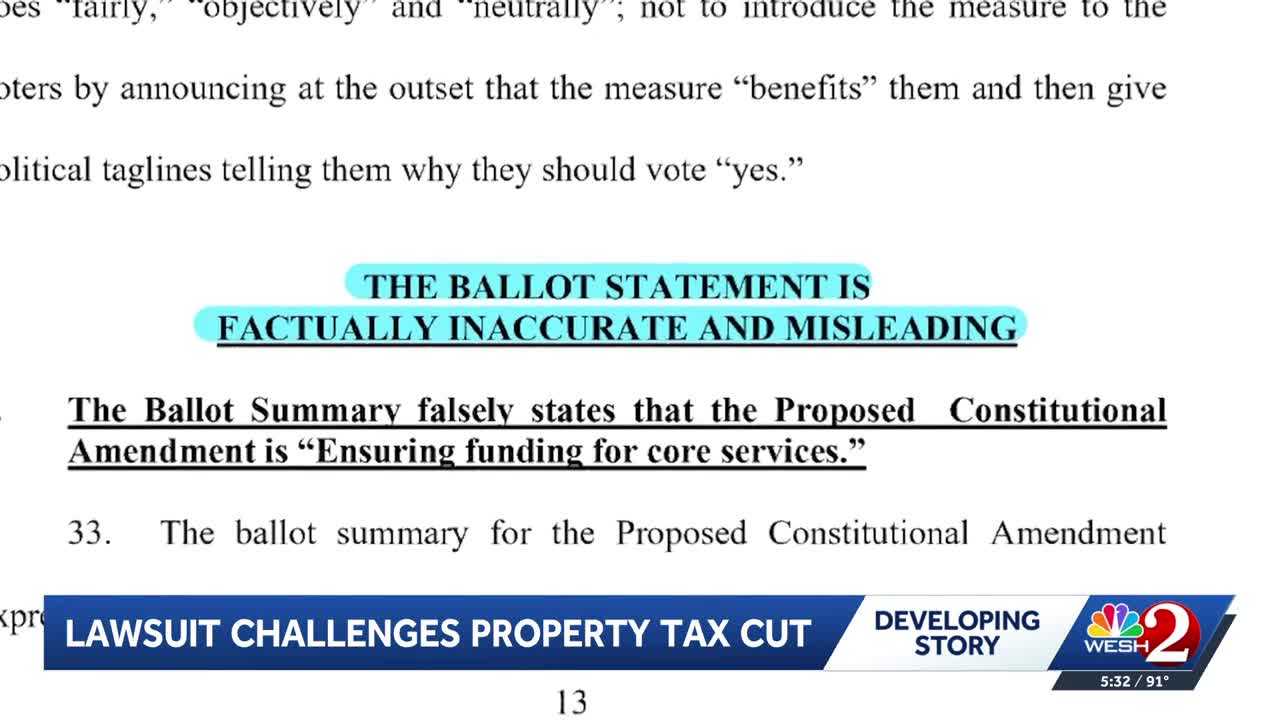
Two former Florida mayors are challenging the wording of a property-tax reduction amendment, arguing it does not fairly explain the effects on local services. The lawsuit asks a judge to order a rewrite before voters decide on the measure.
The amendment would increase Florida’s homestead exemption from $50,000 to $150,000 next year and $250,000 in 2028. The lawsuit, filed by attorney Jamie Cole on behalf of former Key Biscayne Mayor Michael Davey and former Stuart Mayor Thomas Campenni, challenges the ballot language for HJR 1-F and asks a Leon County circuit judge to order a rewrite. The plaintiffs say the wording is biased and misleading.
The plaintiffs say the measure would remove nearly $14 billion from city and county budgets over its first two years, while opponents warn of higher local taxes and fees or cuts to services. Davey called the measure a “power grab” and said it would centralize power. Gov. Ron DeSantis said voters deserve a quick court decision and said the state would appeal if it loses.
Community verdict
15 VOTESPeople in this story
SWIPE →Plaintiff challenging the amendment’s ballot language; former Key Biscayne mayor
Florida governor commenting on the timing and possible appeal in the lawsuit
Discussion · 0
Loading comments…