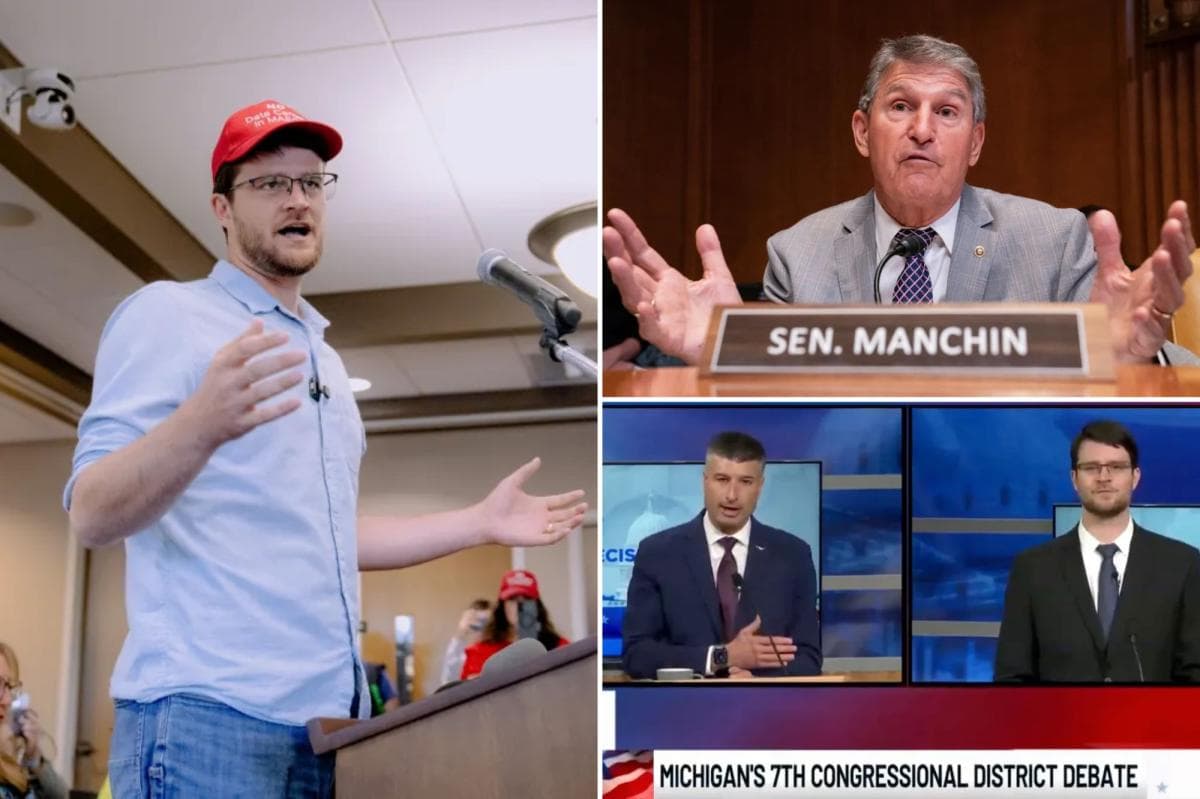
Ex-DSA pol William Lawrence stunned in debate when rival brings up his death wish for Joe Manchin
Barrett challenged Lawrence’s claims about bipartisanship by raising Lawrence’s old lyric about Manchin.
SOURCE CHECK
TAP FOR WHYThe New York Post is an established national publisher with attributed reporting, though its tabloid style and strongly framed political coverage warrant some discount. The article identifies its reporter and points to the debate and archived social-media remarks, but provides limited independent corroboration or response.
- Source type — Established national outlet, discounted for a tabloid style.
- Transparency — The article identifies the debate and reproduces the relevant social-media lyric.
- Author attribution — A reporter is named.
- Editorial standards — The presentation is highly framed and does not include a substantive response from Lawrence’s campaign.
The article provides direct quotations from the debate and the resurfaced post, and says the campaigns and Manchin’s representatives were contacted. It gives little response or context beyond Lawrence’s brief denial, and relies substantially on a partisan research account and loaded descriptions.
HOW WE SCORE ↗The article includes Lawrence’s denial and his debate remarks, but most of its account emphasizes Barrett’s accusation and the negative context surrounding Lawrence. It reports no substantive campaign response to the article’s request for comment.
- Counterarguments presented — Lawrence’s brief denial is included, but no fuller response is reported.
- Loaded language — Repeatedly uses charged descriptions of Lawrence and his political views.
- Source diversity — The account relies mainly on debate remarks, the old post, and an RNC Research post.
- Omitted context — Provides limited context or explanation from Lawrence about the lyric.
The article frames Lawrence’s remarks in sharply negative terms and foregrounds Barrett’s criticism, while using labels such as “far-left” and “lefty.” It includes Lawrence’s denial but little elaboration from his side.
- Language tone — Uses dismissive labels including “lefty” and “far-left.”
- Framing — Centers the controversy around Lawrence’s past lyric and Barrett’s challenge.
- Source selection — Quotes Barrett and a Republican research account, with limited response from Lawrence.
- Headline — The headline presents Lawrence as stunned and spotlights his “death wish” for Manchin.
At a debate for Michigan’s 7th Congressional District, Rep. Tom Barrett challenged candidate William Lawrence over Lawrence’s resurfaced 2021 song lyric wishing Joe Manchin would die. Lawrence denied ever calling for a political opponent’s death; the article says he did not address the old post in his closing pitch.
During the debate, Lawrence spoke about bipartisanship and opposition to endless wars. Barrett then questioned his sincerity, citing a 2021 social-media post that included the lyric, “Hurry up and die so that we can get started.” Lawrence replied, “I have never in my life called for the death of a political opponent.” The article says he did not address the post in his closing pitch.
The article describes Lawrence as a former Democratic Socialists of America member and says his old posts had recently drawn attention. It also notes that he and Barrett are competing in a toss-up-rated House race.
Community verdict
10 VOTES
- Readers of left-leaning coverage: not enough votes yet
- Readers of right-leaning coverage: 56% good look
People in this story
SWIPE →Republican incumbent representative and Lawrence’s debate opponent

Democratic candidate for Michigan’s 7th Congressional District
Lawrence's version of this story ↗
President discussed in connection with Iran and tariffs
Former president whose Build Back Better agenda is mentioned

Former U.S. senator from West Virginia and subject of Lawrence’s song
Discussion · 0
Loading comments…