Whatley pledges support for congressional term limits
Whatley pledged to support a constitutional amendment limiting congressional service if elected to the Senate.
SOURCE CHECK
TAP FOR WHYCarolina Journal is an established state-focused political outlet, and this report identifies its author and attributes claims to named sources and polling. Its source type is recorded as unknown, so the assessment is cautious about its institutional standards and corrections practices.
- Source type — The publisher is recorded as unknown, limiting confidence in the institutional prior.
- Author attribution — A named reporter is credited.
- Transparency — The article identifies the pollster, sample size, dates and margin of error.
- Editorial standards — The article attributes advocacy-group claims and campaign positions, but the text does not establish correction practices.
The report gives specific pledge terms, constitutional procedures and polling details, and attributes the claims it cites. It notes that Cooper's campaign did not respond, though the term-limits discussion relies partly on the advocacy group behind the pledge and offers limited counterargument.
HOW WE SCORE ↗The report includes polling evidence, explains the amendment process and notes Cooper's lack of a public position and campaign response. It gives limited space to arguments against term limits and relies on a supporter of the pledge for evaluative comment.
- Counterarguments presented — The article does not present a substantive case against congressional term limits.
- Source diversity — It combines survey data, an advocacy-group representative and campaign information, but includes no opposing policy advocate.
- Opinion vs reporting — The article is written as reporting and attributes evaluative remarks to their speaker.
- Omitted context — The text explains the constitutional process but gives little context about objections to term limits.
The article uses mostly neutral reporting language, attributes praise and survey findings, and includes both candidates' positions and polling context. Its favorable evidence for term limits is presented through attributed sources rather than an explicit endorsement.
- Language tone — The prose is largely matter-of-fact and avoids overtly partisan language.
- Source selection — The report uses an advocacy-group representative, survey data and campaign-related information.
- Framing — It centers Whatley's pledge while also describing Cooper's position on a related reform issue.
- Headline — The headline accurately describes Whatley's pledge without using loaded language.
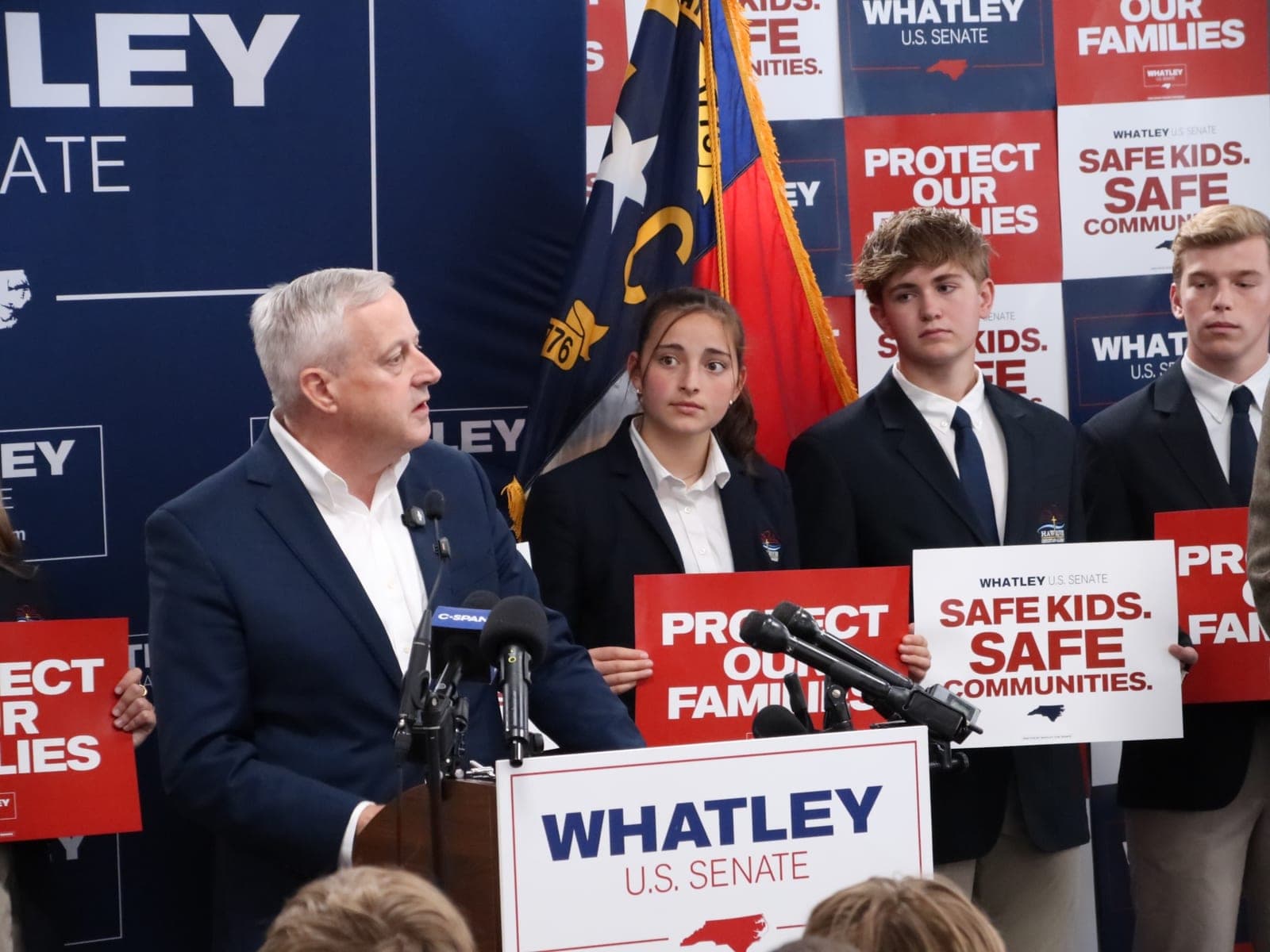
North Carolina Senate candidate Michael Whatley signed a pledge to support a constitutional amendment limiting congressional terms if elected. The article also reports broad public support for term limits and compares the candidates’ positions and polling.
Michael Whatley signed the US Term Limits pledge, committing to cosponsor and vote for a constitutional amendment that would limit House members to three two-year terms and senators to two six-year terms. US Term Limits says it offers the pledge to announced federal candidates and does not endorse candidates. A 2023 Pew Research Center survey found 87% of US adults favored congressional term limits, with majorities of both Republicans and Democrats in support. Amending the Constitution would require two-thirds votes in both chambers and ratification by three-fourths of the states.
The article says Roy Cooper has supported restrictions on congressional stock trading but has not publicly stated whether he supports term limits, and his campaign did not respond to requests for comment. A Carolina Journal poll of likely North Carolina voters conducted Sept. 13-15 found Cooper at 49.2% and Whatley at 34.1%, with 12.3% undecided.
Community verdict
8 VOTES
People in this story
SWIPE →Republican Senate candidate who signed a congressional term-limits pledge

Democratic Senate candidate and Whatley's opponent
Libertarian Senate candidate who also signed the term-limits pledge
Discussion · 0
Loading comments…