6 stories credited to The Verge
Latest story Apr 19, 2026 · on ChamberLight since Apr 2026
A story can appear as several articles (copies of the same piece), so counts of stories and of articles differ.
Scores for The Verge
Writing quality not enough rated stories yet: 2 of 10. How it is measured
Scores last checked Sep 25, 2026.
Stories ChamberLight collected, by month
Stories credited to The Verge, by publication date. ChamberLight collects articles that mention the officials it tracks, so this shows its own coverage of this source, not how much the source publishes.
- Stories from The Verge
- Shaded: ChamberLight collected no stories, or almost none, from any outlet (a gap in its collection, not in the outlet’s publishing)
Show as a table
| Month | Stories | All outlets |
|---|---|---|
| January 2026 | 1 | 25 (collection gap) |
| February 2026 | 1 | 180 |
| March 2026 | 1 | 1,094 |
| April 2026 | 3 | 4,538 |
| May 2026 | 0 | none collected |
| June 2026 | 0 | none collected |
| July 2026 | 0 | none collected |
| August 2026 | 0 | 1 (collection gap) |
| September 2026 | 0 | 1,320 |
Top topics
Share of this source’s stories tagged with each topic. A story can carry several topics, so the shares do not add up to 100%.
- Technology/Privacy5
83% of 6 stories · 10% across all outlets
- Budget/Spending3
50% of 6 stories · 31% across all outlets
- Ethics/Corruption3
50% of 6 stories · 58% across all outlets
- Criminal Justice2
33% of 6 stories · 19% across all outlets
- Economy2
33% of 6 stories · 26% across all outlets
- Foreign Policy1
17% of 6 stories · 29% across all outlets
- Infrastructure1
17% of 6 stories · 8% across all outlets
- Taxes1
17% of 6 stories · 5% across all outlets
The thin mark on each bar is the topic’s share across all outlets.
Who they cover
Party of the officials these stories are mainly about, across all 17 officials named. A story counts once for each official it is mainly about, so the split is over 18 story–official pairs, from 6 stories.
- Democrat50% · 9 pairs
- Republican44% · 8 pairs
- Party not recorded6% · 1 pair
Most covered
Stories mainly about each official, and their share of the source’s 6 stories.
- 1Donald TrumpR2 stories · 33%
- 2Amy KlobucharD1 story · 17%
- 3Brian SchatzD1 story · 17%
- 4Charles SchumerD1 story · 17%
- 5Christopher CoonsD1 story · 17%
- 6Elizabeth WarrenD1 story · 17%
- 7James A Himes–1 story · 17%
- 8James LankfordR1 story · 17%
- 9Jamie RaskinD1 story · 17%
- 10Katie BrittR1 story · 17%
+ 7 other officials (7 story–official pairs)
Article tone
ChamberLight’s article analysis assigns each story a tone toward the official it covers. It describes the coverage of that official, not The Verge’s stance, and reader votes do not change it. 6 stories.
- Good Look
- 0 (0%)
- Mixed
- 5 (83%)
- Informational
- 1 (17%)
- Bad Look
- 0 (0%)
Challenges to these scores
No one has challenged a score on this page yet. Anyone can; editors publish every outcome here.
Articles served from theverge.com
18
The future of local TV news has taken a Trumpian turn
This is The Stepback, a weekly newsletter breaking down one essential story from the tech world. For more stories on Big Tech versus politics in Washington, DC, follow Tina Nguyen and read Regulator. The Stepback arrives in our subscribers’ inboxes at 8AM ET. Opt in for The Stepback here. How it started A long time ago, in 2004, the Federal Communications Commission laid down a rule designed to prevent a monopoly: No one company could broadcast to more than 39 percent of all the TV households in the United States. But then Donald Trump returned to the White House in 2025. Brendan Carr became FCC chairman and immediately kicked off a deregulatory initiative called “Delete, Delete, Delete,” in which Carr vowed to get rid of “every rule, regulation, or guidance document” that placed “unnecessary regulatory burdens” on companies. And within months, Nexstar, which already owned over 200 stations nationwide and had hit its ownership cap, announced that it had entered an agreement to purchase its rival, Tegna, for an estimated $6.2 billion — something that could only happen, however, if Carr agreed to change the FCC’s rules. If you ask Nexstar why it’s pursuing a merger that would give it control of over 80 percent of the market, it’d point to Big Tech as the culprit. As advertisers take their money to Netflix, YouTube, and other digital streamers, linear television — the local television news, the broadcast affiliates, the basic cable networks — has suffered, forcing them to consolidate and shut down newsrooms. In that sense, Nexstar argued, the merger would help it compete for ad revenue with the streaming services, thereby building more robust local journalism. However, the merger’s opponents believe that this is a basic violation of antitrust laws and principles — not to mention the danger of letting one company have editorial control over the vast majority of America’s local television newsrooms. But the second Trump administration handles regulatory hurdles a little differently than others, and companies have found that it’s faster to get what they want if they bypass the agencies and talk (read: suck up) to Trump directly. And when Nexstar did so publicly, it confirmed its opponents’ fears about political influence. Last September, in the fraught weeks after the fatal shooting of Charlie Kirk, Nexstar announced it would no longer broadcast Jimmy Kimmel Live! — a response to Carr’s claim that the FCC could revoke the broadcast licenses of TV stations that aired the comedian’s comments related to Kirk. It briefly led to ABC suspending Kimmel’s show, though ABC and Nexstar soon reversed their decision after a massive nationwide backlash and an ABC boycott. However, Nexstar’s loyalty to Trump himself was not enough to win over his most powerful MAGA supporters. Newsmax, a cable news network with a deeply pro-Trump bent, and its CEO, longtime Trump donor and outside adviser Chris Ruddy, filed a lawsuit objecting to the merger, claiming that Nexstar’s anticompetitive behavior would force channels like his off the air with steeper carriage fees. He specifically accused Nexstar of jacking up the fees for stations to carry Newsmax, while offering its similar network, NewsNation, for much cheaper. The Nexstar-Tegna MAGA makeover then took a more subtle turn. NewsNation hired the pro-Trump Fox News commentator Katie Pavlich and gave her her own primetime show. (The network had already hired a slew of former Fox journalists as well.) Around this time, a political group called Keep News Local began airing ads in DC that seemed to directly address Trump, praising him for having “defeated the fake news monopolies before through independent voices and local news” and claiming that the Nexstar-Tegna merger was “crucial for MAGA to survive.” (A little self-contradictory and mildly illogical, but it’s the kind of stuff that Trump likes to hear.) When I last spoke to Ruddy in February, I asked if he’d worried that the dark money going into Keep News Local would sway Trump, and he chose his words carefully: “I think at the end of the day, Trump makes up his own mind. I’m not sure he’s going to be influenced by an ad campaign.” For months, no one could accurately predict if Trump would override Carr’s wishes and bless the deal, as he’s often done for other companies facing regulatory scrutiny. Trump’s Truth Social posts about the merger have been a good indicator of how precarious the merger has been and who’s been able to influence him at any given moment: Last November, he blasted the deal as an “EXPANSION OF THE FAKE NEWS NETWORKS,” but by February, he posted that the deal would “help knock out the Fake News because there will be more competition.” Several current and former NewsNation employees told Status at the time that they feared that the parent company was steering NewsNation away from the centrist, “unbiased” reputation they’d long cultivated. “A lot of people within the network believe that the network has gone hard right to appeal to Trump and Brendan Carr,” one former employee told Status. Coincidentally, days before the deal was finalized, NewsNation began ramping up its explicitly pro-Trump content, tweeting a clip of CNN’s Kaitlan Collins being berated by White House press secretary Karoline Leavitt, along with the comment “Just going to leave this here.” How it’s going When Trump greenlit the merger in mid-March, but before the FCC’s three commissioners could vote on whether to waive the ownership cap, Nexstar and Tegna immediately announced a new complication: Tegna and Nexstar had already started merging. Tegna was no more and CEO Mike Steib had already sold $22.6 million of his company stock. In response, eight state attorneys general and satellite TV operator DirectTV, which had already been planning to file separate federal antitrust suits against the merger, asked US District Judge Troy Nunley in Sacramento for an emergency restraining order that would prevent Nexstar from taking over Tegna’s assets. The order was granted on March 27th and on April 17, Nunley issued a formal injunction, ruling that Tegna must be operated as an independent financial entity, and Nexstar must take steps to ensure it remains separate from Tegna before further legal proceedings. What happens next For now, Nunley has allowed the states and DirecTV to combine their cases, in which both argue that the merger was a clear violation of antitrust laws and would crush news competition. Meanwhile, Republicans and Democrats in Congress are furious at Carr. On March 30th, Sens. Ted Cruz (R-TX) and Maria Cantwell (D-WA) sent the chairman a joint letter admonishing him for allowing his staff to waive the regulations to let the merger pass, instead of having the full commission of political appointees — one from the Biden administration — vote on it. “Under these circumstances,” they wrote, “any subsequent vote risks being largely procedural rather than a genuine exercise of commission responsibility.” They also pointed out that their hasty approval without the commission’s approval would now complicate the merger financially: “In a transaction of this scale, where integration proceeds quickly and unwinding becomes impractical, delay in judicial review can insulate the decision from meaningful challenge.” Notably, though they share similar ideological views on the media and deregulation, Cruz and Carr have frequently clashed over how to achieve their objectives. Cruz previously slammed Carr as a “mafioso,” for instance, for the way he’d used the FCC to silence Kimmel. But even if it’s legally paused, the journalistic merger’s fallout has started to hit local news. NPR’s David Folkenfirk reported on Tuesday that Tegna journalists had already started receiving orders to stop broadcasting content from major broadcasters like ABC, CBS, and NBC — media outlets being targeted by Carr — and instead begin airing content from Nexstar’s NewsNation. By the way Brendan Carr’s views on using the FCC to punish major broadcasters was outlined pretty extensively in the chapter he authored in Project 2025, an initiative led by the conservative Heritage Foundation on how to reform the federal bureaucracy to be more favorable to the American right. Exactly how much is local television losing to digital? According to industry publication NewscastStudio, in an investor call defending the purchase, Nexstar chairman Perry Sook cited a market research study from Borrell Associates, which found that “digital advertising in local markets exceeds $100 billion, compared to just $25 billion for local linear television advertising, with nearly two-thirds of digital ad dollars flowing to five major technology companies.” If you want to see exactly how much Keep Local News was trying to suck up to Trump, the ads are archived here. Read this The Vergecast has a long-running segment called “Brendan Carr is a dummy.” The LA Times reported on last week’s preliminary hearings in front of Nunley, and how lawyers for Nexstar, the states, and DirecTV plan to argue their case. The Desk has insights from Kirk Varner, a former TV newsroom director, on how the case could go. Andrew Liptak covered Nexstar’s previous acquisition sprees for The Verge in 2018. Adi Robertson walks through exactly how the Kimmel suspension was an attack on free speech. Brendan Carr keeps trying to convince people that he’s not threatening to suspend broadcast licenses for reporting on unfavorable things like the Iran war, reports Lauren Feiner. The Vergecast has a long-running segment called “Brendan Carr is a dummy.”
The future of local TV news has taken a Trumpian turn
This is The Stepback, a weekly newsletter breaking down one essential story from the tech world. For more stories on Big Tech versus politics in Washington, DC, follow Tina Nguyen and read Regulator. The Stepback arrives in our subscribers’ inboxes at 8AM ET. Opt in for The Stepback here. How it started A long time ago, in 2004, the Federal Communications Commission laid down a rule designed to prevent a monopoly: No one company could broadcast to more than 39 percent of all the TV households in the United States. But then Donald Trump returned to the White House in 2025. Brendan Carr became FCC chairman and immediately kicked off a deregulatory initiative called “Delete, Delete, Delete,” in which Carr vowed to get rid of “every rule, regulation, or guidance document” that placed “unnecessary regulatory burdens” on companies. And within months, Nexstar, which already owned over 200 stations nationwide and had hit its ownership cap, announced that it had entered an agreement to purchase its rival, Tegna, for an estimated $6.2 billion — something that could only happen, however, if Carr agreed to change the FCC’s rules. If you ask Nexstar why it’s pursuing a merger that would give it control of over 80 percent of the market, it’d point to Big Tech as the culprit. As advertisers take their money to Netflix, YouTube, and other digital streamers, linear television — the local television news, the broadcast affiliates, the basic cable networks — has suffered, forcing them to consolidate and shut down newsrooms. In that sense, Nexstar argued, the merger would help it compete for ad revenue with the streaming services, thereby building more robust local journalism. However, the merger’s opponents believe that this is a basic violation of antitrust laws and principles — not to mention the danger of letting one company have editorial control over the vast majority of America’s local television newsrooms. But the second Trump administration handles regulatory hurdles a little differently than others, and companies have found that it’s faster to get what they want if they bypass the agencies and talk (read: suck up) to Trump directly. And when Nexstar did so publicly, it confirmed its opponents’ fears about political influence. Last September, in the fraught weeks after the fatal shooting of Charlie Kirk, Nexstar announced it would no longer broadcast Jimmy Kimmel Live! — a response to Carr’s claim that the FCC could revoke the broadcast licenses of TV stations that aired the comedian’s comments related to Kirk. It briefly led to ABC suspending Kimmel’s show, though ABC and Nexstar soon reversed their decision after a massive nationwide backlash and an ABC boycott. However, Nexstar’s loyalty to Trump himself was not enough to win over his most powerful MAGA supporters. Newsmax, a cable news network with a deeply pro-Trump bent, and its CEO, longtime Trump donor and outside adviser Chris Ruddy, filed a lawsuit objecting to the merger, claiming that Nexstar’s anticompetitive behavior would force channels like his off the air with steeper carriage fees. He specifically accused Nexstar of jacking up the fees for stations to carry Newsmax, while offering its similar network, NewsNation, for much cheaper. The Nexstar-Tegna MAGA makeover then took a more subtle turn. NewsNation hired the pro-Trump Fox News commentator Katie Pavlich and gave her her own primetime show. (The network had already hired a slew of former Fox journalists as well.) Around this time, a political group called Keep News Local began airing ads in DC that seemed to directly address Trump, praising him for having “defeated the fake news monopolies before through independent voices and local news” and claiming that the Nexstar-Tegna merger was “crucial for MAGA to survive.” (A little self-contradictory and mildly illogical, but it’s the kind of stuff that Trump likes to hear.) When I last spoke to Ruddy in February, I asked if he’d worried that the dark money going into Keep News Local would sway Trump, and he chose his words carefully: “I think at the end of the day, Trump makes up his own mind. I’m not sure he’s going to be influenced by an ad campaign.” For months, no one could accurately predict if Trump would override Carr’s wishes and bless the deal, as he’s often done for other companies facing regulatory scrutiny. Trump’s Truth Social posts about the merger have been a good indicator of how precarious the merger has been and who’s been able to influence him at any given moment: Last November, he blasted the deal as an “EXPANSION OF THE FAKE NEWS NETWORKS,” but by February, he posted that the deal would “help knock out the Fake News because there will be more competition.” Several current and former NewsNation employees told Status at the time that they feared that the parent company was steering NewsNation away from the centrist, “unbiased” reputation they’d long cultivated. “A lot of people within the network believe that the network has gone hard right to appeal to Trump and Brendan Carr,” one former employee told Status. Coincidentally, days before the deal was finalized, NewsNation began ramping up its explicitly pro-Trump content, tweeting a clip of CNN’s Kaitlan Collins being berated by White House press secretary Karoline Leavitt, along with the comment “Just going to leave this here.” How it’s going When Trump greenlit the merger in mid-March, but before the FCC’s three commissioners could vote on whether to waive the ownership cap, Nexstar and Tegna immediately announced a new complication: Tegna and Nexstar had already started merging. Tegna was no more and CEO Mike Steib had already sold $22.6 million of his company stock. In response, eight state attorneys general and satellite TV operator DirectTV, which had already been planning to file separate federal antitrust suits against the merger, asked US District Judge Troy Nunley in Sacramento for an emergency restraining order that would prevent Nexstar from taking over Tegna’s assets. The order was granted on March 27th and on April 17, Nunley issued a formal injunction, ruling that Tegna must be operated as an independent financial entity, and Nexstar must take steps to ensure it remains separate from Tegna before further legal proceedings. What happens next For now, Nunley has allowed the states and DirecTV to combine their cases, in which both argue that the merger was a clear violation of antitrust laws and would crush news competition. Meanwhile, Republicans and Democrats in Congress are furious at Carr. On March 30th, Sens. Ted Cruz (R-TX) and Maria Cantwell (D-WA) sent the chairman a joint letter admonishing him for allowing his staff to waive the regulations to let the merger pass, instead of having the full commission of political appointees — one from the Biden administration — vote on it. “Under these circumstances,” they wrote, “any subsequent vote risks being largely procedural rather than a genuine exercise of commission responsibility.” They also pointed out that their hasty approval without the commission’s approval would now complicate the merger financially: “In a transaction of this scale, where integration proceeds quickly and unwinding becomes impractical, delay in judicial review can insulate the decision from meaningful challenge.” Notably, though they share similar ideological views on the media and deregulation, Cruz and Carr have frequently clashed over how to achieve their objectives. Cruz previously slammed Carr as a “mafioso,” for instance, for the way he’d used the FCC to silence Kimmel. But even if it’s legally paused, the journalistic merger’s fallout has started to hit local news. NPR’s David Folkenfirk reported on Tuesday that Tegna journalists had already started receiving orders to stop broadcasting content from major broadcasters like ABC, CBS, and NBC — media outlets being targeted by Carr — and instead begin airing content from Nexstar’s NewsNation. By the way Brendan Carr’s views on using the FCC to punish major broadcasters was outlined pretty extensively in the chapter he authored in Project 2025, an initiative led by the conservative Heritage Foundation on how to reform the federal bureaucracy to be more favorable to the American right. Exactly how much is local television losing to digital? According to industry publication NewscastStudio, in an investor call defending the purchase, Nexstar chairman Perry Sook cited a market research study from Borrell Associates, which found that “digital advertising in local markets exceeds $100 billion, compared to just $25 billion for local linear television advertising, with nearly two-thirds of digital ad dollars flowing to five major technology companies.” If you want to see exactly how much Keep Local News was trying to suck up to Trump, the ads are archived here. Read this The Vergecast has a long-running segment called “Brendan Carr is a dummy.” The LA Times reported on last week’s preliminary hearings in front of Nunley, and how lawyers for Nexstar, the states, and DirecTV plan to argue their case. The Desk has insights from Kirk Varner, a former TV newsroom director, on how the case could go. Andrew Liptak covered Nexstar’s previous acquisition sprees for The Verge in 2018. Adi Robertson walks through exactly how the Kimmel suspension was an attack on free speech. Brendan Carr keeps trying to convince people that he’s not threatening to suspend broadcast licenses for reporting on unfavorable things like the Iran war, reports Lauren Feiner. The Vergecast has a long-running segment called “Brendan Carr is a dummy.”
The future of local TV news has taken a Trumpian turn
This is The Stepback, a weekly newsletter breaking down one essential story from the tech world. For more stories on Big Tech versus politics in Washington, DC, follow Tina Nguyen and read Regulator. The Stepback arrives in our subscribers’ inboxes at 8AM ET. Opt in for The Stepback here. How it started A long time ago, in 2004, the Federal Communications Commission laid down a rule designed to prevent a monopoly: No one company could broadcast to more than 39 percent of all the TV households in the United States. But then Donald Trump returned to the White House in 2025. Brendan Carr became FCC chairman and immediately kicked off a deregulatory initiative called “Delete, Delete, Delete,” in which Carr vowed to get rid of “every rule, regulation, or guidance document” that placed “unnecessary regulatory burdens” on companies. And within months, Nexstar, which already owned over 200 stations nationwide and had hit its ownership cap, announced that it had entered an agreement to purchase its rival, Tegna, for an estimated $6.2 billion — something that could only happen, however, if Carr agreed to change the FCC’s rules. If you ask Nexstar why it’s pursuing a merger that would give it control of over 80 percent of the market, it’d point to Big Tech as the culprit. As advertisers take their money to Netflix, YouTube, and other digital streamers, linear television — the local television news, the broadcast affiliates, the basic cable networks — has suffered, forcing them to consolidate and shut down newsrooms. In that sense, Nexstar argued, the merger would help it compete for ad revenue with the streaming services, thereby building more robust local journalism. However, the merger’s opponents believe that this is a basic violation of antitrust laws and principles — not to mention the danger of letting one company have editorial control over the vast majority of America’s local television newsrooms. But the second Trump administration handles regulatory hurdles a little differently than others, and companies have found that it’s faster to get what they want if they bypass the agencies and talk (read: suck up) to Trump directly. And when Nexstar did so publicly, it confirmed its opponents’ fears about political influence. Last September, in the fraught weeks after the fatal shooting of Charlie Kirk, Nexstar announced it would no longer broadcast Jimmy Kimmel Live! — a response to Carr’s claim that the FCC could revoke the broadcast licenses of TV stations that aired the comedian’s comments related to Kirk. It briefly led to ABC suspending Kimmel’s show, though ABC and Nexstar soon reversed their decision after a massive nationwide backlash and an ABC boycott. However, Nexstar’s loyalty to Trump himself was not enough to win over his most powerful MAGA supporters. Newsmax, a cable news network with a deeply pro-Trump bent, and its CEO, longtime Trump donor and outside adviser Chris Ruddy, filed a lawsuit objecting to the merger, claiming that Nexstar’s anticompetitive behavior would force channels like his off the air with steeper carriage fees. He specifically accused Nexstar of jacking up the fees for stations to carry Newsmax, while offering its similar network, NewsNation, for much cheaper. The Nexstar-Tegna MAGA makeover then took a more subtle turn. NewsNation hired the pro-Trump Fox News commentator Katie Pavlich and gave her her own primetime show. (The network had already hired a slew of former Fox journalists as well.) Around this time, a political group called Keep News Local began airing ads in DC that seemed to directly address Trump, praising him for having “defeated the fake news monopolies before through independent voices and local news” and claiming that the Nexstar-Tegna merger was “crucial for MAGA to survive.” (A little self-contradictory and mildly illogical, but it’s the kind of stuff that Trump likes to hear.) When I last spoke to Ruddy in February, I asked if he’d worried that the dark money going into Keep News Local would sway Trump, and he chose his words carefully: “I think at the end of the day, Trump makes up his own mind. I’m not sure he’s going to be influenced by an ad campaign.” For months, no one could accurately predict if Trump would override Carr’s wishes and bless the deal, as he’s often done for other companies facing regulatory scrutiny. Trump’s Truth Social posts about the merger have been a good indicator of how precarious the merger has been and who’s been able to influence him at any given moment: Last November, he blasted the deal as an “EXPANSION OF THE FAKE NEWS NETWORKS,” but by February, he posted that the deal would “help knock out the Fake News because there will be more competition.” Several current and former NewsNation employees told Status at the time that they feared that the parent company was steering NewsNation away from the centrist, “unbiased” reputation they’d long cultivated. “A lot of people within the network believe that the network has gone hard right to appeal to Trump and Brendan Carr,” one former employee told Status. Coincidentally, days before the deal was finalized, NewsNation began ramping up its explicitly pro-Trump content, tweeting a clip of CNN’s Kaitlan Collins being berated by White House press secretary Karoline Leavitt, along with the comment “Just going to leave this here.” How it’s going When Trump greenlit the merger in mid-March, but before the FCC’s three commissioners could vote on whether to waive the ownership cap, Nexstar and Tegna immediately announced a new complication: Tegna and Nexstar had already started merging. Tegna was no more and CEO Mike Steib had already sold $22.6 million of his company stock. In response, eight state attorneys general and satellite TV operator DirectTV, which had already been planning to file separate federal antitrust suits against the merger, asked US District Judge Troy Nunley in Sacramento for an emergency restraining order that would prevent Nexstar from taking over Tegna’s assets. The order was granted on March 27th and on April 17, Nunley issued a formal injunction, ruling that Tegna must be operated as an independent financial entity, and Nexstar must take steps to ensure it remains separate from Tegna before further legal proceedings. What happens next For now, Nunley has allowed the states and DirecTV to combine their cases, in which both argue that the merger was a clear violation of antitrust laws and would crush news competition. Meanwhile, Republicans and Democrats in Congress are furious at Carr. On March 30th, Sens. Ted Cruz (R-TX) and Maria Cantwell (D-WA) sent the chairman a joint letter admonishing him for allowing his staff to waive the regulations to let the merger pass, instead of having the full commission of political appointees — one from the Biden administration — vote on it. “Under these circumstances,” they wrote, “any subsequent vote risks being largely procedural rather than a genuine exercise of commission responsibility.” They also pointed out that their hasty approval without the commission’s approval would now complicate the merger financially: “In a transaction of this scale, where integration proceeds quickly and unwinding becomes impractical, delay in judicial review can insulate the decision from meaningful challenge.” Notably, though they share similar ideological views on the media and deregulation, Cruz and Carr have frequently clashed over how to achieve their objectives. Cruz previously slammed Carr as a “mafioso,” for instance, for the way he’d used the FCC to silence Kimmel. But even if it’s legally paused, the journalistic merger’s fallout has started to hit local news. NPR’s David Folkenfirk reported on Tuesday that Tegna journalists had already started receiving orders to stop broadcasting content from major broadcasters like ABC, CBS, and NBC — media outlets being targeted by Carr — and instead begin airing content from Nexstar’s NewsNation. By the way Brendan Carr’s views on using the FCC to punish major broadcasters was outlined pretty extensively in the chapter he authored in Project 2025, an initiative led by the conservative Heritage Foundation on how to reform the federal bureaucracy to be more favorable to the American right. Exactly how much is local television losing to digital? According to industry publication NewscastStudio, in an investor call defending the purchase, Nexstar chairman Perry Sook cited a market research study from Borrell Associates, which found that “digital advertising in local markets exceeds $100 billion, compared to just $25 billion for local linear television advertising, with nearly two-thirds of digital ad dollars flowing to five major technology companies.” If you want to see exactly how much Keep Local News was trying to suck up to Trump, the ads are archived here. Read this The Vergecast has a long-running segment called “Brendan Carr is a dummy.” The LA Times reported on last week’s preliminary hearings in front of Nunley, and how lawyers for Nexstar, the states, and DirecTV plan to argue their case. The Desk has insights from Kirk Varner, a former TV newsroom director, on how the case could go. Andrew Liptak covered Nexstar’s previous acquisition sprees for The Verge in 2018. Adi Robertson walks through exactly how the Kimmel suspension was an attack on free speech. Brendan Carr keeps trying to convince people that he’s not threatening to suspend broadcast licenses for reporting on unfavorable things like the Iran war, reports Lauren Feiner. The Vergecast has a long-running segment called “Brendan Carr is a dummy.”

The Senate is voting to save free IRS Direct File today
The Senate is getting ready to vote on a bill to resurrect IRS Direct File, the free tax filing service axed by the Trump administration in 2025. On Wednesday, Sen. Elizabeth Warren (D-MA) will seek unanimous consent to pass the Direct File Act, where it will either get fast-tracked to the House of Representatives or forced back into the standard, slow-moving lawmaking process if all 100 senators don’t agree. Launched in 2024 as a pilot program, IRS Direct File allowed Americans to file taxes directly with the government for free. It spread to 25 states before IRS Commissioner Billy Long declared it “gone” last fall. But Warren and Rep. Brad Sherman (D-CA) aim to bring the service back with a bill introduced in February that’s backed by more than 160 Democratic lawmakers. Under the IRS Direct File Act, Americans would be able to file their taxes directly to the IRS for free. It would also ensure that the IRS doesn’t enter into agreements that “restrict its ability” to offer free tax preparation or filing services. In prepared remarks before Congress later today, Warren will call out the $1 million donation to President Donald Trump’s inauguration from TurboTax parent company Intuit and its persistent lobbying to prevent the government from launching services like IRS Direct File. “To Republicans who say that making filing your taxes for free with the IRS is too expensive: for just one day of bombing Iran, we could pay for 20 years of Direct File,” Warren’s remarks say. “And to Republicans defending the status quo, ask yourselves why you’re on the side of TurboTax and H&R Block instead of your constituents.”

Congress can finally close a mass surveillance loophole — but will they?
A warrantless wiretapping authority that has facilitated surveillance for decades is up for renewal in Congress. Section 702 of the Foreign Intelligence Surveillance Act (FISA), last reauthorized in 2024, is set to expire on April 20th. A bipartisan coalition of progressive Democrats and members of the hard-right Freedom Caucus say it’s long overdue for reform. But they’re up against powerful figures in both parties who want to deliver a “clean” reauthorization, even as critics warn the rule is allowing President Donald Trump’s administration to spy on anyone — even Americans. Section 702, first enacted in 2008, formally allows for the surveillance of foreign “targets.” It lets federal intelligence agencies like the FBI, NSA, CIA, and the National Counterterrorism Center access the communications of any “non-US persons” not in the US, meaning noncitizens residing outside the country. If the government wants an American’s communications, however, all it has to do is determine they’re talking to a non-US person. Critics call this the “backdoor search loophole.” Section 702’s last reauthorization was a contentious, drawn-out process that involved several failed votes. The authority was renewed just after midnight on April 20th of that year, meaning that it technically lapsed, though just for a few minutes. This time around, House Speaker Mike Johnson (R-LA) has chosen to delay the vote in what critics say is an attempt to suppress the bipartisan effort to reform FISA. Section 702 has been contentious since whistleblower Edward Snowden revealed details about its use in 2013, but progressives are especially wary in light of the Trump administration’s well-documented abuses of US spying capabilities. Between 2018 and 2020, the FBI used Section 702 to run searches on a member of Congress, campaign donors, more than 130 Black Lives Matter protesters, and “multiple current and former United States Government officials, journalists, and political commentators,” according to declassified documents. Privacy advocates are concerned that the Trump administration will continue to use Section 702’s authority to spy on American citizens. Two people familiar with the White House’s ongoing conversations over FISA reauthorization told Politico that Stephen Miller, the influential White House adviser and architect of the Trump administration’s immigration crackdown, sees Section 702 as critical to homeland security efforts. Trump has also claimed FISA is essential for the ongoing war in Iran. FISA “is extremely important to our Military,” Trump said on Truth Social on March 25th. “I have spoken to many Generals about this, and they consider it vital. Not one said, even tacitly, that they can do without it — especially right now with our brilliant Military Operation in Iran.” The White House has reportedly called in members of the Freedom Caucus, as well as other skeptical Republicans, for briefings on the bill. But libertarian-leaning Republicans, especially those in the Freedom Caucus, have concerns about Fourth Amendment violations under Section 702. On the FISA front, these Republicans’ loyalty to Trump is outweighed by their commitment to civil liberties. Right now, it doesn’t seem like Johnson, who is pushing for a clean extension, has enough Republican votes to get a FISA reauthorization without Democratic support. Some Democrats have long-standing objections to the surveillance authority, while others are wary of extending Trump and Miller’s access to Americans’ communications. Among the latter is Rep. Jamie Raskin (D-MD), who voted to reauthorize Section 702 in 2024 and now opposes extending the program as is. “The safeguards put in place in 2024 have been badly eroded by the Trump Administration,” Raskin wrote in a letter to his colleagues. “The ‘clean’ extension favored by President Trump and Stephen Miller leaves the Trump Administration in charge of policing its own abuses of this authority — and what could go wrong with that?” With Trump at the helm, some Republicans who opposed the 2024 reauthorization may support a clean extension. But the White House needs Democrats to come on board. “Every path for Speaker Johnson right now depends on Jim Himes delivering Democrats, which means getting Democrats to back, literally, Stephen Miller’s personal surveillance agenda,” Sean Vitka, the executive director of Demand Progress, told The Verge. Himes, a Connecticut Democrat who serves as the ranking member of the House Intelligence Committee, is urging Democrats to support a clean extension. In March, Demand Progress and more than 90 civil rights and progressive organizations sent a letter to Democratic leaders urging them to reform Section 702. In 2024, reformers secured limited changes. That reauthorization implemented several new restrictions on the FBI’s ability to query US persons, and required the agency to provide detailed annual reports to Congress regarding noncompliant queries. But there’s still bipartisan appetite for reform. Reps. Warren Davidson (R-OH) and Zoe Lofgren (D-CA) and Sens. Ron Wyden (D-OR) and Mike Lee (R-UT) introduced the Government Surveillance Reform Act, which includes provisions reining in the federal government’s spying capabilities under Section 702, in March. The bill would require the federal government to obtain a warrant to access any Americans’ communications gathered under Section 702. It would also prohibit the federal government from buying Americans’ data from private brokers without a warrant, and implement warrant requirements for surveilling Americans’ location, web browsing data, search and chatbot records, and car onboard data. “The FISA reform coalition is concerned about Constitutional principles not political parties,” Davidson told The Verge. “Constitutional conservatives and progressive liberals don’t agree on much, but we agree that the government shouldn’t be able to intentionally search Americans’ communications or track their movements for domestic law enforcement purposes without a warrant.” It has strong bipartisan support: Sens. Elizabeth Warren (D-MA) and Cynthia Lummis (R-WY) and Reps. Sara Jacobs (D-CA) and Pramila Jayapal (D-WA) have signed on as cosponsors. And the House nearly passed a warrant requirement during the last reauthorization fight: The amendment failed on a 212-212 vote. “Passing FISA 702 without strong new guardrails, while doing nothing to stop the government from buying Americans’ location data and feeding it into AI systems to conduct unprecedented mass surveillance, would be shocking negligence,” Wyden told The Verge. “Our approach shows the government doesn’t need to violate the rights of Americans to target foreign threats.” Johnson has called the warrant requirement “unworkable” and said that previous reforms implemented in 2024 are sufficient. Privacy advocates disagree. The Brennan Center for Justice has called the 2024 changes “unambitious” and pointed out that even these modest changes were flouted by the FBI. The libertarian Cato Institute has similarly claimed that the 2024 reforms “fall short” because they rely on federal enforcement and aren’t subject to independent oversight. Jake Laperruque, the director of the Security and Surveillance Project at the Center for Democracy & Technology, said the changes added to Section 702 didn’t meaningfully affect oversight, and haven’t stopped backdoor searches of Americans. “All of the oversight systems — both the ones that were enacted in 2024 and the ones that previously existed — are dependent on good faith by the executive and rigorous oversight within the executive,” Laperruque told The Verge. “The entire oversight structure, from the privacy and civil liberties board, to independent inspectors general, to meaningfully independent and rigorous auditing within the FBI have all been completely shut down or made to exist within the prerogative of the White House. If something goes wrong in the future, or if things start to get abused in the future, we don’t have the tools to be made aware of it, let alone to stop it.” Still, some Democrats are pushing for a clean extension. In a March letter to his colleagues, Himes said he understood why Democrats may be wary of granting Trump powerful surveillance capabilities but encouraged them to support a clean renewal anyway. Himes has said letting Section 702 lapse “would put the American people at severe risk,” adding that the authority is used to “thwart terrorist attacks, to stop fentanyl traffickers and to identify foreign spies.” “If I saw any evidence that Trump administration officials were directing the intelligence community to use Section 702 for illegal or improper purposes, such as to persecute, surveil, or harass Americans, I would urge a ‘no’ vote on reauthorization, even though I recognize the program’s unparalleled national security value,” he wrote. “I have not seen evidence of misuse, despite being on the lookout for any hint of it.” Himes has managed to sway some lawmakers. Rep. Gregory Meeks (D-NY), the ranking member of the House Foreign Affairs Committee, told The Hill he supported a clean reauthorization after speaking with Himes. “I know the improvements that have been made,” Meeks said — both Johnson and Himes have touted the “substantive” reforms implemented under the 2024 legislation. “I think it’s in our best interest for national security purposes,” Meeks told The Hill. Meeks declined The Verge’s request for comment. Laperruque said Himes’ assertion that the Trump administration has never misused its surveillance authority under 702 is “demonstrably untrue.” “I think some members are treating the intelligence community as their constituents,” Laperruque said. “The intelligence community wants the ability to exploit this loophole, they want the ability to buy data, they don’t want to go to court when they do queries.” “If something goes wrong in the future, or if things start to get abused in the future, we don’t have the tools to be made aware of it, let alone to stop it.“ Jake Laperruque, director of the Security and Surveillance Project at the Center for Democracy & Technology After being confronted by protesters at a town hall last week, Himes said the National Security Agency (NSA) and other foreign intelligence agencies doesn’t buy Americans’ commercial data. But last year, Wyden released classified documents revealing that the NSA does in fact buy Americans’ internet records. And as Kash Patel admitted in a hearing before the Senate Intelligence Committee, so does the FBI. “It felt as if he was coming out there just so he could come back inside and tell everybody he was out there in the first place,” Evan Lucas, the chair of the Connecticut High School Democrats and co-organizer of the protest outside Himes’ town hall, told The Verge. “He has a tendency to lie, and I’m not sure if it’s because he’s unaware or if he believes this is truly the right thing for his constituents.” Lucas said Himes hosted a follow-up town hall on Zoom. Lucas, a high school senior, said he is especially concerned about the federal government using artificial intelligence to “organize and collect and string together the information of American citizens.” Privacy advocates are concerned that the Trump administration will continue to use FISA to spy on American citizens. “Why the fuck is Jim Himes getting behind Stephen Miller’s warrantless surveillance agenda?” Vitka said. “This is a very bad person who is very dangerous who is doing very real harm, not just generally or esoterically or in concept, but very specifically — and undoubtedly to Jim Himes’ constituents.” Himes did not respond to The Verge’s request for comment. When Section 702 was reauthorized with modest reforms in 2024, Chuck Schumer, at the time the Senate majority leader, touted the fact that “bipartisanship has prevailed,” with the two parties coming together “in the nick of time.” Congress is once again working within a narrow window. Section 702 will lapse if it isn’t renewed by April 20th, and no bill has even reached the Rules Committee. Congress is currently in recess, but legislators need to act soon to renew — or reform — FISA. Section 702’s proponents have argued that bipartisan support and a two-year expiration date are enough to justify reauthorizing it without a debate. “There has been huge improvement based on the reforms we have done over the last decade, and this is a temporary extension, a short-term extension at the time we have this military operation going on in Iran,” Rep. Jim Jordan (R-OH), who previously supported a warrant requirement and closing the data broker loophole, told reporters in March. But there’s always a boogeyman that justifies mass surveillance: During the last reauthorization fight it was the Chinese Communist Party and the threat of Russian space nukes. This time, it’s Iran and homeland security. “The fact that there has not been progress at this point does not mean that there isn’t time to do it correctly,” India McKinney, the director of federal affairs at the Electronic Frontier Foundation, told The Verge. “I don’t think it’s a good precedent to reward people not coming to the table and not doing the work by giving them exactly what they want, which is a clean extension. This is hard, I’ll grant that. But we can do hard things. Congress is supposed to do hard things.”
Congress can finally close a mass surveillance loophole — but will they?
A warrantless wiretapping authority that has facilitated surveillance for decades is up for renewal in Congress. Section 702 of the Foreign Intelligence Surveillance Act (FISA), last reauthorized in 2024, is set to expire on April 20th. A bipartisan coalition of progressive Democrats and members of the hard-right Freedom Caucus say it’s long overdue for reform. But they’re up against powerful figures in both parties who want to deliver a “clean” reauthorization, even as critics warn the rule is allowing President Donald Trump’s administration to spy on anyone — even Americans. Section 702, first enacted in 2008, formally allows for the surveillance of foreign “targets.” It lets federal intelligence agencies like the FBI, NSA, CIA, and the National Counterterrorism Center access the communications of any “non-US persons” not in the US, meaning noncitizens residing outside the country. If the government wants an American’s communications, however, all it has to do is determine they’re talking to a non-US person. Critics call this the “backdoor search loophole.” Section 702’s last reauthorization was a contentious, drawn-out process that involved several failed votes. The authority was renewed just after midnight on April 20th of that year, meaning that it technically lapsed, though just for a few minutes. This time around, House Speaker Mike Johnson (R-LA) has chosen to delay the vote in what critics say is an attempt to suppress the bipartisan effort to reform FISA. Section 702 has been contentious since whistleblower Edward Snowden revealed details about its use in 2013, but progressives are especially wary in light of the Trump administration’s well-documented abuses of US spying capabilities. Between 2018 and 2020, the FBI used Section 702 to run searches on a member of Congress, campaign donors, more than 130 Black Lives Matter protesters, and “multiple current and former United States Government officials, journalists, and political commentators,” according to declassified documents. Privacy advocates are concerned that the Trump administration will continue to use Section 702’s authority to spy on American citizens. Two people familiar with the White House’s ongoing conversations over FISA reauthorization told Politico that Stephen Miller, the influential White House adviser and architect of the Trump administration’s immigration crackdown, sees Section 702 as critical to homeland security efforts. Trump has also claimed FISA is essential for the ongoing war in Iran. FISA “is extremely important to our Military,” Trump said on Truth Social on March 25th. “I have spoken to many Generals about this, and they consider it vital. Not one said, even tacitly, that they can do without it — especially right now with our brilliant Military Operation in Iran.” The White House has reportedly called in members of the Freedom Caucus, as well as other skeptical Republicans, for briefings on the bill. But libertarian-leaning Republicans, especially those in the Freedom Caucus, have concerns about Fourth Amendment violations under Section 702. On the FISA front, these Republicans’ loyalty to Trump is outweighed by their commitment to civil liberties. Right now, it doesn’t seem like Johnson, who is pushing for a clean extension, has enough Republican votes to get a FISA reauthorization without Democratic support. Some Democrats have long-standing objections to the surveillance authority, while others are wary of extending Trump and Miller’s access to Americans’ communications. Among the latter is Rep. Jamie Raskin (D-MD), who voted to reauthorize Section 702 in 2024 and now opposes extending the program as is. “The safeguards put in place in 2024 have been badly eroded by the Trump Administration,” Raskin wrote in a letter to his colleagues. “The ‘clean’ extension favored by President Trump and Stephen Miller leaves the Trump Administration in charge of policing its own abuses of this authority — and what could go wrong with that?” With Trump at the helm, some Republicans who opposed the 2024 reauthorization may support a clean extension. But the White House needs Democrats to come on board. “Every path for Speaker Johnson right now depends on Jim Himes delivering Democrats, which means getting Democrats to back, literally, Stephen Miller’s personal surveillance agenda,” Sean Vitka, the executive director of Demand Progress, told The Verge. Himes, a Connecticut Democrat who serves as the ranking member of the House Intelligence Committee, is urging Democrats to support a clean extension. In March, Demand Progress and more than 90 civil rights and progressive organizations sent a letter to Democratic leaders urging them to reform Section 702. In 2024, reformers secured limited changes. That reauthorization implemented several new restrictions on the FBI’s ability to query US persons, and required the agency to provide detailed annual reports to Congress regarding noncompliant queries. But there’s still bipartisan appetite for reform. Reps. Warren Davidson (R-OH) and Zoe Lofgren (D-CA) and Sens. Ron Wyden (D-OR) and Mike Lee (R-UT) introduced the Government Surveillance Reform Act, which includes provisions reining in the federal government’s spying capabilities under Section 702, in March. The bill would require the federal government to obtain a warrant to access any Americans’ communications gathered under Section 702. It would also prohibit the federal government from buying Americans’ data from private brokers without a warrant, and implement warrant requirements for surveilling Americans’ location, web browsing data, search and chatbot records, and car onboard data. “The FISA reform coalition is concerned about Constitutional principles not political parties,” Davidson told The Verge. “Constitutional conservatives and progressive liberals don’t agree on much, but we agree that the government shouldn’t be able to intentionally search Americans’ communications or track their movements for domestic law enforcement purposes without a warrant.” It has strong bipartisan support: Sens. Elizabeth Warren (D-MA) and Cynthia Lummis (R-WY) and Reps. Sara Jacobs (D-CA) and Pramila Jayapal (D-WA) have signed on as cosponsors. And the House nearly passed a warrant requirement during the last reauthorization fight: The amendment failed on a 212-212 vote. “Passing FISA 702 without strong new guardrails, while doing nothing to stop the government from buying Americans’ location data and feeding it into AI systems to conduct unprecedented mass surveillance, would be shocking negligence,” Wyden told The Verge. “Our approach shows the government doesn’t need to violate the rights of Americans to target foreign threats.” Johnson has called the warrant requirement “unworkable” and said that previous reforms implemented in 2024 are sufficient. Privacy advocates disagree. The Brennan Center for Justice has called the 2024 changes “unambitious” and pointed out that even these modest changes were flouted by the FBI. The libertarian Cato Institute has similarly claimed that the 2024 reforms “fall short” because they rely on federal enforcement and aren’t subject to independent oversight. Jake Laperruque, the director of the Security and Surveillance Project at the Center for Democracy & Technology, said the changes added to Section 702 didn’t meaningfully affect oversight, and haven’t stopped backdoor searches of Americans. “All of the oversight systems — both the ones that were enacted in 2024 and the ones that previously existed — are dependent on good faith by the executive and rigorous oversight within the executive,” Laperruque told The Verge. “The entire oversight structure, from the privacy and civil liberties board, to independent inspectors general, to meaningfully independent and rigorous auditing within the FBI have all been completely shut down or made to exist within the prerogative of the White House. If something goes wrong in the future, or if things start to get abused in the future, we don’t have the tools to be made aware of it, let alone to stop it.” Still, some Democrats are pushing for a clean extension. In a March letter to his colleagues, Himes said he understood why Democrats may be wary of granting Trump powerful surveillance capabilities but encouraged them to support a clean renewal anyway. Himes has said letting Section 702 lapse “would put the American people at severe risk,” adding that the authority is used to “thwart terrorist attacks, to stop fentanyl traffickers and to identify foreign spies.” “If I saw any evidence that Trump administration officials were directing the intelligence community to use Section 702 for illegal or improper purposes, such as to persecute, surveil, or harass Americans, I would urge a ‘no’ vote on reauthorization, even though I recognize the program’s unparalleled national security value,” he wrote. “I have not seen evidence of misuse, despite being on the lookout for any hint of it.” Himes has managed to sway some lawmakers. Rep. Gregory Meeks (D-NY), the ranking member of the House Foreign Affairs Committee, told The Hill he supported a clean reauthorization after speaking with Himes. “I know the improvements that have been made,” Meeks said — both Johnson and Himes have touted the “substantive” reforms implemented under the 2024 legislation. “I think it’s in our best interest for national security purposes,” Meeks told The Hill. Meeks declined The Verge’s request for comment. Laperruque said Himes’ assertion that the Trump administration has never misused its surveillance authority under 702 is “demonstrably untrue.” “I think some members are treating the intelligence community as their constituents,” Laperruque said. “The intelligence community wants the ability to exploit this loophole, they want the ability to buy data, they don’t want to go to court when they do queries.” “If something goes wrong in the future, or if things start to get abused in the future, we don’t have the tools to be made aware of it, let alone to stop it.“ Jake Laperruque, director of the Security and Surveillance Project at the Center for Democracy & Technology After being confronted by protesters at a town hall last week, Himes said the National Security Agency (NSA) and other foreign intelligence agencies doesn’t buy Americans’ commercial data. But last year, Wyden released classified documents revealing that the NSA does in fact buy Americans’ internet records. And as Kash Patel admitted in a hearing before the Senate Intelligence Committee, so does the FBI. “It felt as if he was coming out there just so he could come back inside and tell everybody he was out there in the first place,” Evan Lucas, the chair of the Connecticut High School Democrats and co-organizer of the protest outside Himes’ town hall, told The Verge. “He has a tendency to lie, and I’m not sure if it’s because he’s unaware or if he believes this is truly the right thing for his constituents.” Lucas said Himes hosted a follow-up town hall on Zoom. Lucas, a high school senior, said he is especially concerned about the federal government using artificial intelligence to “organize and collect and string together the information of American citizens.” Privacy advocates are concerned that the Trump administration will continue to use FISA to spy on American citizens. “Why the fuck is Jim Himes getting behind Stephen Miller’s warrantless surveillance agenda?” Vitka said. “This is a very bad person who is very dangerous who is doing very real harm, not just generally or esoterically or in concept, but very specifically — and undoubtedly to Jim Himes’ constituents.” Himes did not respond to The Verge’s request for comment. When Section 702 was reauthorized with modest reforms in 2024, Chuck Schumer, at the time the Senate majority leader, touted the fact that “bipartisanship has prevailed,” with the two parties coming together “in the nick of time.” Congress is once again working within a narrow window. Section 702 will lapse if it isn’t renewed by April 20th, and no bill has even reached the Rules Committee. Congress is currently in recess, but legislators need to act soon to renew — or reform — FISA. Section 702’s proponents have argued that bipartisan support and a two-year expiration date are enough to justify reauthorizing it without a debate. “There has been huge improvement based on the reforms we have done over the last decade, and this is a temporary extension, a short-term extension at the time we have this military operation going on in Iran,” Rep. Jim Jordan (R-OH), who previously supported a warrant requirement and closing the data broker loophole, told reporters in March. But there’s always a boogeyman that justifies mass surveillance: During the last reauthorization fight it was the Chinese Communist Party and the threat of Russian space nukes. This time, it’s Iran and homeland security. “The fact that there has not been progress at this point does not mean that there isn’t time to do it correctly,” India McKinney, the director of federal affairs at the Electronic Frontier Foundation, told The Verge. “I don’t think it’s a good precedent to reward people not coming to the table and not doing the work by giving them exactly what they want, which is a clean extension. This is hard, I’ll grant that. But we can do hard things. Congress is supposed to do hard things.”
Congress can finally close a mass surveillance loophole — but will they?
A warrantless wiretapping authority that has facilitated surveillance for decades is up for renewal in Congress. Section 702 of the Foreign Intelligence Surveillance Act (FISA), last reauthorized in 2024, is set to expire on April 20th. A bipartisan coalition of progressive Democrats and members of the hard-right Freedom Caucus say it’s long overdue for reform. But they’re up against powerful figures in both parties who want to deliver a “clean” reauthorization, even as critics warn the rule is allowing President Donald Trump’s administration to spy on anyone — even Americans. Section 702, first enacted in 2008, formally allows for the surveillance of foreign “targets.” It lets federal intelligence agencies like the FBI, NSA, CIA, and the National Counterterrorism Center access the communications of any “non-US persons” not in the US, meaning noncitizens residing outside the country. If the government wants an American’s communications, however, all it has to do is determine they’re talking to a non-US person. Critics call this the “backdoor search loophole.” Section 702’s last reauthorization was a contentious, drawn-out process that involved several failed votes. The authority was renewed just after midnight on April 20th of that year, meaning that it technically lapsed, though just for a few minutes. This time around, House Speaker Mike Johnson (R-LA) has chosen to delay the vote in what critics say is an attempt to suppress the bipartisan effort to reform FISA. Section 702 has been contentious since whistleblower Edward Snowden revealed details about its use in 2013, but progressives are especially wary in light of the Trump administration’s well-documented abuses of US spying capabilities. Between 2018 and 2020, the FBI used Section 702 to run searches on a member of Congress, campaign donors, more than 130 Black Lives Matter protesters, and “multiple current and former United States Government officials, journalists, and political commentators,” according to declassified documents. Privacy advocates are concerned that the Trump administration will continue to use Section 702’s authority to spy on American citizens. Two people familiar with the White House’s ongoing conversations over FISA reauthorization told Politico that Stephen Miller, the influential White House adviser and architect of the Trump administration’s immigration crackdown, sees Section 702 as critical to homeland security efforts. Trump has also claimed FISA is essential for the ongoing war in Iran. FISA “is extremely important to our Military,” Trump said on Truth Social on March 25th. “I have spoken to many Generals about this, and they consider it vital. Not one said, even tacitly, that they can do without it — especially right now with our brilliant Military Operation in Iran.” The White House has reportedly called in members of the Freedom Caucus, as well as other skeptical Republicans, for briefings on the bill. But libertarian-leaning Republicans, especially those in the Freedom Caucus, have concerns about Fourth Amendment violations under Section 702. On the FISA front, these Republicans’ loyalty to Trump is outweighed by their commitment to civil liberties. Right now, it doesn’t seem like Johnson, who is pushing for a clean extension, has enough Republican votes to get a FISA reauthorization without Democratic support. Some Democrats have long-standing objections to the surveillance authority, while others are wary of extending Trump and Miller’s access to Americans’ communications. Among the latter is Rep. Jamie Raskin (D-MD), who voted to reauthorize Section 702 in 2024 and now opposes extending the program as is. “The safeguards put in place in 2024 have been badly eroded by the Trump Administration,” Raskin wrote in a letter to his colleagues. “The ‘clean’ extension favored by President Trump and Stephen Miller leaves the Trump Administration in charge of policing its own abuses of this authority — and what could go wrong with that?” With Trump at the helm, some Republicans who opposed the 2024 reauthorization may support a clean extension. But the White House needs Democrats to come on board. “Every path for Speaker Johnson right now depends on Jim Himes delivering Democrats, which means getting Democrats to back, literally, Stephen Miller’s personal surveillance agenda,” Sean Vitka, the executive director of Demand Progress, told The Verge. Himes, a Connecticut Democrat who serves as the ranking member of the House Intelligence Committee, is urging Democrats to support a clean extension. In March, Demand Progress and more than 90 civil rights and progressive organizations sent a letter to Democratic leaders urging them to reform Section 702. In 2024, reformers secured limited changes. That reauthorization implemented several new restrictions on the FBI’s ability to query US persons, and required the agency to provide detailed annual reports to Congress regarding noncompliant queries. But there’s still bipartisan appetite for reform. Reps. Warren Davidson (R-OH) and Zoe Lofgren (D-CA) and Sens. Ron Wyden (D-OR) and Mike Lee (R-UT) introduced the Government Surveillance Reform Act, which includes provisions reining in the federal government’s spying capabilities under Section 702, in March. The bill would require the federal government to obtain a warrant to access any Americans’ communications gathered under Section 702. It would also prohibit the federal government from buying Americans’ data from private brokers without a warrant, and implement warrant requirements for surveilling Americans’ location, web browsing data, search and chatbot records, and car onboard data. “The FISA reform coalition is concerned about Constitutional principles not political parties,” Davidson told The Verge. “Constitutional conservatives and progressive liberals don’t agree on much, but we agree that the government shouldn’t be able to intentionally search Americans’ communications or track their movements for domestic law enforcement purposes without a warrant.” It has strong bipartisan support: Sens. Elizabeth Warren (D-MA) and Cynthia Lummis (R-WY) and Reps. Sara Jacobs (D-CA) and Pramila Jayapal (D-WA) have signed on as cosponsors. And the House nearly passed a warrant requirement during the last reauthorization fight: The amendment failed on a 212-212 vote. “Passing FISA 702 without strong new guardrails, while doing nothing to stop the government from buying Americans’ location data and feeding it into AI systems to conduct unprecedented mass surveillance, would be shocking negligence,” Wyden told The Verge. “Our approach shows the government doesn’t need to violate the rights of Americans to target foreign threats.” Johnson has called the warrant requirement “unworkable” and said that previous reforms implemented in 2024 are sufficient. Privacy advocates disagree. The Brennan Center for Justice has called the 2024 changes “unambitious” and pointed out that even these modest changes were flouted by the FBI. The libertarian Cato Institute has similarly claimed that the 2024 reforms “fall short” because they rely on federal enforcement and aren’t subject to independent oversight. Jake Laperruque, the director of the Security and Surveillance Project at the Center for Democracy & Technology, said the changes added to Section 702 didn’t meaningfully affect oversight, and haven’t stopped backdoor searches of Americans. “All of the oversight systems — both the ones that were enacted in 2024 and the ones that previously existed — are dependent on good faith by the executive and rigorous oversight within the executive,” Laperruque told The Verge. “The entire oversight structure, from the privacy and civil liberties board, to independent inspectors general, to meaningfully independent and rigorous auditing within the FBI have all been completely shut down or made to exist within the prerogative of the White House. If something goes wrong in the future, or if things start to get abused in the future, we don’t have the tools to be made aware of it, let alone to stop it.” Still, some Democrats are pushing for a clean extension. In a March letter to his colleagues, Himes said he understood why Democrats may be wary of granting Trump powerful surveillance capabilities but encouraged them to support a clean renewal anyway. Himes has said letting Section 702 lapse “would put the American people at severe risk,” adding that the authority is used to “thwart terrorist attacks, to stop fentanyl traffickers and to identify foreign spies.” “If I saw any evidence that Trump administration officials were directing the intelligence community to use Section 702 for illegal or improper purposes, such as to persecute, surveil, or harass Americans, I would urge a ‘no’ vote on reauthorization, even though I recognize the program’s unparalleled national security value,” he wrote. “I have not seen evidence of misuse, despite being on the lookout for any hint of it.” Himes has managed to sway some lawmakers. Rep. Gregory Meeks (D-NY), the ranking member of the House Foreign Affairs Committee, told The Hill he supported a clean reauthorization after speaking with Himes. “I know the improvements that have been made,” Meeks said — both Johnson and Himes have touted the “substantive” reforms implemented under the 2024 legislation. “I think it’s in our best interest for national security purposes,” Meeks told The Hill. Meeks declined The Verge’s request for comment. Laperruque said Himes’ assertion that the Trump administration has never misused its surveillance authority under 702 is “demonstrably untrue.” “I think some members are treating the intelligence community as their constituents,” Laperruque said. “The intelligence community wants the ability to exploit this loophole, they want the ability to buy data, they don’t want to go to court when they do queries.” “If something goes wrong in the future, or if things start to get abused in the future, we don’t have the tools to be made aware of it, let alone to stop it.“ Jake Laperruque, director of the Security and Surveillance Project at the Center for Democracy & Technology After being confronted by protesters at a town hall last week, Himes said the National Security Agency (NSA) and other foreign intelligence agencies doesn’t buy Americans’ commercial data. But last year, Wyden released classified documents revealing that the NSA does in fact buy Americans’ internet records. And as Kash Patel admitted in a hearing before the Senate Intelligence Committee, so does the FBI. “It felt as if he was coming out there just so he could come back inside and tell everybody he was out there in the first place,” Evan Lucas, the chair of the Connecticut High School Democrats and co-organizer of the protest outside Himes’ town hall, told The Verge. “He has a tendency to lie, and I’m not sure if it’s because he’s unaware or if he believes this is truly the right thing for his constituents.” Lucas said Himes hosted a follow-up town hall on Zoom. Lucas, a high school senior, said he is especially concerned about the federal government using artificial intelligence to “organize and collect and string together the information of American citizens.” Privacy advocates are concerned that the Trump administration will continue to use FISA to spy on American citizens. “Why the fuck is Jim Himes getting behind Stephen Miller’s warrantless surveillance agenda?” Vitka said. “This is a very bad person who is very dangerous who is doing very real harm, not just generally or esoterically or in concept, but very specifically — and undoubtedly to Jim Himes’ constituents.” Himes did not respond to The Verge’s request for comment. When Section 702 was reauthorized with modest reforms in 2024, Chuck Schumer, at the time the Senate majority leader, touted the fact that “bipartisanship has prevailed,” with the two parties coming together “in the nick of time.” Congress is once again working within a narrow window. Section 702 will lapse if it isn’t renewed by April 20th, and no bill has even reached the Rules Committee. Congress is currently in recess, but legislators need to act soon to renew — or reform — FISA. Section 702’s proponents have argued that bipartisan support and a two-year expiration date are enough to justify reauthorizing it without a debate. “There has been huge improvement based on the reforms we have done over the last decade, and this is a temporary extension, a short-term extension at the time we have this military operation going on in Iran,” Rep. Jim Jordan (R-OH), who previously supported a warrant requirement and closing the data broker loophole, told reporters in March. But there’s always a boogeyman that justifies mass surveillance: During the last reauthorization fight it was the Chinese Communist Party and the threat of Russian space nukes. This time, it’s Iran and homeland security. “The fact that there has not been progress at this point does not mean that there isn’t time to do it correctly,” India McKinney, the director of federal affairs at the Electronic Frontier Foundation, told The Verge. “I don’t think it’s a good precedent to reward people not coming to the table and not doing the work by giving them exactly what they want, which is a clean extension. This is hard, I’ll grant that. But we can do hard things. Congress is supposed to do hard things.”
Congress can finally close a mass surveillance loophole — but will they?
A warrantless wiretapping authority that has facilitated surveillance for decades is up for renewal in Congress. Section 702 of the Foreign Intelligence Surveillance Act (FISA), last reauthorized in 2024, is set to expire on April 20th. A bipartisan coalition of progressive Democrats and members of the hard-right Freedom Caucus say it’s long overdue for reform. But they’re up against powerful figures in both parties who want to deliver a “clean” reauthorization, even as critics warn the rule is allowing President Donald Trump’s administration to spy on anyone — even Americans. Section 702, first enacted in 2008, formally allows for the surveillance of foreign “targets.” It lets federal intelligence agencies like the FBI, NSA, CIA, and the National Counterterrorism Center access the communications of any “non-US persons” not in the US, meaning noncitizens residing outside the country. If the government wants an American’s communications, however, all it has to do is determine they’re talking to a non-US person. Critics call this the “backdoor search loophole.” Section 702’s last reauthorization was a contentious, drawn-out process that involved several failed votes. The authority was renewed just after midnight on April 20th of that year, meaning that it technically lapsed, though just for a few minutes. This time around, House Speaker Mike Johnson (R-LA) has chosen to delay the vote in what critics say is an attempt to suppress the bipartisan effort to reform FISA. Section 702 has been contentious since whistleblower Edward Snowden revealed details about its use in 2013, but progressives are especially wary in light of the Trump administration’s well-documented abuses of US spying capabilities. Between 2018 and 2020, the FBI used Section 702 to run searches on a member of Congress, campaign donors, more than 130 Black Lives Matter protesters, and “multiple current and former United States Government officials, journalists, and political commentators,” according to declassified documents. Privacy advocates are concerned that the Trump administration will continue to use Section 702’s authority to spy on American citizens. Two people familiar with the White House’s ongoing conversations over FISA reauthorization told Politico that Stephen Miller, the influential White House adviser and architect of the Trump administration’s immigration crackdown, sees Section 702 as critical to homeland security efforts. Trump has also claimed FISA is essential for the ongoing war in Iran. FISA “is extremely important to our Military,” Trump said on Truth Social on March 25th. “I have spoken to many Generals about this, and they consider it vital. Not one said, even tacitly, that they can do without it — especially right now with our brilliant Military Operation in Iran.” The White House has reportedly called in members of the Freedom Caucus, as well as other skeptical Republicans, for briefings on the bill. But libertarian-leaning Republicans, especially those in the Freedom Caucus, have concerns about Fourth Amendment violations under Section 702. On the FISA front, these Republicans’ loyalty to Trump is outweighed by their commitment to civil liberties. Right now, it doesn’t seem like Johnson, who is pushing for a clean extension, has enough Republican votes to get a FISA reauthorization without Democratic support. Some Democrats have long-standing objections to the surveillance authority, while others are wary of extending Trump and Miller’s access to Americans’ communications. Among the latter is Rep. Jamie Raskin (D-MD), who voted to reauthorize Section 702 in 2024 and now opposes extending the program as is. “The safeguards put in place in 2024 have been badly eroded by the Trump Administration,” Raskin wrote in a letter to his colleagues. “The ‘clean’ extension favored by President Trump and Stephen Miller leaves the Trump Administration in charge of policing its own abuses of this authority — and what could go wrong with that?” With Trump at the helm, some Republicans who opposed the 2024 reauthorization may support a clean extension. But the White House needs Democrats to come on board. “Every path for Speaker Johnson right now depends on Jim Himes delivering Democrats, which means getting Democrats to back, literally, Stephen Miller’s personal surveillance agenda,” Sean Vitka, the executive director of Demand Progress, told The Verge. Himes, a Connecticut Democrat who serves as the ranking member of the House Intelligence Committee, is urging Democrats to support a clean extension. In March, Demand Progress and more than 90 civil rights and progressive organizations sent a letter to Democratic leaders urging them to reform Section 702. In 2024, reformers secured limited changes. That reauthorization implemented several new restrictions on the FBI’s ability to query US persons, and required the agency to provide detailed annual reports to Congress regarding noncompliant queries. But there’s still bipartisan appetite for reform. Reps. Warren Davidson (R-OH) and Zoe Lofgren (D-CA) and Sens. Ron Wyden (D-OR) and Mike Lee (R-UT) introduced the Government Surveillance Reform Act, which includes provisions reining in the federal government’s spying capabilities under Section 702, in March. The bill would require the federal government to obtain a warrant to access any Americans’ communications gathered under Section 702. It would also prohibit the federal government from buying Americans’ data from private brokers without a warrant, and implement warrant requirements for surveilling Americans’ location, web browsing data, search and chatbot records, and car onboard data. “The FISA reform coalition is concerned about Constitutional principles not political parties,” Davidson told The Verge. “Constitutional conservatives and progressive liberals don’t agree on much, but we agree that the government shouldn’t be able to intentionally search Americans’ communications or track their movements for domestic law enforcement purposes without a warrant.” It has strong bipartisan support: Sens. Elizabeth Warren (D-MA) and Cynthia Lummis (R-WY) and Reps. Sara Jacobs (D-CA) and Pramila Jayapal (D-WA) have signed on as cosponsors. And the House nearly passed a warrant requirement during the last reauthorization fight: The amendment failed on a 212-212 vote. “Passing FISA 702 without strong new guardrails, while doing nothing to stop the government from buying Americans’ location data and feeding it into AI systems to conduct unprecedented mass surveillance, would be shocking negligence,” Wyden told The Verge. “Our approach shows the government doesn’t need to violate the rights of Americans to target foreign threats.” Johnson has called the warrant requirement “unworkable” and said that previous reforms implemented in 2024 are sufficient. Privacy advocates disagree. The Brennan Center for Justice has called the 2024 changes “unambitious” and pointed out that even these modest changes were flouted by the FBI. The libertarian Cato Institute has similarly claimed that the 2024 reforms “fall short” because they rely on federal enforcement and aren’t subject to independent oversight. Jake Laperruque, the director of the Security and Surveillance Project at the Center for Democracy & Technology, said the changes added to Section 702 didn’t meaningfully affect oversight, and haven’t stopped backdoor searches of Americans. “All of the oversight systems — both the ones that were enacted in 2024 and the ones that previously existed — are dependent on good faith by the executive and rigorous oversight within the executive,” Laperruque told The Verge. “The entire oversight structure, from the privacy and civil liberties board, to independent inspectors general, to meaningfully independent and rigorous auditing within the FBI have all been completely shut down or made to exist within the prerogative of the White House. If something goes wrong in the future, or if things start to get abused in the future, we don’t have the tools to be made aware of it, let alone to stop it.” Still, some Democrats are pushing for a clean extension. In a March letter to his colleagues, Himes said he understood why Democrats may be wary of granting Trump powerful surveillance capabilities but encouraged them to support a clean renewal anyway. Himes has said letting Section 702 lapse “would put the American people at severe risk,” adding that the authority is used to “thwart terrorist attacks, to stop fentanyl traffickers and to identify foreign spies.” “If I saw any evidence that Trump administration officials were directing the intelligence community to use Section 702 for illegal or improper purposes, such as to persecute, surveil, or harass Americans, I would urge a ‘no’ vote on reauthorization, even though I recognize the program’s unparalleled national security value,” he wrote. “I have not seen evidence of misuse, despite being on the lookout for any hint of it.” Himes has managed to sway some lawmakers. Rep. Gregory Meeks (D-NY), the ranking member of the House Foreign Affairs Committee, told The Hill he supported a clean reauthorization after speaking with Himes. “I know the improvements that have been made,” Meeks said — both Johnson and Himes have touted the “substantive” reforms implemented under the 2024 legislation. “I think it’s in our best interest for national security purposes,” Meeks told The Hill. Meeks declined The Verge’s request for comment. Laperruque said Himes’ assertion that the Trump administration has never misused its surveillance authority under 702 is “demonstrably untrue.” “I think some members are treating the intelligence community as their constituents,” Laperruque said. “The intelligence community wants the ability to exploit this loophole, they want the ability to buy data, they don’t want to go to court when they do queries.” “If something goes wrong in the future, or if things start to get abused in the future, we don’t have the tools to be made aware of it, let alone to stop it.“ Jake Laperruque, director of the Security and Surveillance Project at the Center for Democracy & Technology After being confronted by protesters at a town hall last week, Himes said the National Security Agency (NSA) and other foreign intelligence agencies doesn’t buy Americans’ commercial data. But last year, Wyden released classified documents revealing that the NSA does in fact buy Americans’ internet records. And as Kash Patel admitted in a hearing before the Senate Intelligence Committee, so does the FBI. “It felt as if he was coming out there just so he could come back inside and tell everybody he was out there in the first place,” Evan Lucas, the chair of the Connecticut High School Democrats and co-organizer of the protest outside Himes’ town hall, told The Verge. “He has a tendency to lie, and I’m not sure if it’s because he’s unaware or if he believes this is truly the right thing for his constituents.” Lucas said Himes hosted a follow-up town hall on Zoom. Lucas, a high school senior, said he is especially concerned about the federal government using artificial intelligence to “organize and collect and string together the information of American citizens.” Privacy advocates are concerned that the Trump administration will continue to use FISA to spy on American citizens. “Why the fuck is Jim Himes getting behind Stephen Miller’s warrantless surveillance agenda?” Vitka said. “This is a very bad person who is very dangerous who is doing very real harm, not just generally or esoterically or in concept, but very specifically — and undoubtedly to Jim Himes’ constituents.” Himes did not respond to The Verge’s request for comment. When Section 702 was reauthorized with modest reforms in 2024, Chuck Schumer, at the time the Senate majority leader, touted the fact that “bipartisanship has prevailed,” with the two parties coming together “in the nick of time.” Congress is once again working within a narrow window. Section 702 will lapse if it isn’t renewed by April 20th, and no bill has even reached the Rules Committee. Congress is currently in recess, but legislators need to act soon to renew — or reform — FISA. Section 702’s proponents have argued that bipartisan support and a two-year expiration date are enough to justify reauthorizing it without a debate. “There has been huge improvement based on the reforms we have done over the last decade, and this is a temporary extension, a short-term extension at the time we have this military operation going on in Iran,” Rep. Jim Jordan (R-OH), who previously supported a warrant requirement and closing the data broker loophole, told reporters in March. But there’s always a boogeyman that justifies mass surveillance: During the last reauthorization fight it was the Chinese Communist Party and the threat of Russian space nukes. This time, it’s Iran and homeland security. “The fact that there has not been progress at this point does not mean that there isn’t time to do it correctly,” India McKinney, the director of federal affairs at the Electronic Frontier Foundation, told The Verge. “I don’t think it’s a good precedent to reward people not coming to the table and not doing the work by giving them exactly what they want, which is a clean extension. This is hard, I’ll grant that. But we can do hard things. Congress is supposed to do hard things.”
Congress can finally close a mass surveillance loophole — but will they?
A warrantless wiretapping authority that has facilitated surveillance for decades is up for renewal in Congress. Section 702 of the Foreign Intelligence Surveillance Act (FISA), last reauthorized in 2024, is set to expire on April 20th. A bipartisan coalition of progressive Democrats and members of the hard-right Freedom Caucus say it’s long overdue for reform. But they’re up against powerful figures in both parties who want to deliver a “clean” reauthorization, even as critics warn the rule is allowing President Donald Trump’s administration to spy on anyone — even Americans. Section 702, first enacted in 2008, formally allows for the surveillance of foreign “targets.” It lets federal intelligence agencies like the FBI, NSA, CIA, and the National Counterterrorism Center access the communications of any “non-US persons” not in the US, meaning noncitizens residing outside the country. If the government wants an American’s communications, however, all it has to do is determine they’re talking to a non-US person. Critics call this the “backdoor search loophole.” Section 702’s last reauthorization was a contentious, drawn-out process that involved several failed votes. The authority was renewed just after midnight on April 20th of that year, meaning that it technically lapsed, though just for a few minutes. This time around, House Speaker Mike Johnson (R-LA) has chosen to delay the vote in what critics say is an attempt to suppress the bipartisan effort to reform FISA. Section 702 has been contentious since whistleblower Edward Snowden revealed details about its use in 2013, but progressives are especially wary in light of the Trump administration’s well-documented abuses of US spying capabilities. Between 2018 and 2020, the FBI used Section 702 to run searches on a member of Congress, campaign donors, more than 130 Black Lives Matter protesters, and “multiple current and former United States Government officials, journalists, and political commentators,” according to declassified documents. Privacy advocates are concerned that the Trump administration will continue to use Section 702’s authority to spy on American citizens. Two people familiar with the White House’s ongoing conversations over FISA reauthorization told Politico that Stephen Miller, the influential White House adviser and architect of the Trump administration’s immigration crackdown, sees Section 702 as critical to homeland security efforts. Trump has also claimed FISA is essential for the ongoing war in Iran. FISA “is extremely important to our Military,” Trump said on Truth Social on March 25th. “I have spoken to many Generals about this, and they consider it vital. Not one said, even tacitly, that they can do without it — especially right now with our brilliant Military Operation in Iran.” The White House has reportedly called in members of the Freedom Caucus, as well as other skeptical Republicans, for briefings on the bill. But libertarian-leaning Republicans, especially those in the Freedom Caucus, have concerns about Fourth Amendment violations under Section 702. On the FISA front, these Republicans’ loyalty to Trump is outweighed by their commitment to civil liberties. Right now, it doesn’t seem like Johnson, who is pushing for a clean extension, has enough Republican votes to get a FISA reauthorization without Democratic support. Some Democrats have long-standing objections to the surveillance authority, while others are wary of extending Trump and Miller’s access to Americans’ communications. Among the latter is Rep. Jamie Raskin (D-MD), who voted to reauthorize Section 702 in 2024 and now opposes extending the program as is. “The safeguards put in place in 2024 have been badly eroded by the Trump Administration,” Raskin wrote in a letter to his colleagues. “The ‘clean’ extension favored by President Trump and Stephen Miller leaves the Trump Administration in charge of policing its own abuses of this authority — and what could go wrong with that?” With Trump at the helm, some Republicans who opposed the 2024 reauthorization may support a clean extension. But the White House needs Democrats to come on board. “Every path for Speaker Johnson right now depends on Jim Himes delivering Democrats, which means getting Democrats to back, literally, Stephen Miller’s personal surveillance agenda,” Sean Vitka, the executive director of Demand Progress, told The Verge. Himes, a Connecticut Democrat who serves as the ranking member of the House Intelligence Committee, is urging Democrats to support a clean extension. In March, Demand Progress and more than 90 civil rights and progressive organizations sent a letter to Democratic leaders urging them to reform Section 702. In 2024, reformers secured limited changes. That reauthorization implemented several new restrictions on the FBI’s ability to query US persons, and required the agency to provide detailed annual reports to Congress regarding noncompliant queries. But there’s still bipartisan appetite for reform. Reps. Warren Davidson (R-OH) and Zoe Lofgren (D-CA) and Sens. Ron Wyden (D-OR) and Mike Lee (R-UT) introduced the Government Surveillance Reform Act, which includes provisions reining in the federal government’s spying capabilities under Section 702, in March. The bill would require the federal government to obtain a warrant to access any Americans’ communications gathered under Section 702. It would also prohibit the federal government from buying Americans’ data from private brokers without a warrant, and implement warrant requirements for surveilling Americans’ location, web browsing data, search and chatbot records, and car onboard data. “The FISA reform coalition is concerned about Constitutional principles not political parties,” Davidson told The Verge. “Constitutional conservatives and progressive liberals don’t agree on much, but we agree that the government shouldn’t be able to intentionally search Americans’ communications or track their movements for domestic law enforcement purposes without a warrant.” It has strong bipartisan support: Sens. Elizabeth Warren (D-MA) and Cynthia Lummis (R-WY) and Reps. Sara Jacobs (D-CA) and Pramila Jayapal (D-WA) have signed on as cosponsors. And the House nearly passed a warrant requirement during the last reauthorization fight: The amendment failed on a 212-212 vote. “Passing FISA 702 without strong new guardrails, while doing nothing to stop the government from buying Americans’ location data and feeding it into AI systems to conduct unprecedented mass surveillance, would be shocking negligence,” Wyden told The Verge. “Our approach shows the government doesn’t need to violate the rights of Americans to target foreign threats.” Johnson has called the warrant requirement “unworkable” and said that previous reforms implemented in 2024 are sufficient. Privacy advocates disagree. The Brennan Center for Justice has called the 2024 changes “unambitious” and pointed out that even these modest changes were flouted by the FBI. The libertarian Cato Institute has similarly claimed that the 2024 reforms “fall short” because they rely on federal enforcement and aren’t subject to independent oversight. Jake Laperruque, the director of the Security and Surveillance Project at the Center for Democracy & Technology, said the changes added to Section 702 didn’t meaningfully affect oversight, and haven’t stopped backdoor searches of Americans. “All of the oversight systems — both the ones that were enacted in 2024 and the ones that previously existed — are dependent on good faith by the executive and rigorous oversight within the executive,” Laperruque told The Verge. “The entire oversight structure, from the privacy and civil liberties board, to independent inspectors general, to meaningfully independent and rigorous auditing within the FBI have all been completely shut down or made to exist within the prerogative of the White House. If something goes wrong in the future, or if things start to get abused in the future, we don’t have the tools to be made aware of it, let alone to stop it.” Still, some Democrats are pushing for a clean extension. In a March letter to his colleagues, Himes said he understood why Democrats may be wary of granting Trump powerful surveillance capabilities but encouraged them to support a clean renewal anyway. Himes has said letting Section 702 lapse “would put the American people at severe risk,” adding that the authority is used to “thwart terrorist attacks, to stop fentanyl traffickers and to identify foreign spies.” “If I saw any evidence that Trump administration officials were directing the intelligence community to use Section 702 for illegal or improper purposes, such as to persecute, surveil, or harass Americans, I would urge a ‘no’ vote on reauthorization, even though I recognize the program’s unparalleled national security value,” he wrote. “I have not seen evidence of misuse, despite being on the lookout for any hint of it.” Himes has managed to sway some lawmakers. Rep. Gregory Meeks (D-NY), the ranking member of the House Foreign Affairs Committee, told The Hill he supported a clean reauthorization after speaking with Himes. “I know the improvements that have been made,” Meeks said — both Johnson and Himes have touted the “substantive” reforms implemented under the 2024 legislation. “I think it’s in our best interest for national security purposes,” Meeks told The Hill. Meeks declined The Verge’s request for comment. Laperruque said Himes’ assertion that the Trump administration has never misused its surveillance authority under 702 is “demonstrably untrue.” “I think some members are treating the intelligence community as their constituents,” Laperruque said. “The intelligence community wants the ability to exploit this loophole, they want the ability to buy data, they don’t want to go to court when they do queries.” “If something goes wrong in the future, or if things start to get abused in the future, we don’t have the tools to be made aware of it, let alone to stop it.“ Jake Laperruque, director of the Security and Surveillance Project at the Center for Democracy & Technology After being confronted by protesters at a town hall last week, Himes said the National Security Agency (NSA) and other foreign intelligence agencies doesn’t buy Americans’ commercial data. But last year, Wyden released classified documents revealing that the NSA does in fact buy Americans’ internet records. And as Kash Patel admitted in a hearing before the Senate Intelligence Committee, so does the FBI. “It felt as if he was coming out there just so he could come back inside and tell everybody he was out there in the first place,” Evan Lucas, the chair of the Connecticut High School Democrats and co-organizer of the protest outside Himes’ town hall, told The Verge. “He has a tendency to lie, and I’m not sure if it’s because he’s unaware or if he believes this is truly the right thing for his constituents.” Lucas said Himes hosted a follow-up town hall on Zoom. Lucas, a high school senior, said he is especially concerned about the federal government using artificial intelligence to “organize and collect and string together the information of American citizens.” Privacy advocates are concerned that the Trump administration will continue to use FISA to spy on American citizens. “Why the fuck is Jim Himes getting behind Stephen Miller’s warrantless surveillance agenda?” Vitka said. “This is a very bad person who is very dangerous who is doing very real harm, not just generally or esoterically or in concept, but very specifically — and undoubtedly to Jim Himes’ constituents.” Himes did not respond to The Verge’s request for comment. When Section 702 was reauthorized with modest reforms in 2024, Chuck Schumer, at the time the Senate majority leader, touted the fact that “bipartisanship has prevailed,” with the two parties coming together “in the nick of time.” Congress is once again working within a narrow window. Section 702 will lapse if it isn’t renewed by April 20th, and no bill has even reached the Rules Committee. Congress is currently in recess, but legislators need to act soon to renew — or reform — FISA. Section 702’s proponents have argued that bipartisan support and a two-year expiration date are enough to justify reauthorizing it without a debate. “There has been huge improvement based on the reforms we have done over the last decade, and this is a temporary extension, a short-term extension at the time we have this military operation going on in Iran,” Rep. Jim Jordan (R-OH), who previously supported a warrant requirement and closing the data broker loophole, told reporters in March. But there’s always a boogeyman that justifies mass surveillance: During the last reauthorization fight it was the Chinese Communist Party and the threat of Russian space nukes. This time, it’s Iran and homeland security. “The fact that there has not been progress at this point does not mean that there isn’t time to do it correctly,” India McKinney, the director of federal affairs at the Electronic Frontier Foundation, told The Verge. “I don’t think it’s a good precedent to reward people not coming to the table and not doing the work by giving them exactly what they want, which is a clean extension. This is hard, I’ll grant that. But we can do hard things. Congress is supposed to do hard things.”
Congress can finally close a mass surveillance loophole — but will they?
A warrantless wiretapping authority that has facilitated surveillance for decades is up for renewal in Congress. Section 702 of the Foreign Intelligence Surveillance Act (FISA), last reauthorized in 2024, is set to expire on April 20th. A bipartisan coalition of progressive Democrats and members of the hard-right Freedom Caucus say it’s long overdue for reform. But they’re up against powerful figures in both parties who want to deliver a “clean” reauthorization, even as critics warn the rule is allowing President Donald Trump’s administration to spy on anyone — even Americans. Section 702, first enacted in 2008, formally allows for the surveillance of foreign “targets.” It lets federal intelligence agencies like the FBI, NSA, CIA, and the National Counterterrorism Center access the communications of any “non-US persons” not in the US, meaning noncitizens residing outside the country. If the government wants an American’s communications, however, all it has to do is determine they’re talking to a non-US person. Critics call this the “backdoor search loophole.” Section 702’s last reauthorization was a contentious, drawn-out process that involved several failed votes. The authority was renewed just after midnight on April 20th of that year, meaning that it technically lapsed, though just for a few minutes. This time around, House Speaker Mike Johnson (R-LA) has chosen to delay the vote in what critics say is an attempt to suppress the bipartisan effort to reform FISA. Section 702 has been contentious since whistleblower Edward Snowden revealed details about its use in 2013, but progressives are especially wary in light of the Trump administration’s well-documented abuses of US spying capabilities. Between 2018 and 2020, the FBI used Section 702 to run searches on a member of Congress, campaign donors, more than 130 Black Lives Matter protesters, and “multiple current and former United States Government officials, journalists, and political commentators,” according to declassified documents. Privacy advocates are concerned that the Trump administration will continue to use Section 702’s authority to spy on American citizens. Two people familiar with the White House’s ongoing conversations over FISA reauthorization told Politico that Stephen Miller, the influential White House adviser and architect of the Trump administration’s immigration crackdown, sees Section 702 as critical to homeland security efforts. Trump has also claimed FISA is essential for the ongoing war in Iran. FISA “is extremely important to our Military,” Trump said on Truth Social on March 25th. “I have spoken to many Generals about this, and they consider it vital. Not one said, even tacitly, that they can do without it — especially right now with our brilliant Military Operation in Iran.” The White House has reportedly called in members of the Freedom Caucus, as well as other skeptical Republicans, for briefings on the bill. But libertarian-leaning Republicans, especially those in the Freedom Caucus, have concerns about Fourth Amendment violations under Section 702. On the FISA front, these Republicans’ loyalty to Trump is outweighed by their commitment to civil liberties. Right now, it doesn’t seem like Johnson, who is pushing for a clean extension, has enough Republican votes to get a FISA reauthorization without Democratic support. Some Democrats have long-standing objections to the surveillance authority, while others are wary of extending Trump and Miller’s access to Americans’ communications. Among the latter is Rep. Jamie Raskin (D-MD), who voted to reauthorize Section 702 in 2024 and now opposes extending the program as is. “The safeguards put in place in 2024 have been badly eroded by the Trump Administration,” Raskin wrote in a letter to his colleagues. “The ‘clean’ extension favored by President Trump and Stephen Miller leaves the Trump Administration in charge of policing its own abuses of this authority — and what could go wrong with that?” With Trump at the helm, some Republicans who opposed the 2024 reauthorization may support a clean extension. But the White House needs Democrats to come on board. “Every path for Speaker Johnson right now depends on Jim Himes delivering Democrats, which means getting Democrats to back, literally, Stephen Miller’s personal surveillance agenda,” Sean Vitka, the executive director of Demand Progress, told The Verge. Himes, a Connecticut Democrat who serves as the ranking member of the House Intelligence Committee, is urging Democrats to support a clean extension. In March, Demand Progress and more than 90 civil rights and progressive organizations sent a letter to Democratic leaders urging them to reform Section 702. In 2024, reformers secured limited changes. That reauthorization implemented several new restrictions on the FBI’s ability to query US persons, and required the agency to provide detailed annual reports to Congress regarding noncompliant queries. But there’s still bipartisan appetite for reform. Reps. Warren Davidson (R-OH) and Zoe Lofgren (D-CA) and Sens. Ron Wyden (D-OR) and Mike Lee (R-UT) introduced the Government Surveillance Reform Act, which includes provisions reining in the federal government’s spying capabilities under Section 702, in March. The bill would require the federal government to obtain a warrant to access any Americans’ communications gathered under Section 702. It would also prohibit the federal government from buying Americans’ data from private brokers without a warrant, and implement warrant requirements for surveilling Americans’ location, web browsing data, search and chatbot records, and car onboard data. “The FISA reform coalition is concerned about Constitutional principles not political parties,” Davidson told The Verge. “Constitutional conservatives and progressive liberals don’t agree on much, but we agree that the government shouldn’t be able to intentionally search Americans’ communications or track their movements for domestic law enforcement purposes without a warrant.” It has strong bipartisan support: Sens. Elizabeth Warren (D-MA) and Cynthia Lummis (R-WY) and Reps. Sara Jacobs (D-CA) and Pramila Jayapal (D-WA) have signed on as cosponsors. And the House nearly passed a warrant requirement during the last reauthorization fight: The amendment failed on a 212-212 vote. “Passing FISA 702 without strong new guardrails, while doing nothing to stop the government from buying Americans’ location data and feeding it into AI systems to conduct unprecedented mass surveillance, would be shocking negligence,” Wyden told The Verge. “Our approach shows the government doesn’t need to violate the rights of Americans to target foreign threats.” Johnson has called the warrant requirement “unworkable” and said that previous reforms implemented in 2024 are sufficient. Privacy advocates disagree. The Brennan Center for Justice has called the 2024 changes “unambitious” and pointed out that even these modest changes were flouted by the FBI. The libertarian Cato Institute has similarly claimed that the 2024 reforms “fall short” because they rely on federal enforcement and aren’t subject to independent oversight. Jake Laperruque, the director of the Security and Surveillance Project at the Center for Democracy & Technology, said the changes added to Section 702 didn’t meaningfully affect oversight, and haven’t stopped backdoor searches of Americans. “All of the oversight systems — both the ones that were enacted in 2024 and the ones that previously existed — are dependent on good faith by the executive and rigorous oversight within the executive,” Laperruque told The Verge. “The entire oversight structure, from the privacy and civil liberties board, to independent inspectors general, to meaningfully independent and rigorous auditing within the FBI have all been completely shut down or made to exist within the prerogative of the White House. If something goes wrong in the future, or if things start to get abused in the future, we don’t have the tools to be made aware of it, let alone to stop it.” Still, some Democrats are pushing for a clean extension. In a March letter to his colleagues, Himes said he understood why Democrats may be wary of granting Trump powerful surveillance capabilities but encouraged them to support a clean renewal anyway. Himes has said letting Section 702 lapse “would put the American people at severe risk,” adding that the authority is used to “thwart terrorist attacks, to stop fentanyl traffickers and to identify foreign spies.” “If I saw any evidence that Trump administration officials were directing the intelligence community to use Section 702 for illegal or improper purposes, such as to persecute, surveil, or harass Americans, I would urge a ‘no’ vote on reauthorization, even though I recognize the program’s unparalleled national security value,” he wrote. “I have not seen evidence of misuse, despite being on the lookout for any hint of it.” Himes has managed to sway some lawmakers. Rep. Gregory Meeks (D-NY), the ranking member of the House Foreign Affairs Committee, told The Hill he supported a clean reauthorization after speaking with Himes. “I know the improvements that have been made,” Meeks said — both Johnson and Himes have touted the “substantive” reforms implemented under the 2024 legislation. “I think it’s in our best interest for national security purposes,” Meeks told The Hill. Meeks declined The Verge’s request for comment. Laperruque said Himes’ assertion that the Trump administration has never misused its surveillance authority under 702 is “demonstrably untrue.” “I think some members are treating the intelligence community as their constituents,” Laperruque said. “The intelligence community wants the ability to exploit this loophole, they want the ability to buy data, they don’t want to go to court when they do queries.” “If something goes wrong in the future, or if things start to get abused in the future, we don’t have the tools to be made aware of it, let alone to stop it.“ Jake Laperruque, director of the Security and Surveillance Project at the Center for Democracy & Technology After being confronted by protesters at a town hall last week, Himes said the National Security Agency (NSA) and other foreign intelligence agencies doesn’t buy Americans’ commercial data. But last year, Wyden released classified documents revealing that the NSA does in fact buy Americans’ internet records. And as Kash Patel admitted in a hearing before the Senate Intelligence Committee, so does the FBI. “It felt as if he was coming out there just so he could come back inside and tell everybody he was out there in the first place,” Evan Lucas, the chair of the Connecticut High School Democrats and co-organizer of the protest outside Himes’ town hall, told The Verge. “He has a tendency to lie, and I’m not sure if it’s because he’s unaware or if he believes this is truly the right thing for his constituents.” Lucas said Himes hosted a follow-up town hall on Zoom. Lucas, a high school senior, said he is especially concerned about the federal government using artificial intelligence to “organize and collect and string together the information of American citizens.” Privacy advocates are concerned that the Trump administration will continue to use FISA to spy on American citizens. “Why the fuck is Jim Himes getting behind Stephen Miller’s warrantless surveillance agenda?” Vitka said. “This is a very bad person who is very dangerous who is doing very real harm, not just generally or esoterically or in concept, but very specifically — and undoubtedly to Jim Himes’ constituents.” Himes did not respond to The Verge’s request for comment. When Section 702 was reauthorized with modest reforms in 2024, Chuck Schumer, at the time the Senate majority leader, touted the fact that “bipartisanship has prevailed,” with the two parties coming together “in the nick of time.” Congress is once again working within a narrow window. Section 702 will lapse if it isn’t renewed by April 20th, and no bill has even reached the Rules Committee. Congress is currently in recess, but legislators need to act soon to renew — or reform — FISA. Section 702’s proponents have argued that bipartisan support and a two-year expiration date are enough to justify reauthorizing it without a debate. “There has been huge improvement based on the reforms we have done over the last decade, and this is a temporary extension, a short-term extension at the time we have this military operation going on in Iran,” Rep. Jim Jordan (R-OH), who previously supported a warrant requirement and closing the data broker loophole, told reporters in March. But there’s always a boogeyman that justifies mass surveillance: During the last reauthorization fight it was the Chinese Communist Party and the threat of Russian space nukes. This time, it’s Iran and homeland security. “The fact that there has not been progress at this point does not mean that there isn’t time to do it correctly,” India McKinney, the director of federal affairs at the Electronic Frontier Foundation, told The Verge. “I don’t think it’s a good precedent to reward people not coming to the table and not doing the work by giving them exactly what they want, which is a clean extension. This is hard, I’ll grant that. But we can do hard things. Congress is supposed to do hard things.”
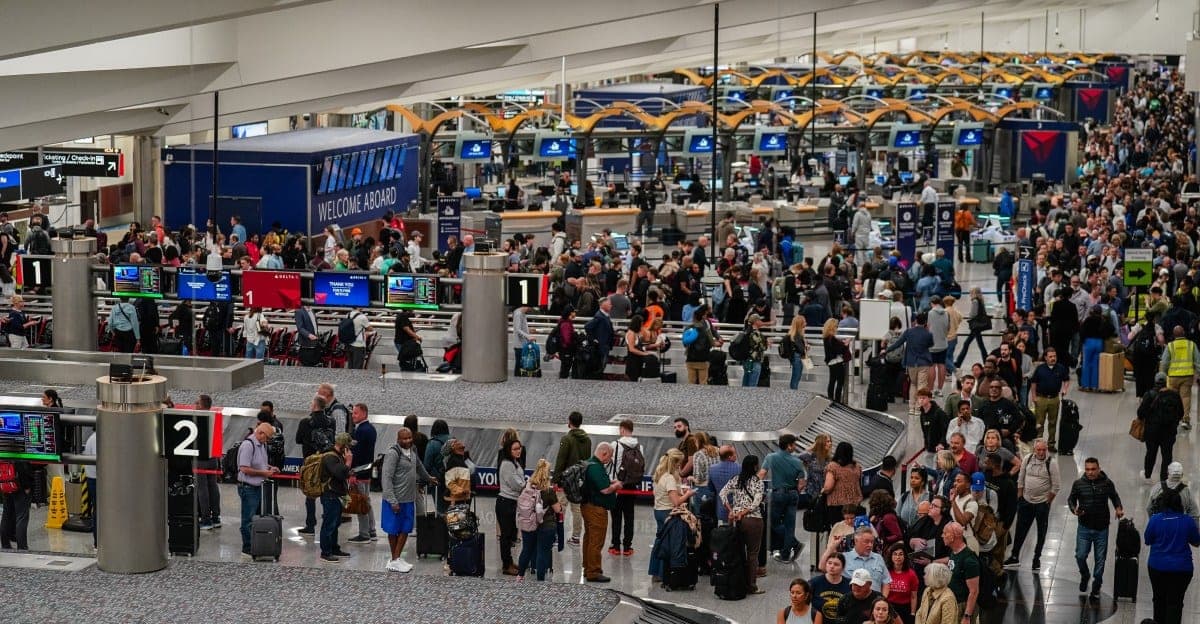
The TSA is broken — is privatization next?
Travelers wait in line at a Transportation Security Administration (TSA) checkpoint at Hartsfield-Jackson Atlanta International Airport on March 23, 2026. | Bloomberg via Getty Images KC Guidry usually gets to the airport two hours before a flight to give herself enough time to get through security. But she knew her flight on the morning of Monday, March 23, out of Houston’s George Bush Intercontinental Airport was going to be anything but routine. “I heard the lines were long through TikTok and through the news,” she said. “The day before, I saw the wait time for the terminal I needed to leave from was 200 minutes. I saw they were not doing PreCheck or CLEAR, so I adjusted my schedule.” She arrived at the airport at 12:30AM for a 7:20AM flight and joined a security line that was already looping around Houston’s Terminal E. She didn’t get through until 4:30AM. Others likely fared worse. By 9:30AM, the airport was already warning travelers that wait times could approach four hours. By the end of the day, they were averaging closer to five — and some security lines stretched all the way out of the terminal and into the underground parking garage. @g.schim sleepover at IAH! ps this is the craziest thing I’ve ever seen. #travel #tsa #iahairport #houston ♬ son original – out of context hannah montana Airport chaos has become the hallmark of the Trump era. Travelers already have to deal with skyrocketing oil prices, a crumbling safety system, and the war in Iran. And for the third time in six months, funding for the TSA has lapsed due to a budget impasse. Nearly 50,000 Transportation Security Officers (TSOs) who man the nation’s airport security checkpoints haven’t received a paycheck since late February. As “essential workers,” TSOs are required by law to show up for work even if they’re not getting paid. But not all of them do. Although it’s illegal for TSA employees to organize an official strike, thousands are independently calling out sick. Two weeks ago, nearly 6 percent of them didn’t report to work — three times higher than normal. This week it’s closer to 10 percent nationwide. And call-out rates exceeded 33 percent at several of the country’s largest airports, including JFK in New York, Hartsfield-Jackson in Atlanta, and Houston’s George Bush Intercontinental. Despite the chaos, the Trump administration appears in no hurry to end the budget stalemate, even though a recent CBS News/YouGov poll showed broad disapproval of the shutdown in general, and the way Republicans were handling it. For weeks, President Trump himself has tied any deal to restore TSA funding to the passage of the Safeguard American Voter Eligibility (SAVE) Act, which Democrats are prepared to filibuster. He even rejected a compromise negotiated by members of his own party that would have reopened the department on Monday. Instead, he ordered Immigrations and Customs Enforcement (ICE) agents to the nation’s airports to “help our wonderful TSA Agents.” This appeared to surprise Cabinet officials, who offered vague, contradictory explanations on ICE’s new role. On Monday, ICE agents could be spotted at airports doing little more than standing around, looking tough, and occasionally helping people lift their bags into scanners. (ICE did not respond to our request for more details about their deployment). @dom.giordano #phx #skyharbor ♬ nothing beats a jet2 holiday – A7-BBH | MAN Like much of Trump’s second-term agenda, his position on the shutdown makes little sense on its face. But the strategy becomes clear when examined through the lens of the Heritage Foundation’s Project 2025, which calls for the complete dismantling of the TSA. “The Transportation Security Administration [should] be privatized,” the document says. “Until it is privatized, TSA should be treated as a national security provider, and its workforce should be deunionized immediately.” Former DHS Secretary Kristi Noem did accomplish the last of these goals, stripping TSA workers of many of their collective bargaining rights last December. But she spent the rest of her tenure glorying in her department’s power. She personally attended ICE raids in New York, Minneapolis, and Los Angeles in full hair and makeup. She used Coast Guard funds to purchase two private jets and authorized the TSA’s purchase of $1 billion in new security equipment. She even spent $220 million on an ad campaign starring herself that was apparently meant to scold undocumented migrants back across the border. This was not the behavior of someone ready to give DHS’s responsibilities — and its considerable budget — to the private sector. Her successor Markwayne Mullin, who was confirmed on March 24, doesn’t seem to share Noem’s proclivity for the spotlight. “My goal in six months is that we’re not in the lead story every single day,” he said at his confirmation hearing. He didn’t otherwise mention how he might run the TSA except to generally advocate for better funding for the whole department. But we do know he is a consistent supporter of the Heritage Foundation. During his final term in Congress, he voted in line with the think tank’s positions 90 percent of the time. Supporters of TSA privatization clearly sense an opportunity with Mullin in charge. Since his nomination was announced, Fox News, Reason magazine, and the right-leaning Competitive Enterprise Institute have published articles laying out the case for TSA privatization. Over the weekend, Senator Tommy Tuberville (R-AL) promised to revive his “Abolish TSA Act,” which died in committee last year. Mullin may never have a better opportunity to do so than he does now, with Trump seemingly willing to endure voter anger and public bafflement to advance his agenda. TSA workers are quitting at a rate of nearly 200 per week. And a public that has endured airport meltdowns during two of the busiest travel periods of all time — Thanksgiving 2025 and Spring Break 2026 — might be willing to accept radical change if it means getting through security in a reasonable amount of time. Privatization might look something like the arrangement at Kansas City International or Orlando Sanford. At these airports, employees of a third-party security company called VMD Corp staff the checkpoints but still follow TSA procedures. They have been unaffected by the government shutdown: “The professional teams at our SPP airports have less than 3 minute lines,” the company taunted on X over the weekend. Or it could look like the mess at Canada’s Calgary International. In 2024, a company named Paladin International took over screening duties. Since then, security screeners have complained about consistent understaffing, poor working conditions, and even being denied bathroom breaks and access to water. Wait times at Calgary routinely exceed 30 minutes, far higher than the national average for Canada. Privatization is no magic bullet. But the status quo is untenable as well. For as long as the TSA remains useful as political leverage, travelers should prepare for periodic disruptions with unbearably long wait times. And if President Trump continues to complain that “our airports are like from a third world country,” as he did during a 2016 debate, he needs to look no farther than his own administration for someone to blame.

Senators ask Meta why it waited so long to make teen accounts private by default
Mark Zuckerberg. | Image: Cath Virginia / The Verge, Getty Images A group of senators has written a letter to Meta CEO Mark Zuckerberg asking why his company delayed launching key protections for users under 18. The letter, signed by Brian Schatz (D-HI), Katie Britt (R-AL), Amy Klobuchar (D-MN), James Lankford (R-OK), and Christopher Coons (D-DE), cites court documents unsealed late last year that revealed claims that Meta may have downplayed its platforms' harm in favor of increasing user engagement. Meta started automatically putting teens on Instagram into private and more restrictive accounts in September 2024, before extending the protections to Facebook and Messenger last year. But an unredacted cou … Read the full story at The Verge.
Senators ask Meta why it waited so long to make teen accounts private by default
Mark Zuckerberg. | Image: Cath Virginia / The Verge, Getty Images A group of senators has written a letter to Meta CEO Mark Zuckerberg asking why his company delayed launching key protections for users under 18. The letter, signed by Brian Schatz (D-HI), Katie Britt (R-AL), Amy Klobuchar (D-MN), James Lankford (R-OK), and Christopher Coons (D-DE), cites court documents unsealed late last year that revealed claims that Meta may have downplayed its platforms' harm in favor of increasing user engagement. Meta started automatically putting teens on Instagram into private and more restrictive accounts in September 2024, before extending the protections to Facebook and Messenger last year. But an unredacted cou … Read the full story at The Verge.
Senators ask Meta why it waited so long to make teen accounts private by default
Mark Zuckerberg. | Image: Cath Virginia / The Verge, Getty Images A group of senators has written a letter to Meta CEO Mark Zuckerberg asking why his company delayed launching key protections for users under 18. The letter, signed by Brian Schatz (D-HI), Katie Britt (R-AL), Amy Klobuchar (D-MN), James Lankford (R-OK), and Christopher Coons (D-DE), cites court documents unsealed late last year that revealed claims that Meta may have downplayed its platforms' harm in favor of increasing user engagement. Meta started automatically putting teens on Instagram into private and more restrictive accounts in September 2024, before extending the protections to Facebook and Messenger last year. But an unredacted cou … Read the full story at The Verge.
Senators ask Meta why it waited so long to make teen accounts private by default
Mark Zuckerberg. | Image: Cath Virginia / The Verge, Getty Images A group of senators has written a letter to Meta CEO Mark Zuckerberg asking why his company delayed launching key protections for users under 18. The letter, signed by Brian Schatz (D-HI), Katie Britt (R-AL), Amy Klobuchar (D-MN), James Lankford (R-OK), and Christopher Coons (D-DE), cites court documents unsealed late last year that revealed claims that Meta may have downplayed its platforms' harm in favor of increasing user engagement. Meta started automatically putting teens on Instagram into private and more restrictive accounts in September 2024, before extending the protections to Facebook and Messenger last year. But an unredacted cou … Read the full story at The Verge.
Senators ask Meta why it waited so long to make teen accounts private by default
Mark Zuckerberg. | Image: Cath Virginia / The Verge, Getty Images A group of senators has written a letter to Meta CEO Mark Zuckerberg asking why his company delayed launching key protections for users under 18. The letter, signed by Brian Schatz (D-HI), Katie Britt (R-AL), Amy Klobuchar (D-MN), James Lankford (R-OK), and Christopher Coons (D-DE), cites court documents unsealed late last year that revealed claims that Meta may have downplayed its platforms' harm in favor of increasing user engagement. Meta started automatically putting teens on Instagram into private and more restrictive accounts in September 2024, before extending the protections to Facebook and Messenger last year. But an unredacted cou … Read the full story at The Verge.
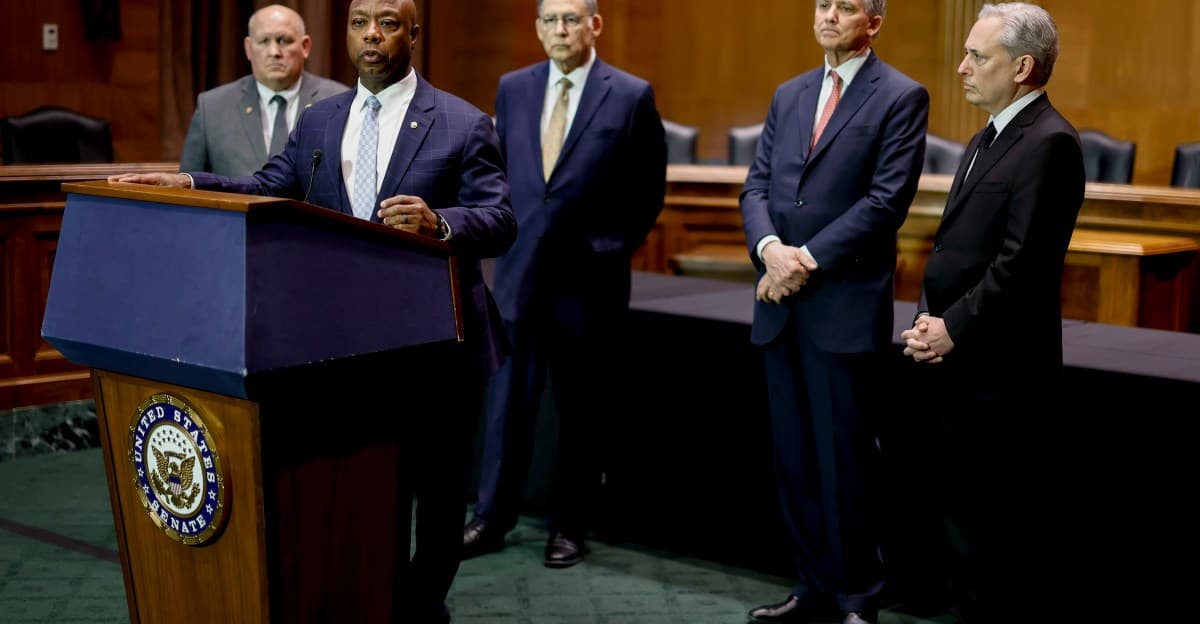
The crypto bill is falling apart in Congress
Rep. Glenn Thompson (R-PA), from left, Sen. Tim Scott (R-SC) Sen. John Boozman (R-AK), Rep. French Hill (R-AK), and David Sacks, White House Artificial Intelligence (AI) and Crypto czar, during a news conference on Capitol Hill in Washington, DC, US, on Tuesday, Feb. 4, 2025. | Ting Shen/Bloomberg via Getty Images. Hello and welcome to Regulator, the Verge newsletter about the technology politics happening in our nation’s capital. I hope our snowstorm-affected readers are safe, warm, and haven’t reenacted The Shining at home yet. Do you know what prevents that? Subscribing to The Verge. Last week, when I was tracking Coinbase’s opposition to the Clarity Act, I kept hearing the same fear from worried DC insiders: The crypto industry was running out of time to pass a bipartisan market structure bill that would actually give them a favorable outcome. The midterm elections are imminent, and Congress will switch to campaign mode in the upcoming weeks, meaning policymaking and bipartisanship will take a backseat to reelection priorities. To put it in private sector parlance, there will be guaranteed personnel turnover, and their replacements may not be quite as friendly to the crypto industry. But to put it in political terms, the Democrats are likely to gain a lot more power, and the Republicans are about to lose it. Historical statistics almost guarantee it: In 90 percent of the midterm elections over the past 80 years, the incumbent president’s party lost seats in the House. Every president since Bill Clinton has lost both the House and Senate in the first two years of their term. Midterms are, more or less, a referendum on the president, and the less popular a president is, the more seats his party ends up losing. Given this trend, Coinbase has taken a huge gamble: that crypto’s allies would remain in Congress, with the Republicans nudged along by President Donald Trump, and that the Democrats who are hostile to crypto, like Rep. Maxine Waters (D-CA) or Sen. Elizabeth Warren (D-MA) wouldn’t seize the policy wheel. They had two allies speaking on their behalf, too: White House AI and crypto czar David Sacks, and the president’s son, Eric Trump, who told a crowd at the World Economic Forum in Davos, Switzerland, that the banking industry was responsible for Clarity stalling. Then ICE agents killed an ICU nurse in broad daylight during an anti-ICE protest in Minneapolis on Saturday. And as the country erupted in fury, politics took over the US Capitol, and policy was kicked to the backburner. In response to Alex Pretti’s death and ICE’s continued presence in Minneapolis, Senate Minority Leader Chuck Schumer (D-NY) announced that the Democrats would not vote for any budget that continued to fund ICE at the Department of Homeland Security, setting up the possibility of a partial government shutdown. Crucially, several moderate Senate Dems revoked their support as well, including Sen. Patty Murray (D-WA), the top Democrat negotiator for the current funding package. Although she’d initially been urging her colleagues to vote for the bill, Murray announced on Sunday that she was reversing course. “Federal agents cannot murder people in broad daylight and face zero consequences,” she wrote on X. Partisanship had already started leaking into the Clarity debate, said Cody Carbone, the CEO of The Digital Chamber, a major digital asset and blockchain industry trade association in Washington. Most of the opposition to the last Clarity draft came from Democrats, as well as two Republicans who represented states with large banking industries. (One of them, Sen. Thom Tillis of North Carolina, is retiring this year due to his opposition to Trump.) But Carbone raised concerns that Pretti’s death would prompt each party to become more hardline, both in the Senate and the House (which would have to review the bill again if the Senate made substantial changes). More floor time would be dedicated to deeply partisan, existential battles, from government shutdowns to hearings. And crypto was in danger of being lost in the fold, to the detriment of both parties. “Crypto holders are super intense about crypto. They’re single-issue voters, and they vote with their wallets,” he told me, noting that while they tended to hold Democrat-leaning views, they overwhelmingly voted Republican because they perceived the party to be friendlier to the industry. “If you look at some of the political dollars that the crypto industry gave last election, and some of the enthusiasm from crypto voters, it can swing elections.” The crypto sausage-making resumes this week when the Senate Agriculture Committee, which regulates commodities, convenes on Thursday for its own markup of the Clarity Act. (The Banking Committee, which regulates securities, seems to be in a stalemate.) Below, Carbone and I chat about what crypto lobbyists are hearing in the smoke-filled backrooms, which Senators are being wooed by the banks, and a doomsday scenario (for the industry) in which the Democrats win either the House or the Senate before Clarity is passed. “I imagine there’ll be a lot of subpoenas and they’ll want to look into the Trump family’s dealings around crypto,” he predicted. “There’s not going to be any interest in passing crypto legislation that will help in terms of adoption.” This week at The Verge: “I grew up with Alex Pretti”, Kristen Radtke: The kind-hearted ICU nurse shot by federal agents was my childhood best friend. “The day of the second killing”, Gaby del Valle: After Alex Pretti was shot, photographer Steven Garcia followed peaceful protestors as they withstood being teargassed by ICE agents. “It doesn’t matter if Alex Pretti had a gun”, Sarah Jeong: What is the point of law enforcement that doesn’t follow the law? “Why won’t anyone stop ICE from masking?”, Sarah Jeong: Doxxing is not a good reason to have faceless police. “Creators and communities everywhere take a stand against ICE”, Terence O’Brien Even the most seemingly apolitical creators have had enough. “Even the big dick subreddit is mad about ICE”, Mia Sato: After immigration agents killed a second person in Minneapolis, anti-ICE sentiment has reached every corner of the internet — including adult subreddits. “OpenAI’s president is a Trump mega-donor”, Hayden Field: Greg Brockman said he started ‘getting involved politically’ in 2025. “2026 is the year of social media’s legal reckoning”, Lauren Feiner: The first sampling among thousands of cases over tech companies’ alleged failure to protect kids will be tried this year. “The great e-bike crackdown has begun”, Andrew J. Hawkins: New Jersey just approved a wildly out-of-step new law that restricts all e-bikes, regardless of speed or power capabilities. Will other states follow? “Hang on, there’s a Trump Phone Ultra coming too?”, Dominic Preston: We’re still waiting for the first Trump Phone, but one of Trump Mobile’s execs claims a higher spec version is on the way. “I think we’ll be kicking ourselves if we get a Democratic Congress, and then we can’t get anything through” This interview has been edited for clarity and length. So let’s summarize what’s causing the bill to be stuck. I think the biggest issue right now holding up the bill is whether stablecoin issuers are going to be able to continue to issue rewards to consumers. So right now, if you are on Coinbase and you’re holding USDC, you get 3.5 percent from your holdings in terms of rewards. Is it like a cashback program, or an interest payout? Essentially, it’s like an interest. That is what the bank lobby is very upset about, and that is who is pushing back against Clarity. They are concerned that if stablecoin issuers, or third parties that are holding stablecoins like exchanges, are passing along the interest to consumers, that will lead to a bank deposit flight — that your mom and dad, whomever, will stop going to their community or regional bank to hold their money, because at that bank, they’re only getting .001 percent interest yield. They may start holding their savings in stablecoins because they’re getting 3.5 percent or 4.5 percent, or just higher interest rates overall, through these rewards. That’s way higher than a traditional bank interest rate. Way higher. Right now, under the GENIUS Act, it is not prohibited to offer these rewards. It is prohibited to offer yields. So the banks are calling it a loophole. Now, there’s nothing in the bill that prohibits the banks from offering rewards or higher interest rates, but that is what’s holding up market structures. The banking industry is saying, The only way we can prohibit stablecoin issuers, or anyone holding stablecoin offering these rewards, is to have it addressed now in market structure legislation. So they have lobbied really, really hard to get a full prohibition on rewards in this bill. That’s Coinbase’s number one issue with this, and it’s the number one reason that this bill, or at least the markup at Senate banking, didn’t go forward two weeks ago. There wasn’t direct alignment, even between Republicans — but especially between Republicans, Democrats, and the members of the committee and the crypto industry — on what to do and how to solve this issue. How much exactly does Coinbase stand to lose if this provision goes through? It would be a huge detriment to their business. It’s not their whole business, but there’s a massive appetite — and I’m sure there’s a massive user base on Coinbase right now — for people to go in and to hold and buy stablecoins because of the rewards. I mean, I am someone who has moved their savings from a traditional bank to USDC because I get 3.5 percent back versus getting .001 percent. I think it’s a big use case for stablecoins overall, especially as we’re still in this nascent period where we just passed the first regulatory framework [with the GENIUS Act]. There’s still not mainstream adoption of stablecoins, but there could be very, very soon, not only from business to business, but business to consumer. One of the big concerns I was hearing about this bill, even before the shooting happened, was that there was only a limited amount of political runway to get this bill done before the election season started. Do you think that a lack of partisanship would impact the passage of this bill? It has to be bipartisan. The only way this bill can pass the Senate floor is if they get 60 votes, so they will need at least six Democrats. There’s a group of 12 Democrats who have earnestly been working day by day with a majority of Senate Republicans to get this done. There were over a hundred Democrats in the House who supported it, so this should be a bipartisan issue. The Democrat negotiators have gotten a lot of what they’ve asked for, at least in the Senate banking bill, so I’m hoping that they can come to the table and say, You know what? We want to support this, and we’re gonna vote yes. Even though it is a completely partisan climate, this is one of the few issues that could be bipartisan, and it has been demonstrated to be bipartisan. Even this year in the Senate, with the GENIUS Act’s passage, and then the House with the Clarity and GENIUS acts’ passage. But politics trumps policy, and the closer and closer that we get to November and election day, the harder it is to put policy first and to try to get this bill done. So I’m really targeting the end of this quarter, early in the second quarter, to get this bill done and to the president’s desk. But then it gets much, much harder. What does crypto look like as an issue going into the midterm elections? Like, is it too closely tied with MAGA and Trump, or will it be less of a factor that drives voters’ decisions? Well, it’s really interesting. When you talk to the average voter, it’s not the number one issue that comes out, especially in today’s climate. But we conducted a survey at the end of last year where we looked at the political leaning of crypto holders. They actually lean left, and they tend to be more Democratic-leaning or have historically supported Democrats. However, crypto holders are super intense about crypto. They’re single-issue voters, and they vote with their wallets. So even though they tend to lead politically left, they’ve been voting Republican because they perceive Republicans to be more supportive of crypto. I’m hoping that will illustrate to both Republicans and Democrats that there is a voter base out here that they can get. It’s a small voter base, but if you look at some of the political dollars that the crypto industry gave last election, and some of the enthusiasm from crypto voters, it can swing elections. The crypto vote will really be dictated on: Are we going to get market structure legislation? Is that going to be an issue that’s still looming in November? If market structure passes in the next few months, there’s not as many hot-button crypto issues that need to be addressed. So it’s not a huge ballot issue, but we’re getting to the point where crypto issues are becoming more woven into the fabric of economic issues with the country. Going back to Congress: What should one be on the lookout for during the Agriculture markup? Number one is what [New Jersey Democratic Sen.] Cory Booker does. So [Minnesota Democratic Sen. Amy] Klobuchar, the ranking member, delegated the task of negotiating this bill with the Chairman [Arkansas Republican Sen. John Boozman] to Booker. Klobuchar is probably busy right now. She’s quite busy. So Booker has been working earnestly with the chairman. It has been the Senate Ag Committee’s stated intention from the start of this Congress: We want to have a bipartisan product. That’s really important to us. That manifested itself in a bipartisan discussion draft that came out a few months ago. However, the most recent text that came out last week was the first product that came out that was not bipartisan. Democrats said, Hey, we’re not signing onto this. However, we’re continuously working with Republicans to get to yes. So, as of right now, as we sit here 72 hours before the markup, has that changed since the text was released last week? Has Cory Booker come on board? Can they broker an agreement? What we have heard from other Democrats on the committee is that they’re not going to do anything without Cory Booker’s blessing. If Cory Booker says he’s a yes on this, then I imagine a big portion of the Senate Democrats vote yes. If Cory Booker says he’s a no, then I imagine it’s going to be a partisan vote, and the bill will pass out of committee with just Republican supporters. Let’s game out a situation where either the House and/or Senate is taken by the Dems. Exactly how much will the partisan makeup of a chamber impact whether this bill comes through again? Just based on the people in power on the Democratic side for the committees of jurisdiction, it’ll mean a lot. If you look at the House Financial Services Committee, [California Rep.] Maxine Waters, who would take back over as chairwoman, is not a fan of this technology. So that makes it difficult right out of the gate to move this through. Same thing in Senate Banking. It’s almost even worse for the crypto industry, because [Massachusetts Sen.] Elizabeth Warren is a ranking member and would become the chairwoman. If either of those chambers flip, I don’t see how the Clarity Act would be possible, because those two committee chairs will not try to move these issues through. Their focus will be on enforcement. I imagine there’ll be a lot of subpoenas and they’ll want to look into the Trump family’s dealings around crypto. There’s not going to be any interest in passing crypto legislation that will help in terms of adoption. On the flip side of that, who does the banking industry have on their side? I would say most of the Democrats right now. And then there are a few Republicans who are very concerned about what the banking industry is saying because they represent a large population of community, regional or large banks. [Republican Sen.] Thom Tillis represents a huge banking capital in Charlotte, North Carolina. He’s been very concerned about what rewards will do for deposit flights. We’ve heard from [Alabama] Sen. Katie Britt and she’s been very concerned about what her community banks are saying about how stablecoins could outcompete them. Again, my counter to all of them is that there is nothing in this bill that prohibits the banks from issuing their own stablecoins and offering rewards and competing with crypto exchanges. To me, this is all about competition and trying to keep a competitive moat. But there are Republicans who are very concerned and at the negotiating table. They are always very clear that they’re not anti-crypto and they’re not anti-stablecoins, but they want to make sure that the banks are protected. So hopefully we find a compromise soon. I just still think we’re in that limbo where no one knows what that compromise is yet. Has Coinbase indicated anything that would bring them back to the table yet? Nothing I’ve heard directly from Coinbase. They would know better than I. But I’m hoping, as this bill continues to improve, they are one of, if not the largest, names in crypto, and that they will find that a good bill is better than no bill. I understand everyone saying out there no bill is better than a bad bill. I don’t disagree, but we need to be at the negotiating table to improve this bill, because we want a bill, and I think we’ll be kicking ourselves if we get a Democratic Congress, and then we can’t get anything through, and then maybe it’s a Democratic administration. Who knows? We’d be reliving the Gary Gensler era of the Biden administration all over again, and we would be sitting here being like, Man, I really wish we’d gotten that bill done in 2026. And now, Recess. See you next week.
The crypto bill is falling apart in Congress
Rep. Glenn Thompson (R-PA), from left, Sen. Tim Scott (R-SC) Sen. John Boozman (R-AK), Rep. French Hill (R-AK), and David Sacks, White House Artificial Intelligence (AI) and Crypto czar, during a news conference on Capitol Hill in Washington, DC, US, on Tuesday, Feb. 4, 2025. | Ting Shen/Bloomberg via Getty Images. Hello and welcome to Regulator, the Verge newsletter about the technology politics happening in our nation’s capital. I hope our snowstorm-affected readers are safe, warm, and haven’t reenacted The Shining at home yet. Do you know what prevents that? Subscribing to The Verge. Last week, when I was tracking Coinbase’s opposition to the Clarity Act, I kept hearing the same fear from worried DC insiders: The crypto industry was running out of time to pass a bipartisan market structure bill that would actually give them a favorable outcome. The midterm elections are imminent, and Congress will switch to campaign mode in the upcoming weeks, meaning policymaking and bipartisanship will take a backseat to reelection priorities. To put it in private sector parlance, there will be guaranteed personnel turnover, and their replacements may not be quite as friendly to the crypto industry. But to put it in political terms, the Democrats are likely to gain a lot more power, and the Republicans are about to lose it. Historical statistics almost guarantee it: In 90 percent of the midterm elections over the past 80 years, the incumbent president’s party lost seats in the House. Every president since Bill Clinton has lost both the House and Senate in the first two years of their term. Midterms are, more or less, a referendum on the president, and the less popular a president is, the more seats his party ends up losing. Given this trend, Coinbase has taken a huge gamble: that crypto’s allies would remain in Congress, with the Republicans nudged along by President Donald Trump, and that the Democrats who are hostile to crypto, like Rep. Maxine Waters (D-CA) or Sen. Elizabeth Warren (D-MA) wouldn’t seize the policy wheel. They had two allies speaking on their behalf, too: White House AI and crypto czar David Sacks, and the president’s son, Eric Trump, who told a crowd at the World Economic Forum in Davos, Switzerland, that the banking industry was responsible for Clarity stalling. Then ICE agents killed an ICU nurse in broad daylight during an anti-ICE protest in Minneapolis on Saturday. And as the country erupted in fury, politics took over the US Capitol, and policy was kicked to the backburner. In response to Alex Pretti’s death and ICE’s continued presence in Minneapolis, Senate Minority Leader Chuck Schumer (D-NY) announced that the Democrats would not vote for any budget that continued to fund ICE at the Department of Homeland Security, setting up the possibility of a partial government shutdown. Crucially, several moderate Senate Dems revoked their support as well, including Sen. Patty Murray (D-WA), the top Democrat negotiator for the current funding package. Although she’d initially been urging her colleagues to vote for the bill, Murray announced on Sunday that she was reversing course. “Federal agents cannot murder people in broad daylight and face zero consequences,” she wrote on X. Partisanship had already started leaking into the Clarity debate, said Cody Carbone, the CEO of The Digital Chamber, a major digital asset and blockchain industry trade association in Washington. Most of the opposition to the last Clarity draft came from Democrats, as well as two Republicans who represented states with large banking industries. (One of them, Sen. Thom Tillis of North Carolina, is retiring this year due to his opposition to Trump.) But Carbone raised concerns that Pretti’s death would prompt each party to become more hardline, both in the Senate and the House (which would have to review the bill again if the Senate made substantial changes). More floor time would be dedicated to deeply partisan, existential battles, from government shutdowns to hearings. And crypto was in danger of being lost in the fold, to the detriment of both parties. “Crypto holders are super intense about crypto. They’re single-issue voters, and they vote with their wallets,” he told me, noting that while they tended to hold Democrat-leaning views, they overwhelmingly voted Republican because they perceived the party to be friendlier to the industry. “If you look at some of the political dollars that the crypto industry gave last election, and some of the enthusiasm from crypto voters, it can swing elections.” The crypto sausage-making resumes this week when the Senate Agriculture Committee, which regulates commodities, convenes on Thursday for its own markup of the Clarity Act. (The Banking Committee, which regulates securities, seems to be in a stalemate.) Below, Carbone and I chat about what crypto lobbyists are hearing in the smoke-filled backrooms, which Senators are being wooed by the banks, and a doomsday scenario (for the industry) in which the Democrats win either the House or the Senate before Clarity is passed. “I imagine there’ll be a lot of subpoenas and they’ll want to look into the Trump family’s dealings around crypto,” he predicted. “There’s not going to be any interest in passing crypto legislation that will help in terms of adoption.” This week at The Verge: “I grew up with Alex Pretti”, Kristen Radtke: The kind-hearted ICU nurse shot by federal agents was my childhood best friend. “The day of the second killing”, Gaby del Valle: After Alex Pretti was shot, photographer Steven Garcia followed peaceful protestors as they withstood being teargassed by ICE agents. “It doesn’t matter if Alex Pretti had a gun”, Sarah Jeong: What is the point of law enforcement that doesn’t follow the law? “Why won’t anyone stop ICE from masking?”, Sarah Jeong: Doxxing is not a good reason to have faceless police. “Creators and communities everywhere take a stand against ICE”, Terence O’Brien Even the most seemingly apolitical creators have had enough. “Even the big dick subreddit is mad about ICE”, Mia Sato: After immigration agents killed a second person in Minneapolis, anti-ICE sentiment has reached every corner of the internet — including adult subreddits. “OpenAI’s president is a Trump mega-donor”, Hayden Field: Greg Brockman said he started ‘getting involved politically’ in 2025. “2026 is the year of social media’s legal reckoning”, Lauren Feiner: The first sampling among thousands of cases over tech companies’ alleged failure to protect kids will be tried this year. “The great e-bike crackdown has begun”, Andrew J. Hawkins: New Jersey just approved a wildly out-of-step new law that restricts all e-bikes, regardless of speed or power capabilities. Will other states follow? “Hang on, there’s a Trump Phone Ultra coming too?”, Dominic Preston: We’re still waiting for the first Trump Phone, but one of Trump Mobile’s execs claims a higher spec version is on the way. “I think we’ll be kicking ourselves if we get a Democratic Congress, and then we can’t get anything through” This interview has been edited for clarity and length. So let’s summarize what’s causing the bill to be stuck. I think the biggest issue right now holding up the bill is whether stablecoin issuers are going to be able to continue to issue rewards to consumers. So right now, if you are on Coinbase and you’re holding USDC, you get 3.5 percent from your holdings in terms of rewards. Is it like a cashback program, or an interest payout? Essentially, it’s like an interest. That is what the bank lobby is very upset about, and that is who is pushing back against Clarity. They are concerned that if stablecoin issuers, or third parties that are holding stablecoins like exchanges, are passing along the interest to consumers, that will lead to a bank deposit flight — that your mom and dad, whomever, will stop going to their community or regional bank to hold their money, because at that bank, they’re only getting .001 percent interest yield. They may start holding their savings in stablecoins because they’re getting 3.5 percent or 4.5 percent, or just higher interest rates overall, through these rewards. That’s way higher than a traditional bank interest rate. Way higher. Right now, under the GENIUS Act, it is not prohibited to offer these rewards. It is prohibited to offer yields. So the banks are calling it a loophole. Now, there’s nothing in the bill that prohibits the banks from offering rewards or higher interest rates, but that is what’s holding up market structures. The banking industry is saying, The only way we can prohibit stablecoin issuers, or anyone holding stablecoin offering these rewards, is to have it addressed now in market structure legislation. So they have lobbied really, really hard to get a full prohibition on rewards in this bill. That’s Coinbase’s number one issue with this, and it’s the number one reason that this bill, or at least the markup at Senate banking, didn’t go forward two weeks ago. There wasn’t direct alignment, even between Republicans — but especially between Republicans, Democrats, and the members of the committee and the crypto industry — on what to do and how to solve this issue. How much exactly does Coinbase stand to lose if this provision goes through? It would be a huge detriment to their business. It’s not their whole business, but there’s a massive appetite — and I’m sure there’s a massive user base on Coinbase right now — for people to go in and to hold and buy stablecoins because of the rewards. I mean, I am someone who has moved their savings from a traditional bank to USDC because I get 3.5 percent back versus getting .001 percent. I think it’s a big use case for stablecoins overall, especially as we’re still in this nascent period where we just passed the first regulatory framework [with the GENIUS Act]. There’s still not mainstream adoption of stablecoins, but there could be very, very soon, not only from business to business, but business to consumer. One of the big concerns I was hearing about this bill, even before the shooting happened, was that there was only a limited amount of political runway to get this bill done before the election season started. Do you think that a lack of partisanship would impact the passage of this bill? It has to be bipartisan. The only way this bill can pass the Senate floor is if they get 60 votes, so they will need at least six Democrats. There’s a group of 12 Democrats who have earnestly been working day by day with a majority of Senate Republicans to get this done. There were over a hundred Democrats in the House who supported it, so this should be a bipartisan issue. The Democrat negotiators have gotten a lot of what they’ve asked for, at least in the Senate banking bill, so I’m hoping that they can come to the table and say, You know what? We want to support this, and we’re gonna vote yes. Even though it is a completely partisan climate, this is one of the few issues that could be bipartisan, and it has been demonstrated to be bipartisan. Even this year in the Senate, with the GENIUS Act’s passage, and then the House with the Clarity and GENIUS acts’ passage. But politics trumps policy, and the closer and closer that we get to November and election day, the harder it is to put policy first and to try to get this bill done. So I’m really targeting the end of this quarter, early in the second quarter, to get this bill done and to the president’s desk. But then it gets much, much harder. What does crypto look like as an issue going into the midterm elections? Like, is it too closely tied with MAGA and Trump, or will it be less of a factor that drives voters’ decisions? Well, it’s really interesting. When you talk to the average voter, it’s not the number one issue that comes out, especially in today’s climate. But we conducted a survey at the end of last year where we looked at the political leaning of crypto holders. They actually lean left, and they tend to be more Democratic-leaning or have historically supported Democrats. However, crypto holders are super intense about crypto. They’re single-issue voters, and they vote with their wallets. So even though they tend to lead politically left, they’ve been voting Republican because they perceive Republicans to be more supportive of crypto. I’m hoping that will illustrate to both Republicans and Democrats that there is a voter base out here that they can get. It’s a small voter base, but if you look at some of the political dollars that the crypto industry gave last election, and some of the enthusiasm from crypto voters, it can swing elections. The crypto vote will really be dictated on: Are we going to get market structure legislation? Is that going to be an issue that’s still looming in November? If market structure passes in the next few months, there’s not as many hot-button crypto issues that need to be addressed. So it’s not a huge ballot issue, but we’re getting to the point where crypto issues are becoming more woven into the fabric of economic issues with the country. Going back to Congress: What should one be on the lookout for during the Agriculture markup? Number one is what [New Jersey Democratic Sen.] Cory Booker does. So [Minnesota Democratic Sen. Amy] Klobuchar, the ranking member, delegated the task of negotiating this bill with the Chairman [Arkansas Republican Sen. John Boozman] to Booker. Klobuchar is probably busy right now. She’s quite busy. So Booker has been working earnestly with the chairman. It has been the Senate Ag Committee’s stated intention from the start of this Congress: We want to have a bipartisan product. That’s really important to us. That manifested itself in a bipartisan discussion draft that came out a few months ago. However, the most recent text that came out last week was the first product that came out that was not bipartisan. Democrats said, Hey, we’re not signing onto this. However, we’re continuously working with Republicans to get to yes. So, as of right now, as we sit here 72 hours before the markup, has that changed since the text was released last week? Has Cory Booker come on board? Can they broker an agreement? What we have heard from other Democrats on the committee is that they’re not going to do anything without Cory Booker’s blessing. If Cory Booker says he’s a yes on this, then I imagine a big portion of the Senate Democrats vote yes. If Cory Booker says he’s a no, then I imagine it’s going to be a partisan vote, and the bill will pass out of committee with just Republican supporters. Let’s game out a situation where either the House and/or Senate is taken by the Dems. Exactly how much will the partisan makeup of a chamber impact whether this bill comes through again? Just based on the people in power on the Democratic side for the committees of jurisdiction, it’ll mean a lot. If you look at the House Financial Services Committee, [California Rep.] Maxine Waters, who would take back over as chairwoman, is not a fan of this technology. So that makes it difficult right out of the gate to move this through. Same thing in Senate Banking. It’s almost even worse for the crypto industry, because [Massachusetts Sen.] Elizabeth Warren is a ranking member and would become the chairwoman. If either of those chambers flip, I don’t see how the Clarity Act would be possible, because those two committee chairs will not try to move these issues through. Their focus will be on enforcement. I imagine there’ll be a lot of subpoenas and they’ll want to look into the Trump family’s dealings around crypto. There’s not going to be any interest in passing crypto legislation that will help in terms of adoption. On the flip side of that, who does the banking industry have on their side? I would say most of the Democrats right now. And then there are a few Republicans who are very concerned about what the banking industry is saying because they represent a large population of community, regional or large banks. [Republican Sen.] Thom Tillis represents a huge banking capital in Charlotte, North Carolina. He’s been very concerned about what rewards will do for deposit flights. We’ve heard from [Alabama] Sen. Katie Britt and she’s been very concerned about what her community banks are saying about how stablecoins could outcompete them. Again, my counter to all of them is that there is nothing in this bill that prohibits the banks from issuing their own stablecoins and offering rewards and competing with crypto exchanges. To me, this is all about competition and trying to keep a competitive moat. But there are Republicans who are very concerned and at the negotiating table. They are always very clear that they’re not anti-crypto and they’re not anti-stablecoins, but they want to make sure that the banks are protected. So hopefully we find a compromise soon. I just still think we’re in that limbo where no one knows what that compromise is yet. Has Coinbase indicated anything that would bring them back to the table yet? Nothing I’ve heard directly from Coinbase. They would know better than I. But I’m hoping, as this bill continues to improve, they are one of, if not the largest, names in crypto, and that they will find that a good bill is better than no bill. I understand everyone saying out there no bill is better than a bad bill. I don’t disagree, but we need to be at the negotiating table to improve this bill, because we want a bill, and I think we’ll be kicking ourselves if we get a Democratic Congress, and then we can’t get anything through, and then maybe it’s a Democratic administration. Who knows? We’d be reliving the Gary Gensler era of the Biden administration all over again, and we would be sitting here being like, Man, I really wish we’d gotten that bill done in 2026. And now, Recess. See you next week.