5 stories credited to scheerpost.com
Latest story Apr 16, 2026 · on ChamberLight since Apr 2026
A story can appear as several articles (copies of the same piece), so counts of stories and of articles differ.
Scores for scheerpost.com
Writing quality not enough rated stories yet: 4 of 10. How it is measured
Scores last checked Sep 25, 2026.
Stories ChamberLight collected, by month
Stories credited to scheerpost.com, by publication date. ChamberLight collects articles that mention the officials it tracks, so this shows its own coverage of this source, not how much the source publishes.
- Stories from scheerpost.com
- Shaded: ChamberLight collected no stories, or almost none, from any outlet (a gap in its collection, not in the outlet’s publishing)
Show as a table
| Month | Stories | All outlets |
|---|---|---|
| February 2026 | 1 | 117 |
| March 2026 | 0 | 1,094 |
| April 2026 | 4 | 4,538 |
| May 2026 | 0 | none collected |
| June 2026 | 0 | none collected |
| July 2026 | 0 | none collected |
| August 2026 | 0 | 1 (collection gap) |
| September 2026 | 0 | 1,320 |
Top topics
Share of this source’s stories tagged with each topic. A story can carry several topics, so the shares do not add up to 100%.
- Ethics/Corruption4
80% of 5 stories · 58% across all outlets
- Foreign Policy3
60% of 5 stories · 29% across all outlets
- Criminal Justice2
40% of 5 stories · 19% across all outlets
- Defense/Military2
40% of 5 stories · 25% across all outlets
- Immigration2
40% of 5 stories · 13% across all outlets
- Budget/Spending1
20% of 5 stories · 31% across all outlets
- Economy1
20% of 5 stories · 26% across all outlets
The thin mark on each bar is the topic’s share across all outlets.
Who they cover
Party of the officials these stories are mainly about, across all 8 officials named. A story counts once for each official it is mainly about, so the split is over 10 story–official pairs, from 5 stories.
- Democrat50% · 5 pairs
- Republican40% · 4 pairs
- Independent10% · 1 pair
Most covered
Stories mainly about each official, and their share of the source’s 5 stories.
Article tone
ChamberLight’s article analysis assigns each story a tone toward the official it covers. It describes the coverage of that official, not scheerpost.com’s stance, and reader votes do not change it. 5 stories.
- Good Look
- 2 (40%)
- Mixed
- 1 (20%)
- Informational
- 0 (0%)
- Bad Look
- 2 (40%)
Challenges to these scores
No one has challenged a score on this page yet. Anyone can; editors publish every outcome here.
Articles served from scheerpost.com
10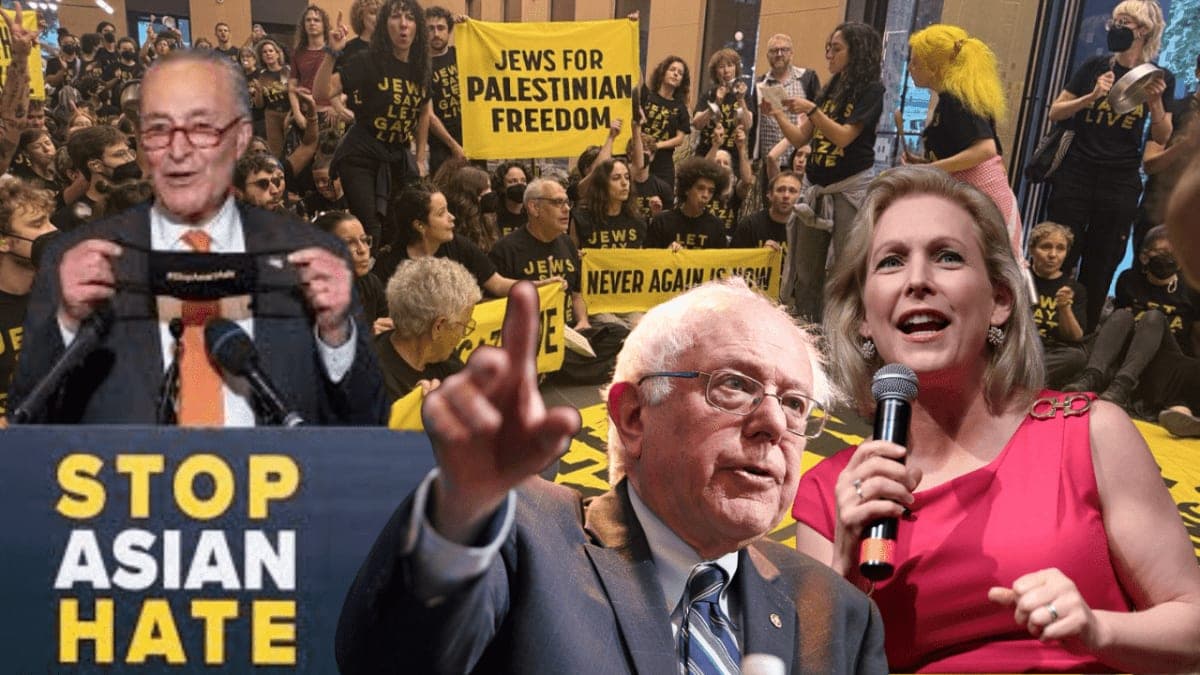
Seven Democrats Side With Republicans to Keep Weapons Flowing to Israel as War Expands
In one of the scariest moments in modern history, we're doing our best at ScheerPost to pierce the fog of lies that conceal it but we need some help to pay our writers and staff. Please consider a tax-deductible donation. Joshua Scheer In a vote that cuts straight through the carefully managed language of Washington diplomacy, seven Senate Democrats broke with much of their party and joined Republicans to block an effort that would have halted U.S. arms sales to Israel. The resolution—introduced by Sen. Bernie Sanders—failed 40–59, ensuring the continued transfer of military equipment as the region slides deeper into war. Seven Democrats, led by Chuck Schumer, voted for the resolution. Which included Senators Richard Blumenthal, Chris Coons, Catherine Cortez Masto, John Fetterman, Kirsten Gillibrand, Jacky Rosen, and Senate Minority Leader Chuck Schumer—voted to keep the pipeline open. Their decision ensured the failure of a measure that, while unlikely to pass, represented one of the clearest attempts yet to challenge U.S. complicity in Israel’s ongoing military campaigns. At stake was not just a shipment of military bulldozers or thousands of 1,000-pound bombs. It was a question that has been building for months: whether the United States will continue to bankroll and materially support an expanding conflict that now stretches from Gaza to Lebanon to Iran. The answer, at least for now, is yes. The backlash was immediate—and public. With Bernie Sanders making the statement: “When we started this effort there were just 11 votes. Now, there are 40,” Bernie Sanders said in a statement. “That shift reflects where the American people are. Americans, whether they are Democrats, Republicans or independents, want to see our tax money invested in improving lives here at home — not used to kill innocent women and children in the Middle East and put American troops in harm’s way as part of Netanyahu’s illegal wars of expansion.” Rep. Ro Khanna didn’t hedge. He didn’t soften it. He said what much of the Democratic base has been building toward for months. “Chuck Schumer was one of 7 Senate Democrats to vote to send bulldozers to Israel. 40 Democratic Senators voted no,” Khanna wrote. “Mr. Schumer, you are out of touch with our base and the nation. Step aside.” Chuck Schumer was one of 7 Senate Democrats to vote to send bulldozers to Israel. 40 Democratic Senators voted no. Mr. Schumer, you are out of touch with our base and the nation. Step aside. https://t.co/FnOMgApkqN pic.twitter.com/gwGX7OCXmm — Ro Khanna (@RoKhanna) April 16, 2026 The vote came at a moment of intensifying crisis. The U.S. and Israel are actively engaged in coordinated strikes on Iran, while Israel continues its military operations in Lebanon despite nominal cease-fire claims. Civilian casualties are mounting. The risk of a broader regional war is no longer hypothetical—it is unfolding in real time. And yet, even as the scale of the conflict grows, so too does the political contradiction in Washington. A majority of Senate Democrats supported at least one of the resolutions. That alone marks a significant shift. Just two years ago, such measures would have drawn only a small minority of support. Now, opposition to unconditional military aid to Israel is no longer fringe—it is approaching the center of the Democratic base. Sanders himself framed the vote as evidence of that shift, pointing to growing public anger over the use of taxpayer dollars to fund wars abroad while domestic needs go unmet. But the outcome also reveals the limits of that shift. Because when it came time to act—when the vote could have materially altered the flow of weapons—the political establishment held the line. Some of the dissenting Democrats justified their votes by invoking alliance obligations or fears of “abandoning” Israel. Others offered no immediate explanation. But the underlying logic is familiar: support for Israel remains one of the most entrenched pillars of U.S. foreign policy, even as the political and moral costs of that support become harder to ignore. Meanwhile, outside the halls of Congress, the pressure is mounting. Protests have erupted across the country, including demonstrations in New York where activists demanded that senators like Schumer and Gillibrand block the very arms sales they ultimately allowed to proceed. Nearly 100 protesters were arrested earlier this week in actions led by antiwar groups calling for an end to U.S. complicity. The message from the streets is increasingly clear: the war abroad is not disconnected from life at home. It is paid for here. It is justified here. And it is contested here. Inside Congress, however, that pressure has yet to fully translate into policy. However a shift is indeed happening, as pointed out, a notable change in U.S. political attitudes toward Israel is becoming increasingly clear. A significant number of Democratic senators voted against supplying military equipment to the Israeli army—40 opposing the transfer of bulldozers and 36 rejecting the provision of bombs—highlighting growing reluctance within the party. Notably, no Democratic senator considered a potential presidential contender supported sending weapons. The failed vote on arms sales followed closely on the heels of another collapse—a War Powers resolution aimed at ending U.S. military involvement in Iran. That measure also fell short, reinforcing a pattern: growing dissent, but not yet enough to overcome the institutional gravity of war. And so the contradiction deepens. A Democratic electorate that is shifting. A political class that is lagging behind it. And a war that continues to expand in the gap between the two. The question now is not whether that gap exists. It is how long it can hold. We must keep the pressure on—on our representatives and on our fellow Americans—to make clear that this path is a grave error. And as Linda Sarsour reminds us, may we never forget these votes, or the actions of weak-willed politicians who chose power over principle—figures like Chuck Schumer who stood on the wrong side when it mattered most. View this post on Instagram A post shared by MPower Change (@mpowerchange) Subscribe Editor’s Note: At a moment when the once vaunted model of responsible journalism is overwhelmingly the play thing of self-serving billionaires and their corporate scribes, alternatives of integrity are desperately needed, and ScheerPost is one of them. Please support our independent journalism by contributing to our online donation platform, Network for Good, or send a check to our new PO Box. We can’t thank you enough, and promise to keep bringing you this kind of vital news. Donate Online Send a Check You can also make a donation to our PayPal or subscribe to our Patreon. Please share this story and help us grow our network!
Seven Democrats Side With Republicans to Keep Weapons Flowing to Israel as War Expands
In one of the scariest moments in modern history, we're doing our best at ScheerPost to pierce the fog of lies that conceal it but we need some help to pay our writers and staff. Please consider a tax-deductible donation. Joshua Scheer In a vote that cuts straight through the carefully managed language of Washington diplomacy, seven Senate Democrats broke with much of their party and joined Republicans to block an effort that would have halted U.S. arms sales to Israel. The resolution—introduced by Sen. Bernie Sanders—failed 40–59, ensuring the continued transfer of military equipment as the region slides deeper into war. Seven Democrats, led by Chuck Schumer, voted for the resolution. Which included Senators Richard Blumenthal, Chris Coons, Catherine Cortez Masto, John Fetterman, Kirsten Gillibrand, Jacky Rosen, and Senate Minority Leader Chuck Schumer—voted to keep the pipeline open. Their decision ensured the failure of a measure that, while unlikely to pass, represented one of the clearest attempts yet to challenge U.S. complicity in Israel’s ongoing military campaigns. At stake was not just a shipment of military bulldozers or thousands of 1,000-pound bombs. It was a question that has been building for months: whether the United States will continue to bankroll and materially support an expanding conflict that now stretches from Gaza to Lebanon to Iran. The answer, at least for now, is yes. The backlash was immediate—and public. With Bernie Sanders making the statement: “When we started this effort there were just 11 votes. Now, there are 40,” Bernie Sanders said in a statement. “That shift reflects where the American people are. Americans, whether they are Democrats, Republicans or independents, want to see our tax money invested in improving lives here at home — not used to kill innocent women and children in the Middle East and put American troops in harm’s way as part of Netanyahu’s illegal wars of expansion.” Rep. Ro Khanna didn’t hedge. He didn’t soften it. He said what much of the Democratic base has been building toward for months. “Chuck Schumer was one of 7 Senate Democrats to vote to send bulldozers to Israel. 40 Democratic Senators voted no,” Khanna wrote. “Mr. Schumer, you are out of touch with our base and the nation. Step aside.” Chuck Schumer was one of 7 Senate Democrats to vote to send bulldozers to Israel. 40 Democratic Senators voted no. Mr. Schumer, you are out of touch with our base and the nation. Step aside. https://t.co/FnOMgApkqN pic.twitter.com/gwGX7OCXmm — Ro Khanna (@RoKhanna) April 16, 2026 The vote came at a moment of intensifying crisis. The U.S. and Israel are actively engaged in coordinated strikes on Iran, while Israel continues its military operations in Lebanon despite nominal cease-fire claims. Civilian casualties are mounting. The risk of a broader regional war is no longer hypothetical—it is unfolding in real time. And yet, even as the scale of the conflict grows, so too does the political contradiction in Washington. A majority of Senate Democrats supported at least one of the resolutions. That alone marks a significant shift. Just two years ago, such measures would have drawn only a small minority of support. Now, opposition to unconditional military aid to Israel is no longer fringe—it is approaching the center of the Democratic base. Sanders himself framed the vote as evidence of that shift, pointing to growing public anger over the use of taxpayer dollars to fund wars abroad while domestic needs go unmet. But the outcome also reveals the limits of that shift. Because when it came time to act—when the vote could have materially altered the flow of weapons—the political establishment held the line. Some of the dissenting Democrats justified their votes by invoking alliance obligations or fears of “abandoning” Israel. Others offered no immediate explanation. But the underlying logic is familiar: support for Israel remains one of the most entrenched pillars of U.S. foreign policy, even as the political and moral costs of that support become harder to ignore. Meanwhile, outside the halls of Congress, the pressure is mounting. Protests have erupted across the country, including demonstrations in New York where activists demanded that senators like Schumer and Gillibrand block the very arms sales they ultimately allowed to proceed. Nearly 100 protesters were arrested earlier this week in actions led by antiwar groups calling for an end to U.S. complicity. The message from the streets is increasingly clear: the war abroad is not disconnected from life at home. It is paid for here. It is justified here. And it is contested here. Inside Congress, however, that pressure has yet to fully translate into policy. However a shift is indeed happening, as pointed out, a notable change in U.S. political attitudes toward Israel is becoming increasingly clear. A significant number of Democratic senators voted against supplying military equipment to the Israeli army—40 opposing the transfer of bulldozers and 36 rejecting the provision of bombs—highlighting growing reluctance within the party. Notably, no Democratic senator considered a potential presidential contender supported sending weapons. The failed vote on arms sales followed closely on the heels of another collapse—a War Powers resolution aimed at ending U.S. military involvement in Iran. That measure also fell short, reinforcing a pattern: growing dissent, but not yet enough to overcome the institutional gravity of war. And so the contradiction deepens. A Democratic electorate that is shifting. A political class that is lagging behind it. And a war that continues to expand in the gap between the two. The question now is not whether that gap exists. It is how long it can hold. We must keep the pressure on—on our representatives and on our fellow Americans—to make clear that this path is a grave error. And as Linda Sarsour reminds us, may we never forget these votes, or the actions of weak-willed politicians who chose power over principle—figures like Chuck Schumer who stood on the wrong side when it mattered most. View this post on Instagram A post shared by MPower Change (@mpowerchange) Subscribe Editor’s Note: At a moment when the once vaunted model of responsible journalism is overwhelmingly the play thing of self-serving billionaires and their corporate scribes, alternatives of integrity are desperately needed, and ScheerPost is one of them. Please support our independent journalism by contributing to our online donation platform, Network for Good, or send a check to our new PO Box. We can’t thank you enough, and promise to keep bringing you this kind of vital news. Donate Online Send a Check You can also make a donation to our PayPal or subscribe to our Patreon. Please share this story and help us grow our network!
Seven Democrats Side With Republicans to Keep Weapons Flowing to Israel as War Expands
In one of the scariest moments in modern history, we're doing our best at ScheerPost to pierce the fog of lies that conceal it but we need some help to pay our writers and staff. Please consider a tax-deductible donation. Joshua Scheer In a vote that cuts straight through the carefully managed language of Washington diplomacy, seven Senate Democrats broke with much of their party and joined Republicans to block an effort that would have halted U.S. arms sales to Israel. The resolution—introduced by Sen. Bernie Sanders—failed 40–59, ensuring the continued transfer of military equipment as the region slides deeper into war. Seven Democrats, led by Chuck Schumer, voted for the resolution. Which included Senators Richard Blumenthal, Chris Coons, Catherine Cortez Masto, John Fetterman, Kirsten Gillibrand, Jacky Rosen, and Senate Minority Leader Chuck Schumer—voted to keep the pipeline open. Their decision ensured the failure of a measure that, while unlikely to pass, represented one of the clearest attempts yet to challenge U.S. complicity in Israel’s ongoing military campaigns. At stake was not just a shipment of military bulldozers or thousands of 1,000-pound bombs. It was a question that has been building for months: whether the United States will continue to bankroll and materially support an expanding conflict that now stretches from Gaza to Lebanon to Iran. The answer, at least for now, is yes. The backlash was immediate—and public. With Bernie Sanders making the statement: “When we started this effort there were just 11 votes. Now, there are 40,” Bernie Sanders said in a statement. “That shift reflects where the American people are. Americans, whether they are Democrats, Republicans or independents, want to see our tax money invested in improving lives here at home — not used to kill innocent women and children in the Middle East and put American troops in harm’s way as part of Netanyahu’s illegal wars of expansion.” Rep. Ro Khanna didn’t hedge. He didn’t soften it. He said what much of the Democratic base has been building toward for months. “Chuck Schumer was one of 7 Senate Democrats to vote to send bulldozers to Israel. 40 Democratic Senators voted no,” Khanna wrote. “Mr. Schumer, you are out of touch with our base and the nation. Step aside.” Chuck Schumer was one of 7 Senate Democrats to vote to send bulldozers to Israel. 40 Democratic Senators voted no. Mr. Schumer, you are out of touch with our base and the nation. Step aside. https://t.co/FnOMgApkqN pic.twitter.com/gwGX7OCXmm — Ro Khanna (@RoKhanna) April 16, 2026 The vote came at a moment of intensifying crisis. The U.S. and Israel are actively engaged in coordinated strikes on Iran, while Israel continues its military operations in Lebanon despite nominal cease-fire claims. Civilian casualties are mounting. The risk of a broader regional war is no longer hypothetical—it is unfolding in real time. And yet, even as the scale of the conflict grows, so too does the political contradiction in Washington. A majority of Senate Democrats supported at least one of the resolutions. That alone marks a significant shift. Just two years ago, such measures would have drawn only a small minority of support. Now, opposition to unconditional military aid to Israel is no longer fringe—it is approaching the center of the Democratic base. Sanders himself framed the vote as evidence of that shift, pointing to growing public anger over the use of taxpayer dollars to fund wars abroad while domestic needs go unmet. But the outcome also reveals the limits of that shift. Because when it came time to act—when the vote could have materially altered the flow of weapons—the political establishment held the line. Some of the dissenting Democrats justified their votes by invoking alliance obligations or fears of “abandoning” Israel. Others offered no immediate explanation. But the underlying logic is familiar: support for Israel remains one of the most entrenched pillars of U.S. foreign policy, even as the political and moral costs of that support become harder to ignore. Meanwhile, outside the halls of Congress, the pressure is mounting. Protests have erupted across the country, including demonstrations in New York where activists demanded that senators like Schumer and Gillibrand block the very arms sales they ultimately allowed to proceed. Nearly 100 protesters were arrested earlier this week in actions led by antiwar groups calling for an end to U.S. complicity. The message from the streets is increasingly clear: the war abroad is not disconnected from life at home. It is paid for here. It is justified here. And it is contested here. Inside Congress, however, that pressure has yet to fully translate into policy. However a shift is indeed happening, as pointed out, a notable change in U.S. political attitudes toward Israel is becoming increasingly clear. A significant number of Democratic senators voted against supplying military equipment to the Israeli army—40 opposing the transfer of bulldozers and 36 rejecting the provision of bombs—highlighting growing reluctance within the party. Notably, no Democratic senator considered a potential presidential contender supported sending weapons. The failed vote on arms sales followed closely on the heels of another collapse—a War Powers resolution aimed at ending U.S. military involvement in Iran. That measure also fell short, reinforcing a pattern: growing dissent, but not yet enough to overcome the institutional gravity of war. And so the contradiction deepens. A Democratic electorate that is shifting. A political class that is lagging behind it. And a war that continues to expand in the gap between the two. The question now is not whether that gap exists. It is how long it can hold. We must keep the pressure on—on our representatives and on our fellow Americans—to make clear that this path is a grave error. And as Linda Sarsour reminds us, may we never forget these votes, or the actions of weak-willed politicians who chose power over principle—figures like Chuck Schumer who stood on the wrong side when it mattered most. View this post on Instagram A post shared by MPower Change (@mpowerchange) Subscribe Editor’s Note: At a moment when the once vaunted model of responsible journalism is overwhelmingly the play thing of self-serving billionaires and their corporate scribes, alternatives of integrity are desperately needed, and ScheerPost is one of them. Please support our independent journalism by contributing to our online donation platform, Network for Good, or send a check to our new PO Box. We can’t thank you enough, and promise to keep bringing you this kind of vital news. Donate Online Send a Check You can also make a donation to our PayPal or subscribe to our Patreon. Please share this story and help us grow our network!
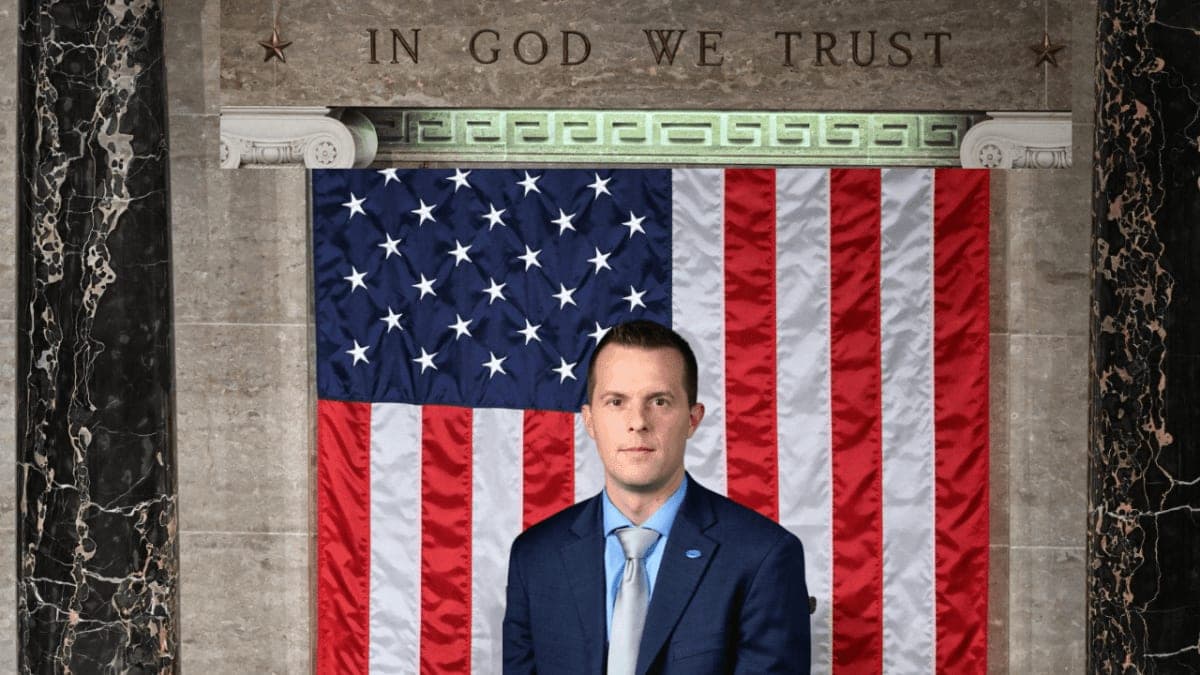
One Vote, One War: How a Lone Democrat Helped Sink Effort to Stop Trump’s Iran Assault
In one of the scariest moments in modern history, we're doing our best at ScheerPost to pierce the fog of lies that conceal it but we need some help to pay our writers and staff. Please consider a tax-deductible donation. Joshua Scheer A razor-thin House vote exposes a widening gap between public opposition to war—and the political will to end it In a moment that should have marked a turning point, the U.S. House instead delivered something else entirely: a reminder of just how fragile—and perhaps illusory—Congressional resistance to war has become. On Thursday, a war powers resolution aimed at halting President Donald Trump’s ongoing assault on Iran failed by a single vote—213 to 214. And the deciding factor wasn’t a bloc of Republicans. It was one Democrat: Rep. Jared Golden of Maine. That lone vote didn’t just tip the scales. It effectively handed the continuation of the war to the executive branch—again. A War Without Authorization—And Still No Exit The resolution would have forced Trump to withdraw U.S. forces from hostilities with Iran unless Congress formally authorized the conflict. It was, at its core, a test of whether lawmakers were willing to reclaim even minimal constitutional authority over war-making powers. They failed. More than six weeks into a war that began on February 28 without Congressional approval, the House has now rejected multiple attempts to rein it in. Thursday’s vote marked the sixth time an Iran-related war powers effort has collapsed in either chamber. And yet, the central facts remain unchanged: No authorization. No clear strategy. No exit plan. Only escalation. Democratic Leadership Under Fire If Golden’s vote was decisive, it was not the only point of contention. Progressive advocates and policy voices are increasingly turning their frustration toward Democratic leadership itself—accusing them of hesitation at a moment that demanded urgency. In the weeks leading up to the vote, leadership delayed bringing the resolution forward, even as tensions escalated and civilian casualties mounted. By the time the measure reached the floor, the political landscape had shifted—and the opportunity may have already slipped away. Demand Progress senior policy adviser Cavan Kharrazian saying “They previously declined to force a war powers vote before a critical period of escalation… Now they have moved forward under less favorable conditions… That inconsistency raises a serious question about what is driving leadership’s priorities: strategy or politics.” adding “We urge members of Congress, Democrats and Republicans alike, to support sustained diplomatic efforts to resolve this conflict,” Kharrazian added. “The American people overwhelmingly reject this war and want a diplomatic end to it.” Of course, that assumes Congress still sees itself as accountable to the public at all. Because if the American people overwhelmingly reject this war—and Congress keeps funding, enabling, and extending it—then the question isn’t just strategy or politics. It’s representation itself. Public Opposition vs. Political Reality What makes the outcome even more stark is the growing disconnect between Washington and the public. By most accounts, the war is deeply unpopular. With one poll from late March reporting that about six-in-ten Americans (61%) disapprove of Trump’s handling of the conflict, while 37% approve. Lawmakers themselves acknowledge it. Rep. Mark Pocan described it plainly: a “war of choice” launched without authorization and without coherent objectives. And yet, despite that recognition, Congress once again declined to act. Advocacy groups warn that this gap—between public opposition and legislative inaction—is narrowing, but not fast enough to stop the machinery already in motion. Ryan Costello, policy director at the National Iranian American Council, described the House’s narrow failure to pass the Iran War Powers Resolution as a “tragic missed opportunity,” while noting that momentum against the war is slowly building. He pointed out that nearly every House Democrat backed the measure—joined by just one Republican—and that several Democrats who had previously opposed similar efforts “took the right side of history” by switching their votes. Still, Costello emphasized that a single additional vote could have ended the conflict, placing particular scrutiny on Rep. Jared Golden, whose opposition helped sustain what he characterized as a disastrous war of choice—one that risks civilian lives, undermines global stability, and prioritizes geopolitical ambitions over American public interest. Despite the setback, Costello argued that public pressure, including from anti-war Iranian Americans, is beginning to shift the political landscape, citing growing Senate opposition to arms sales tied to the broader regional conflict. With stakes spanning U.S. security, the lives of civilians in Iran, and the global economy, he urged lawmakers to redouble diplomatic efforts before further damage is done. Because once a war begins, inertia becomes policy. The Cost of One Vote Golden’s decision now carries weight far beyond a single roll call. It raises immediate political consequences—particularly in a state like Maine, where veterans and anti-war sentiment run deep. But more broadly, it underscores a systemic reality: it doesn’t take a majority to sustain a war. Sometimes, it takes just enough inaction—and one vote in the wrong direction. The Bigger Picture: A Pattern, Not an Exception This isn’t an isolated failure. It’s part of a longer pattern. Again and again, Congress signals discomfort with war—questions its rationale, criticizes its execution, acknowledges its unpopularity—only to ultimately allow it to continue. The result is a political structure where accountability dissolves in real time. Where wars are declared without being declared. Where opposition exists without consequence. Where votes happen—but nothing changes. Call it what it is: not dysfunction, not gridlock—permission. Wars like this don’t survive on strategy. They survive on cowardice, calculation, and just enough political cover to keep the bombs falling. One vote didn’t just fail to stop the war—it helped legitimize it. And the next escalation will arrive wrapped in the same silence. Subscribe Editor’s Note: At a moment when the once vaunted model of responsible journalism is overwhelmingly the play thing of self-serving billionaires and their corporate scribes, alternatives of integrity are desperately needed, and ScheerPost is one of them. Please support our independent journalism by contributing to our online donation platform, Network for Good, or send a check to our new PO Box. We can’t thank you enough, and promise to keep bringing you this kind of vital news. Donate Online Send a Check You can also make a donation to our PayPal or subscribe to our Patreon. Please share this story and help us grow our network!
One Vote, One War: How a Lone Democrat Helped Sink Effort to Stop Trump’s Iran Assault
In one of the scariest moments in modern history, we're doing our best at ScheerPost to pierce the fog of lies that conceal it but we need some help to pay our writers and staff. Please consider a tax-deductible donation. Joshua Scheer A razor-thin House vote exposes a widening gap between public opposition to war—and the political will to end it In a moment that should have marked a turning point, the U.S. House instead delivered something else entirely: a reminder of just how fragile—and perhaps illusory—Congressional resistance to war has become. On Thursday, a war powers resolution aimed at halting President Donald Trump’s ongoing assault on Iran failed by a single vote—213 to 214. And the deciding factor wasn’t a bloc of Republicans. It was one Democrat: Rep. Jared Golden of Maine. That lone vote didn’t just tip the scales. It effectively handed the continuation of the war to the executive branch—again. A War Without Authorization—And Still No Exit The resolution would have forced Trump to withdraw U.S. forces from hostilities with Iran unless Congress formally authorized the conflict. It was, at its core, a test of whether lawmakers were willing to reclaim even minimal constitutional authority over war-making powers. They failed. More than six weeks into a war that began on February 28 without Congressional approval, the House has now rejected multiple attempts to rein it in. Thursday’s vote marked the sixth time an Iran-related war powers effort has collapsed in either chamber. And yet, the central facts remain unchanged: No authorization. No clear strategy. No exit plan. Only escalation. Democratic Leadership Under Fire If Golden’s vote was decisive, it was not the only point of contention. Progressive advocates and policy voices are increasingly turning their frustration toward Democratic leadership itself—accusing them of hesitation at a moment that demanded urgency. In the weeks leading up to the vote, leadership delayed bringing the resolution forward, even as tensions escalated and civilian casualties mounted. By the time the measure reached the floor, the political landscape had shifted—and the opportunity may have already slipped away. Demand Progress senior policy adviser Cavan Kharrazian saying “They previously declined to force a war powers vote before a critical period of escalation… Now they have moved forward under less favorable conditions… That inconsistency raises a serious question about what is driving leadership’s priorities: strategy or politics.” adding “We urge members of Congress, Democrats and Republicans alike, to support sustained diplomatic efforts to resolve this conflict,” Kharrazian added. “The American people overwhelmingly reject this war and want a diplomatic end to it.” Of course, that assumes Congress still sees itself as accountable to the public at all. Because if the American people overwhelmingly reject this war—and Congress keeps funding, enabling, and extending it—then the question isn’t just strategy or politics. It’s representation itself. Public Opposition vs. Political Reality What makes the outcome even more stark is the growing disconnect between Washington and the public. By most accounts, the war is deeply unpopular. With one poll from late March reporting that about six-in-ten Americans (61%) disapprove of Trump’s handling of the conflict, while 37% approve. Lawmakers themselves acknowledge it. Rep. Mark Pocan described it plainly: a “war of choice” launched without authorization and without coherent objectives. And yet, despite that recognition, Congress once again declined to act. Advocacy groups warn that this gap—between public opposition and legislative inaction—is narrowing, but not fast enough to stop the machinery already in motion. Ryan Costello, policy director at the National Iranian American Council, described the House’s narrow failure to pass the Iran War Powers Resolution as a “tragic missed opportunity,” while noting that momentum against the war is slowly building. He pointed out that nearly every House Democrat backed the measure—joined by just one Republican—and that several Democrats who had previously opposed similar efforts “took the right side of history” by switching their votes. Still, Costello emphasized that a single additional vote could have ended the conflict, placing particular scrutiny on Rep. Jared Golden, whose opposition helped sustain what he characterized as a disastrous war of choice—one that risks civilian lives, undermines global stability, and prioritizes geopolitical ambitions over American public interest. Despite the setback, Costello argued that public pressure, including from anti-war Iranian Americans, is beginning to shift the political landscape, citing growing Senate opposition to arms sales tied to the broader regional conflict. With stakes spanning U.S. security, the lives of civilians in Iran, and the global economy, he urged lawmakers to redouble diplomatic efforts before further damage is done. Because once a war begins, inertia becomes policy. The Cost of One Vote Golden’s decision now carries weight far beyond a single roll call. It raises immediate political consequences—particularly in a state like Maine, where veterans and anti-war sentiment run deep. But more broadly, it underscores a systemic reality: it doesn’t take a majority to sustain a war. Sometimes, it takes just enough inaction—and one vote in the wrong direction. The Bigger Picture: A Pattern, Not an Exception This isn’t an isolated failure. It’s part of a longer pattern. Again and again, Congress signals discomfort with war—questions its rationale, criticizes its execution, acknowledges its unpopularity—only to ultimately allow it to continue. The result is a political structure where accountability dissolves in real time. Where wars are declared without being declared. Where opposition exists without consequence. Where votes happen—but nothing changes. Call it what it is: not dysfunction, not gridlock—permission. Wars like this don’t survive on strategy. They survive on cowardice, calculation, and just enough political cover to keep the bombs falling. One vote didn’t just fail to stop the war—it helped legitimize it. And the next escalation will arrive wrapped in the same silence. Subscribe Editor’s Note: At a moment when the once vaunted model of responsible journalism is overwhelmingly the play thing of self-serving billionaires and their corporate scribes, alternatives of integrity are desperately needed, and ScheerPost is one of them. Please support our independent journalism by contributing to our online donation platform, Network for Good, or send a check to our new PO Box. We can’t thank you enough, and promise to keep bringing you this kind of vital news. Donate Online Send a Check You can also make a donation to our PayPal or subscribe to our Patreon. Please share this story and help us grow our network!
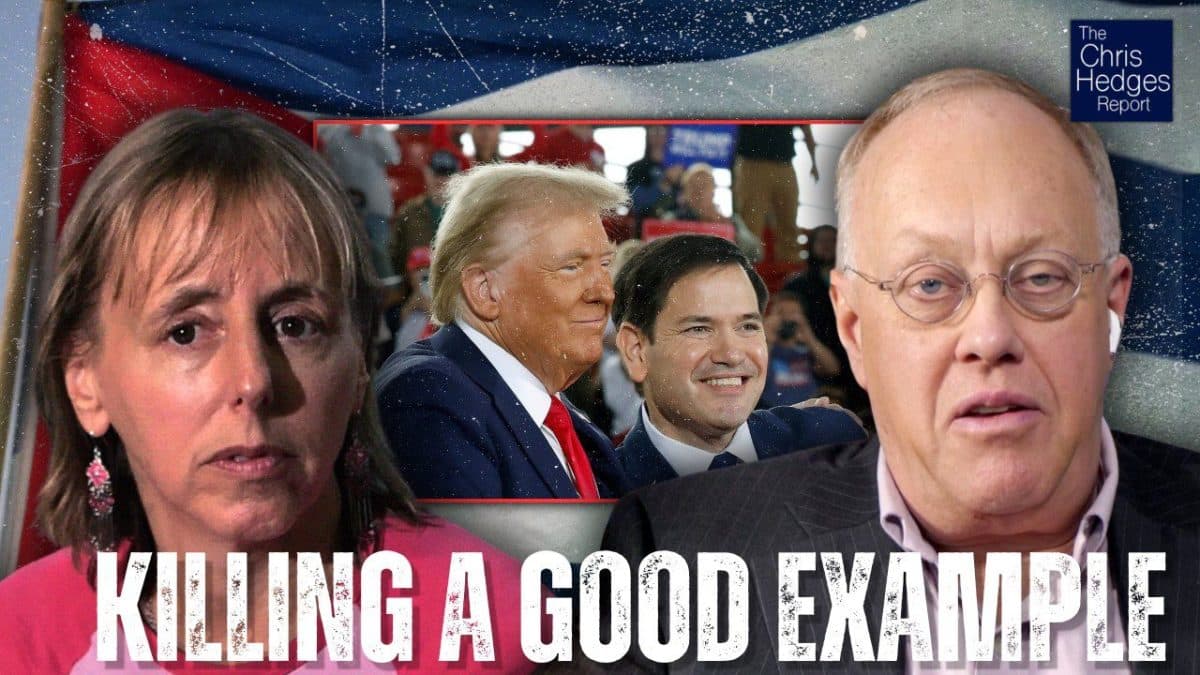
The Trump Administration’s War on Cuba (w/ Medea Benjamin) | The Chris Hedges Report
In one of the scariest moments in modern history, we're doing our best at ScheerPost to pierce the fog of lies that conceal it but we need some help to pay our writers and staff. Please consider a tax-deductible donation. The US economic strangulation of Cuba has created unbearable hardships for the population. Medea Benjamin describes what she saw on a recent solidarity delegation and how we can break the blockade. Chris Hedges Medea Benjamin, a co-founder of the antiwar organization CODEPINK, speaks with Chris Hedges about her recent visit to Cuba as part of one of the many humanitarian delegations that have visited the island in response to the severe economic blockade imposed by the Trump administration. Benjamin describes the current situation as “dire”, the worst she has experienced in her 50 years of solidarity work with Cuba, referring to the escalation of the blockade as a “medieval siege.” The fuel shortages have had deadly impacts, imposing nationwide power outages. Sanctions and the blockade have created shortages of food, medicine and other necessities. Benjamin recounts, “People can’t go to work because the buses aren’t working or if they got to work, there’s no electricity or no materials.” She says that doctors and teachers are leaving the country because their salaries are too low to survive. The U.S. media blame the hardships in Cuba on its communist government, but Benjamin shares the advancements that have been made since the Revolution, despite enduring more than sixty years of U.S.-imposed sanctions. A poor country of ten million, Cuba created a once-enviable universal healthcare system and an excellent education system that is free to residents. Now, many of those gains, such as reductions in infant mortality and improvements in life expectancy, are deteriorating under the boot of American imperialism. Delegations have traveled to Cuba from all over the world this year to bring solar panels, medicines and other necessities. Palestinians participated in the delegation that Benjamin helped to organize, and they witnessed many similarities between Cuba and Gaza. In addition to the shortages, another similarity is the growing power of the Cuban-American lobby that supports the blockade, which is modeled on the Israeli-American lobby, AIPAC. Despite this, the situation in Cuba is so severe that even many members of Congress can no longer deny the cruelty of the situation. There are two new pieces of legislation in Congress that CODEPINK and other Cuba solidarity organizations support. Benjamin urges people to take action in any way that they can because she believes Cubans will not be able to endure the hardships of the blockade for much longer. Host Chris Hedges Executive Producer: Max Jones Intro: Margaret Flowers Transcript: Margaret Flowers Crew: Sofia Menemenlis and Thomas Hedges Subscribe Please share this story and help us grow our network! Transcript Chris Hedges: The Trump administration, after targeting Venezuela and Iran, seems intent on overthrowing the Cuban government. It has orchestrated a siege of the island, cutting off vital Venezuelan oil shipments three months ago. This has left Cuba’s economy without imported oil, as well as diesel, gasoline, jet fuel, and liquefied petroleum gas. Cuba relies on those shipments for about 60 % of its energy. Cuba is now enduring massive power outages, including two island-wide blackouts in recent days. Trump’s executive order of January 29th, 2026, states, “The policies, practices and actions of the government of Cuba constitute an unusual and extraordinary threat to U.S. national security and foreign policy.” The order charges that the Cuban government blatantly allows Russia and China, which reportedly has four listening posts on the island, to base sophisticated military and intelligence capabilities there that threaten US national security. It notes that Cuba hosts Russia’s largest overseas signals intelligence facility, which tries to steal sensitive national security information of the United States. The Trump White House has invoked the International Emergency Economic Powers Act of 1977, which empowers the US to impose tariffs on foreign countries that “directly or indirectly supply oil to the Cuban government”. This has resulted in transportation shortages, reduced working hours, flight cancellations, along with shortages, not only of fuel, but of food, medicine, and vital equipment, including medical equipment. The Justice Department has indicted several Cuban officials and entities for their alleged involvement in drug trafficking, a tactic that is also being used to target Colombia’s president, Gustavo Petro. “Cuba is going to fall pretty soon,” Trump announced. “They want to make a deal. And so, I’m going to put Marco over there and we’ll see how that works out. We’re really focused on this one right now, [he meant Iran]. We’ve got plenty of time, but Cuba’s ready after 50 years. I’ve been watching it for 50 years and it’s fallen right into my lap because of me, it’s fallen, but it’s nevertheless fallen right into the lap and we’re doing very well.” The goal is the reassertion of US imperialism over the island, which the Cuban revolution led by Fidel Castro vanquished in 1959. If Trump fails to achieve his objectives in Iran, which increasingly seems likely, he appears ready to shift his focus to Cuba. With the kidnapping of the Venezuelan president, Nicolas Maduro, and the collapse of the Soviet Union, Cuba has few allies that can come to its aid, although a Russian tanker carrying 730,000 barrels of crude oil appears headed to Cuba. Joining me to discuss the war on Cuba is Medea Benjamin, a co-founder of the anti-war group CODEPINK, who just returned from a trip to Cuba where she and other solidarity groups delivered humanitarian aid and supplies, including medicine, solar panels, bicycles, and food. So, Medea, you were slammed in the Washington Post. Although I think this says a lot more about the Washington Post than it does about you. The title says: “Useful idiots visit Cuba right on time.” I’m just going to read a couple sentences and let you respond: “Communism has impoverished the island. American Leftists only care now because they can blame Trump. Leftists from around the world descended on Cuba over the weekend for a ‘humanitarian trip’ [in their quotes] aimed at protesting the United States’ oil blockade and they played the role of useful idiots perfectly. Nothing says solidarity like going to an impoverished country and staying at a five-star hotel.” Further down: “The best way to help the Cuban people, of course, would be to free them from a dictatorship that has failed to meet their needs for more than half a century. Yet the roster of attendees was more interested in bashing America. And then, while the socialist tourists might blame American sanctions for the island’s decline, Cubans overwhelmingly believe the people who have run their economy since 1959 are at fault.” And the last line, “The truth is that these activists only care about Cubans now that they have an excuse to rail against America. The shtick might have been more convincing without the parties.” I’m sure you were partying night and day in Cuba. But let’s just, I just couldn’t believe it. It sounds like something out of the National Review, or maybe the Onion, I don’t know. Medea Benjamin: Or the New York Post. Chris Hedges: Yeah. Medea Benjamin: So, you want me to react to that, Chris? Chris Hedges: Well, yeah, I mean, it’s such a slam and it’s such a distortion of history. I mean, we’ve been strangling Cuba since its inception. Medea Benjamin: Well, absolutely. And you know, it was interesting that it was such a multi-generational group. We had 170 people in our charter plane that we took with all of these medicines. And some of them were young Cubans, “Cuban Americans for Cuba”, they’re called. Some of them had never been to Cuba before. And many of us older folks have been doing work around Cuba for many decades. So, to say we just came at this to bash Trump is kind of funny because I’ve been going to Cuba since 1979 and trying to change US policy since then. So, that’s one thing. The other is this issue of putting all the blame on the communist government. You know, there’s such an easy answer for that, Chris, which is, well, lift the sanctions and then you can blame everything on the communist government. We’ve been saying that for years after years after years, but they don’t want to do that because they want the Cuban economy to be in tatters so they can say communism doesn’t work, people rise up, let’s put U.S. golf courses and Trump Towers all over the island. And in terms of us staying in fancy hotels, I find that one pretty funny too because there is a list that we could scroll, it would go on and on and on of hotels that the US government says we are not allowed to stay in because they say they’re somehow connected to the Cuban military. So, there’s only five hotels that we are allowed to stay in. They are all “luxury hotels”, and they are all owned by foreign companies. We stayed in the one that was called Iberostar. It’s a Spanish-owned company. And we also stayed there for, well, two other reasons. One, they gave us a very good price, and two, it was centrally located because the others are farther away and we didn’t want to use buses. We didn’t want to be consuming much fuel. So, we only used buses to get from the airport to the hotel and back to the airport. And for most of the time, we walked and walked and walked in the hot sun. And it was very good for people to do that because this is something the Cubans do every day. When we had breakfast in the hotel and we would ask the workers, “How did they get there in the morning?” They’d say, “I walked three miles. I walked four miles.” So, we tried to have a gentle footprint, but I guess that didn’t impress the Washington Post. Chris Hedges: Let’s talk about where Cuba is. I mean, Cuba has been beset, of course, by sanctions for decades. And, just quickly, all sorts of attempts by the CIA to overthrow the Castro government, the invasion of the Bay of Pigs, which was foiled by Cuba during the Kennedy administration. I think there were seven concerted assassination attempts against Castro himself. I mean all sorts of weird stuff like exploding cigars, if I remember, and, I don’t know, poison pieces of coral or something. I don’t remember what it all was. But this war on Cuba has never abated, although in many ways what’s happening now, and I’ll let you comment on that, is perhaps the most severe. Medea Benjamin: Yes, I mean it did abate a little bit during Obama when there were some openings and some of the sanctions were lifted and we saw a flowering of private enterprise and of tourists coming and the economy really picked up and it was good for US people and it was good for Cuban people, but unfortunately, the Trump administration rolled that back, and the Biden administration didn’t do anything to improve relations, and then we’re stuck with Trump again. Now, when you say it’s worse than ever, yes, that’s absolutely true because of this bragging by Trump that not a drop of oil has reached the island in over three months. The U.S. Venezuela not to send oil, it forced Mexico not to send oil. We’re going to see what happens with this Russian tanker, and that should be interesting. But, as you said Chris, this is not new. And I just want to point out some of the ways that the U.S. has sabotaged the Cuban economy for so long. One is, this is a Caribbean island, and in small countries like in Central America and the Caribbean, one of the main sources of income is remittances, what people from those countries move to richer countries like the United States or to Spain and send back to their relatives. The U.S. has made it very difficult to even send money to your family on the island. Then there’s the issue of tourism. Also, a mainstay of Caribbean countries. The U.S. has made it so hard for tourism to thrive on the island. You can’t go as a tourist to lie on the beaches. You have to fit into one of the categories to be able to go. That’s not very hard. People think it’s harder than it is, and that’s why so many people don’t go. But, our European friends, they can’t get the same US visa if they’ve been to Cuba. And since COVID, tourism has really taken a dive. And now, with Donald Trump, the conditions are even difficult for tourists if you can’t get around, if the buses aren’t functioning, that kind of thing. So, tourism has really been impacted. And then there’s one source of income that I always thought was brilliant for Cuba and the world. And that was the medical professionals that they were sending around the world. These Cuban doctors and nurses that went to both poor countries that was often paid for by UN agencies, and went to wealthier countries, like Italy during COVID, that was paid for by the countries themselves. That became a major source of income for Cuba. And the US government went in there and systematically threatened countries to not accept Cuban doctors, to expel Cuban doctors that were there, even telling countries not to send their students to study for free in the medical school in Cuba. So, these are just some of the ways that the U.S. has been sabotaging. And of course, being on the State Sponsor of Terrorism List means that you can’t use the international financial system, the SWIFT system, which means you can’t trade in the international arena. So, this is not new, but not getting fuel is a whole new level. And nobody can say right now that there’s not a blockade on Cuba. Everybody can see it now, and it’s devastating. Chris Hedges: The island has only 10 million people. Why throughout its history has Cuba been seen by the United States as such a threat? Medea Benjamin: Well, I think at one point it was a threat of a good example, a threat because it did have a thriving health care system that led Cuba to have a lower infant mortality rate than most places in the United States, a higher life expectancy rate, a family doctor system that was the envy of people around the world. I mean, imagine, Chris, having your doctor in your neighborhood. It was one doctor to like 125 families. They would actually know you. They would know what your health condition was. They would visit you in your home. I mean, it was a beautiful system. It’s so frayed right now because the poor doctors are earning a miserable salary and many are leaving the profession and they don’t have materials to work with. But it still remains a totally free system. And that’s a threat to all the people in the U.S. that profit from making our health care for-profit lousy system. The other thing is that in the beginning the educational, the literacy program was really a major, major breakthrough in taking a poor society with a high literacy rate, turning it into an educated population where you could get free education up into a PhD. It was also seen as a threat because of the relationship with Russia, which even after the Cuba Missile Crisis, U.S. maintained relations with what was the Soviet Union until the time that it broke up in 1991. And then, there are all the Cuban Americans, and I shouldn’t say all because it’s actually a small group of Cuban Americans, that left the island after the revolution and have been outraged ever since that they lost some of their properties and have been constantly pushing the US government to overthrow the Cuban government so that they could get their properties back. And then they’re finally, I want to say that this Cuban-American group has become very powerful. They have modeled themselves after the pro-Israel lobby group called AIPAC, and they are a very, very powerful foreign lobby group for such a small population. They get millions of our tax dollars. They get them year after year to spread propaganda against the Cuban government. They have elected Cuban-Americans to office like Maria Elvira Salazar, Carlos Gimenez, Díaz-Balart, whose entire careers are built on this anti-Cuban government policy. And so those are some of the reasons. And then finally, let me say that there has been a contest for Florida between the Democrats and Republicans, and the Democrats have thought that they could win back some seats in Florida if they took this hardline position. It hasn’t worked out for them, but they continue to think that it’s in their favor to be not only bashing the Cuban government, but hurting the Cuban people. Chris Hedges: So, the response of the Cuban government has been to offer concessions. I think they’ve even said they would negotiate with Cuban exiles over reparations for their property. They’ve talked about loosening restrictions on foreign investment. Can you speak a little bit about how the Cuban government is responding? Medea Benjamin: Well, the Cuban government has always been open to talks and actually having talks with the US about migration issues and about drugs. And the Cuban government has been very helpful in combating drugs in the Caribbean. But these issues now about investment, Cuba has opened to private enterprise, not in a big way, but in a very significant way. You can have private companies. You can hire up to 100 people. I would say most of the Cubans now are working in some form or another in the private sector because the government sector has collapsed in many ways. And the Cuban Americans are allowed to support enterprises in Cuba. And in fact, every small store that you see as you walk along in the streets, not only in Havana, but other cities, are mostly there thanks to investments from their relatives in the United States. But what the Trump administration wants is big stuff. It wants to own land. It wants to be able to build whatever it wants and have U.S. companies come in and take over things that have been nationalized. So, those are things, actually, that the Cuban government is willing to talk to. And as you said, they recently said that they’re willing to talk about compensation. Now when the Cuban government started to nationalize foreign properties in the early 1960s, all of the other countries negotiated and worked out a deal with the Cuban government. The U.S. was the only country that refused to work out a deal. But the Cubans are saying right now, let’s work it out. Let’s have normal trade relations with the United States. Chris Hedges: What are the consequences if this siege continues, which I assume it will, what are going to be the consequences within Cuba? Medea Benjamin: You know, Chris, I can’t even imagine this siege continuing because it is really breaking down the ability to have a normal life. People can’t go to work because the buses aren’t working or if they got to work, there’s no electricity or no materials. So, what are you supposed to do? The children are having a hard time getting to school. Many of the teachers have left because their salaries are so bad. The hospitals are barely functioning. The doctors there are heroes, still holding on, still trying to attend to their patients with the little that they have. But when you don’t even have access to hot water in the hospital, much less analgesics and all kinds of things like sutures, basic things needed for operations, the government has said there are 60,000 people waiting to get operated on and 11,000 of them are children. The infant mortality rate is rising. The cancer patients can’t get their treatment. Diabetes patients can’t get their treatments. So, this is causing severe misery in Cuba right now. You see the garbage piled up in the streets because they don’t have the gasoline for the trucks. In the hotter months, that led to an outbreak of three different mosquito-borne diseases that affected one-third of the population. How long can this last? I don’t know. I don’t know. I can’t see this going on for another six months, for example, because people are just desperate. And I’m hoping that there are talks between the US and Cuba. And we hear that there are, but I don’t know what they are. But I hope that there are, because something has to give. And I’m also hoping that more and more people are starting to realize how dire the situation is in Cuba, how medieval this siege is on the Cuban people, how hypocritical is to say that you care about human rights in Cuba and yet you’re denying the people the basics of life. So, I’m hoping more people are becoming educated and active. We just came back from our trip to Cuba and I ran into Congress today to be with a group of 10 people that were going around asking them to support a War Powers Act saying that Trump does not have the right to invade Cuba, but also an act called the US-Cuba Trade Act to lift these restrictions. And as we went to the offices, we started out with the Democrats, and they were extremely sympathetic because they had heard about the conditions on the island. So, I think people are waking up to what is happening, and I’m hoping that we can apply some significant pressure on our government. Chris Hedges: Although every attempt by the Cuban government to reach out is rebuffed by Marco Rubio. Medea Benjamin: Well, certainly that has been the case, but you know, like we’re seeing in Iran and we saw in Venezuela, there’s not always a 100 % agreement between Marco Rubio and Trump when it comes to policies. I’m sure Marco Rubio wanted to overthrow the entire government in Venezuela, but Trump was content to kidnap Maduro and his wife and to keep the rest of the government in place as long as he could get greater access, because there was already Chevron working in Venezuela, but greater access for US companies. The same might be true in the case of Cuba, where Marco Rubio definitely wants to have the historic opportunity to overthrow the Cuban government, but maybe Trump is content with some lesser kind of agreement in Cuba where there would be a greater openness to investments. So, we shall see. I don’t think we should think that Marco Rubio has the absolute word on what will happen with Cuba. Chris Hedges: How likely do you see the possibility of an actual ground invasion? Medea Benjamin: The U.S. keeps saying they are not contemplating a ground invasion in Cuba, yet we can’t take our government’s word for anything. I can’t imagine a ground invasion, but I couldn’t imagine the U.S. invading and starting this war with Iran either. I think the Cuban military would be very hard pressed to defeat a military attack by the U.S. But a ground invasion would be a different story. And I don’t think Cuban Americans really want to see their relatives bombed, although many of them seemed okay with seeing them starved. So, I don’t know what the likelihood of a military invasion would be. Chris Hedges: When you were in Cuba, what surprised you the most? Medea Benjamin: What surprised me was the level of resignation that many people had. That even though they hated the idea of Trump saying he was going to take over the country and do whatever he wanted, many people I talked to on the street said, “Whatever, just get us out of this misery. We can’t keep going like this.” And so that is something I haven’t seen. And I want to say, Chris, that I’ve been going to Cuba for many years. This is not the Cuba that I knew. There are so many people begging in the streets. I never saw beggars when I first went to Cuba. There are people, not a lot of homeless, but there are. I didn’t see that before. And the level of inequality is so great because the salaries are $20 a month, $25 a month, and the prices are so high for local people. And so, it’s a similar situation that we see in a place like Gaza, where you see food in the marketplace, but people don’t have the money to buy it. On the other hand, those people who have relatives overseas are in a much better position, and there now are very wealthy Cubans. And one of the things that our speakers talked to us about was the increase in racial disparities because those with relatives overseas that have money to send back tend to be white Cubans. And so, the ones who tend to have the businesses inside Cuba are white Cubans. And it’s the black Cubans who tend to bear the brunt of this economic strangulation. Chris Hedges: When you talk about the buses aren’t running, how severely impacted is transportation? Are the streets empty? Medea Benjamin: The streets are unbelievably sparsely, cars, there are some cars. There are some electric vehicles. There are some vehicles that have managed to get gasoline on the black market, which was very, very expensive. And what they’re coming up with is some very innovative electric vehicles. There are something called the Tricicletas, three-wheelers, electric and they can fit six people in the back and they’re used for transporting goods as well as people. There are electric motorcycles that people have, And the few cars that are in the road, people are hitchhiking and the people with cars are very sympathetic and are constantly stopping to pick people up. We asked our guides, “How do you get here?” And one of them said,” I hitchhike back and forth every day.” She sometimes has to wait quite a while for a car to pick her up. But there is this solidarity economy where people really help each other. So even though in a country where there is not that sense of collectivism, you would see a lot more hunger, a lot more misery, and Cuba, they’re managing to get by because of this kind of solidarity. I’ve been to the eastern part of the island recently. There was even less traffic there. But what I found in Holguín, for example, was a revival of the use of the horse and buggy. And the carts were taking people around. The carts were also picking up garbage on the street. And that made it much cleaner than in Havana. But I asked about horses in Havana. And I’m sure there are some restrictions, but people told me there’s not even enough food to keep the horses healthy enough to provide that kind of transportation. Chris Hedges: And this effort was multinational. There was a flotilla that left from Mexico, but there were all sorts of nationalities that participated in this attempt to bring, it ends up being symbolic, but attempt to bring in humanitarian aid and protest the siege, is that correct? Medea Benjamin: You know, our presence really boosted the spirit of Cubans. We couldn’t walk around the street without people coming up to us and saying, “Thank you for your solidarity. I saw you on television. Thank you.” So, we were coming from all over Europe. There were delegations from Italy, from Spain. There were people from Colombia, Brazil, a lot of people from Mexico and there were a lot of us from the United States. There were 170 in our group, but there were also groups coming with different organizations, the People’s Forum, Global Exchange. There were people there from the National Network on Cuba, this group of Cuban Americans that I mentioned, the Cuban Americans for Cuba. So, we were hundreds of people and it was wonderful going around town and seeing people and lots of high fives and solidarities and it really was a boost. And the boats we had a problem with, because the insurance companies did not want to insure boats to go to Cuba. And they were also afraid of the threats from Trump. So, we did manage to get one boat that carried about 30 people and then a couple of sailboats. And the bigger boat just arrived in Cuba today to a really wonderful welcome. And there were people on that boat coming from all over. And one of the real connections that was made was the solidarity movement around Gaza and Palestine and in Cuba. On our delegation, we had Palestinian professionals, we had Palestinian writers, we had Palestinian health workers, Doctors Against Genocide, and they met up in Cuba with the Palestinians who had been studying at medical school and some who had already graduated. And that was a beautiful coming together. And also on the boat, we have a lot of people, and also in our delegation, who are part of the Global Sumud Flotilla and will be part of the upcoming Global Sumud Flotilla that will be happening in April. So, there were a lot of connections between people who have been advocating for the Palestinian people and now many of them newly aware of the problems in Cuba and many similarities that the Cubans and the Palestinians face. Chris Hedges: When you meet with lawmakers, if they are sympathetic, what are you asking for? Medea Benjamin: So, there’s this War Powers Act in the Senate and in the House starting today, and that is a bill that says that Trump without going to Congress cannot invade Cuba. It’s very important, even symbolically, to have that kind of vote. And of course, we’re pushing all of the Democrats and trying to get some Republicans to be on board as well. Things are so partisan in Congress, and the Republicans are so afraid of going against Trump. But we hope we will get some of them on this as well, because many of them are not happy with what’s happening in Iran. And this would be a chance for them to show that they don’t support the US sticking its nose in all these other countries. So that’s one. And then there is another bill that was introduced recently by Jim McGovern. It’s House Resolution 1721, the US-Cuba Trade Act, which would lift the embargo and would allow U.S. companies to trade with Cuba. So, this is what we’re asking for. And I must say that today we got a lot of sympathy. I managed to speak directly to some members of Congress and they say, “Oh, I’m just so, so upset about what is happening in Cuba and glad there’s finally some bill that they can show their support for.” Of course, these people could have introduced their own bill a long time ago and didn’t. But I think we will get quite a good support in Congress. Chris Hedges: Is there anything else you want to add, Medea, before we go? Medea Benjamin: Yes. We also are trying to have trips to Cuba on a regular basis, going and going and going, because we found that people who couldn’t get on this trip, they really want to go. So, you can check the CODEPINK website for the next trips. And the other thing is to do your own fundraisers for Cuba. It’s a great way to bring people together, to talk about what’s happening, to raise some money, to give it to one of the many organizations that is raising money for solar panels or for medicines to Cuba. So those are other things that people can do. Chris Hedges: Great. Thank you, Medea. And I want to thank Sophia, Thomas, and Max, who produced the show. You can find me at chrisedges.substack.com

“Alligator Alcatraz” Guards Allegedly Beat Prisoners for Requesting Phone Access
In one of the scariest moments in modern history, we're doing our best at ScheerPost to pierce the fog of lies that conceal it but we need some help to pay our writers and staff. Please consider a tax-deductible donation. Renée Feltz for Truthout On April 2, guards at the remote Immigration and Customs Enforcement (ICE) jail known as “Alligator Alcatraz” allegedly brutally beat several detained men who demanded access to phones. It took nearly a week for word to get out. Six days after the reported attack, Raiko Lopez Morffi’s right eye was still swollen and black during a video call with his lawyer Katie Blankenship, who took screenshots of his injured face and arm. Another man held in the same cage with Morffi, Lazaro Hernandez Galban, spoke to Blankenship on April 10 about the incident and told her he and others were loudly asking, “When are we going to get the phones back?” after service was cut for an entire day without warning or explanation. Galban said one guard told him to “watch what you say” before a group of them entered the cage in a cloud of tear gas that prompted an older detained man to pass out, and began to beat and kick Morffi and others. Blankenship said Morffi “does not know which guards were involved, as they do not wear ID badges, but he believes he would recognize them.” She told Truthout he never received medical care and was instead placed in solitary confinement. “Cutting them off from just the very last thread of access they have to the world is a big deal,” Blankenship added. “It’s like a strategy of obstruction.” ACLU lawyers argued guards are engaging in obstruction and noncompliance on April 13, in their first hearing with U.S. District Judge Sheri Polster Chappell since her March 27 order demanded officials who operate the facility in the Florida Everglades provide constitutionally guaranteed “access to timely, free, confidential, unmonitored, unrecorded outgoing legal calls.” Phone access can make a huge difference in whether someone gets deported, as Truthout has reported. The ACLU cited the April 2 incident as an example of how state and federal officials in charge of running the facility are making little effort to comply with the judge’s order, and people held there are suffering as a result. Judge Chappell appeared to agree, for the most part, telling officials to “stop sandbagging the court.” She did not move to require officials to submit evidence of their compliance, as suggested by the ACLU and “vigorously” rejected by Nicholas Meros, attorney for the Florida officials in charge of the immigration jail. Meros said “the quickest and most practical option” for meeting a part of the judge’s order to provide access to at least one phone for every 25 people jailed at the camp was “to have a large amount of cellphones, approximately 80 or 90, using Starlink,” which he said is already used on site. He noted that officials had rejected other options like building a cell phone tower, and “are moving forward” with the other plan “as quickly as we can.” ACLU attorney Corene Kendrick told Truthout she was disturbed by how Florida and ICE officials were taking such a “flippant stance toward the court’s order” by not already having the new cell phones in use, noting that Gov. Ron DeSantis cut no-bid contracts with Republican donors to erect and open the jail in just eight days last July. Democratic Senators Jon Ossoff of Georgia and Dick Durbin of Illinois have launched an inquiry over the “credible allegations” raised in this case that people held at Alligator Alcatraz faced constitutional violations, including lack of access to phones and lawyers and “particularly egregious” claims that they “have been punished with confinement in a small cage-like structure known as ‘the box,’ where they are held in stress positions with hands and feet tightly shackled for hours at a time, in direct sunlight with no access to food or water.” Immigrant rights advocates argue ICE’s entire immigration detention system is inherently abusive. “When ICE puts a person in solitary confinement, the agency is subjecting them to a form of torture where their life hangs in the balance,” Carly Pérez Fernández, communications director of Detention Watch Network, told Truthout. “We denounce the abuse at Everglades and demand people be immediately released and the facility shut down for good.” The ACLU said in an April 10 filing titled “Notice of Non-Compliance With Court Order” that Alligator Alcatraz was “put on lockdown all week due to several disturbances that were precipitated by the facility’s denial of phone access.” At the April 13 hearing, Judge Chappell said she “does not intend to … serve as a super warden,” for Alligator Alcatraz, but expects the demands she laid out in her March 27 order to be met. Lawyers for Florida officials have appealed the order, even though they argue they are already meeting the requirements. Assistant United States Attorney Chad Spraker told the court that federal officials “had no position” on whether to stay the case proceedings as that appeal plays out before a magistrate judge. The ACLU of course has no plans to ask the court to delay the proceedings, either. “The open defiance of an order like this one, I think, is what sets Alligator Alcatraz aside,” ACLU attorney Carmen Iguina Gonzalez told Truthout. “The government should be respecting individuals’ rights to demand access to their attorneys and to speak up when that is being denied without explanation or without reason.” She noted the ACLU has won judicial orders to grant legal access in many ICE jails. In an Arizona case, Iguina Gonzalez said “a judge mandated the facility build additional rooms for virtual appointments,” and while the case is ongoing, “at the very least the contractor there complied with that part of the order.” Renée Feltz is an award-winning investigative journalist whose coverage of immigration, mass incarceration, environmental justice, and more spans 25 years. She is a former news co-director at Democracy Now!. Subscribe Editor’s Note: At a moment when the once vaunted model of responsible journalism is overwhelmingly the play thing of self-serving billionaires and their corporate scribes, alternatives of integrity are desperately needed, and ScheerPost is one of them. Please support our independent journalism by contributing to our online donation platform, Network for Good, or send a check to our new PO Box. We can’t thank you enough, and promise to keep bringing you this kind of vital news. Donate Online Send a Check You can also make a donation to our PayPal or subscribe to our Patreon. Please share this story and help us grow our network!
The Trump Administration’s War on Cuba (w/ Medea Benjamin) | The Chris Hedges Report
In one of the scariest moments in modern history, we're doing our best at ScheerPost to pierce the fog of lies that conceal it but we need some help to pay our writers and staff. Please consider a tax-deductible donation. The US economic strangulation of Cuba has created unbearable hardships for the population. Medea Benjamin describes what she saw on a recent solidarity delegation and how we can break the blockade. Chris Hedges Medea Benjamin, a co-founder of the antiwar organization CODEPINK, speaks with Chris Hedges about her recent visit to Cuba as part of one of the many humanitarian delegations that have visited the island in response to the severe economic blockade imposed by the Trump administration. Benjamin describes the current situation as “dire”, the worst she has experienced in her 50 years of solidarity work with Cuba, referring to the escalation of the blockade as a “medieval siege.” The fuel shortages have had deadly impacts, imposing nationwide power outages. Sanctions and the blockade have created shortages of food, medicine and other necessities. Benjamin recounts, “People can’t go to work because the buses aren’t working or if they got to work, there’s no electricity or no materials.” She says that doctors and teachers are leaving the country because their salaries are too low to survive. The U.S. media blame the hardships in Cuba on its communist government, but Benjamin shares the advancements that have been made since the Revolution, despite enduring more than sixty years of U.S.-imposed sanctions. A poor country of ten million, Cuba created a once-enviable universal healthcare system and an excellent education system that is free to residents. Now, many of those gains, such as reductions in infant mortality and improvements in life expectancy, are deteriorating under the boot of American imperialism. Delegations have traveled to Cuba from all over the world this year to bring solar panels, medicines and other necessities. Palestinians participated in the delegation that Benjamin helped to organize, and they witnessed many similarities between Cuba and Gaza. In addition to the shortages, another similarity is the growing power of the Cuban-American lobby that supports the blockade, which is modeled on the Israeli-American lobby, AIPAC. Despite this, the situation in Cuba is so severe that even many members of Congress can no longer deny the cruelty of the situation. There are two new pieces of legislation in Congress that CODEPINK and other Cuba solidarity organizations support. Benjamin urges people to take action in any way that they can because she believes Cubans will not be able to endure the hardships of the blockade for much longer. Host Chris Hedges Executive Producer: Max Jones Intro: Margaret Flowers Transcript: Margaret Flowers Crew: Sofia Menemenlis and Thomas Hedges Subscribe Please share this story and help us grow our network! Transcript Chris Hedges: The Trump administration, after targeting Venezuela and Iran, seems intent on overthrowing the Cuban government. It has orchestrated a siege of the island, cutting off vital Venezuelan oil shipments three months ago. This has left Cuba’s economy without imported oil, as well as diesel, gasoline, jet fuel, and liquefied petroleum gas. Cuba relies on those shipments for about 60 % of its energy. Cuba is now enduring massive power outages, including two island-wide blackouts in recent days. Trump’s executive order of January 29th, 2026, states, “The policies, practices and actions of the government of Cuba constitute an unusual and extraordinary threat to U.S. national security and foreign policy.” The order charges that the Cuban government blatantly allows Russia and China, which reportedly has four listening posts on the island, to base sophisticated military and intelligence capabilities there that threaten US national security. It notes that Cuba hosts Russia’s largest overseas signals intelligence facility, which tries to steal sensitive national security information of the United States. The Trump White House has invoked the International Emergency Economic Powers Act of 1977, which empowers the US to impose tariffs on foreign countries that “directly or indirectly supply oil to the Cuban government”. This has resulted in transportation shortages, reduced working hours, flight cancellations, along with shortages, not only of fuel, but of food, medicine, and vital equipment, including medical equipment. The Justice Department has indicted several Cuban officials and entities for their alleged involvement in drug trafficking, a tactic that is also being used to target Colombia’s president, Gustavo Petro. “Cuba is going to fall pretty soon,” Trump announced. “They want to make a deal. And so, I’m going to put Marco over there and we’ll see how that works out. We’re really focused on this one right now, [he meant Iran]. We’ve got plenty of time, but Cuba’s ready after 50 years. I’ve been watching it for 50 years and it’s fallen right into my lap because of me, it’s fallen, but it’s nevertheless fallen right into the lap and we’re doing very well.” The goal is the reassertion of US imperialism over the island, which the Cuban revolution led by Fidel Castro vanquished in 1959. If Trump fails to achieve his objectives in Iran, which increasingly seems likely, he appears ready to shift his focus to Cuba. With the kidnapping of the Venezuelan president, Nicolas Maduro, and the collapse of the Soviet Union, Cuba has few allies that can come to its aid, although a Russian tanker carrying 730,000 barrels of crude oil appears headed to Cuba. Joining me to discuss the war on Cuba is Medea Benjamin, a co-founder of the anti-war group CODEPINK, who just returned from a trip to Cuba where she and other solidarity groups delivered humanitarian aid and supplies, including medicine, solar panels, bicycles, and food. So, Medea, you were slammed in the Washington Post. Although I think this says a lot more about the Washington Post than it does about you. The title says: “Useful idiots visit Cuba right on time.” I’m just going to read a couple sentences and let you respond: “Communism has impoverished the island. American Leftists only care now because they can blame Trump. Leftists from around the world descended on Cuba over the weekend for a ‘humanitarian trip’ [in their quotes] aimed at protesting the United States’ oil blockade and they played the role of useful idiots perfectly. Nothing says solidarity like going to an impoverished country and staying at a five-star hotel.” Further down: “The best way to help the Cuban people, of course, would be to free them from a dictatorship that has failed to meet their needs for more than half a century. Yet the roster of attendees was more interested in bashing America. And then, while the socialist tourists might blame American sanctions for the island’s decline, Cubans overwhelmingly believe the people who have run their economy since 1959 are at fault.” And the last line, “The truth is that these activists only care about Cubans now that they have an excuse to rail against America. The shtick might have been more convincing without the parties.” I’m sure you were partying night and day in Cuba. But let’s just, I just couldn’t believe it. It sounds like something out of the National Review, or maybe the Onion, I don’t know. Medea Benjamin: Or the New York Post. Chris Hedges: Yeah. Medea Benjamin: So, you want me to react to that, Chris? Chris Hedges: Well, yeah, I mean, it’s such a slam and it’s such a distortion of history. I mean, we’ve been strangling Cuba since its inception. Medea Benjamin: Well, absolutely. And you know, it was interesting that it was such a multi-generational group. We had 170 people in our charter plane that we took with all of these medicines. And some of them were young Cubans, “Cuban Americans for Cuba”, they’re called. Some of them had never been to Cuba before. And many of us older folks have been doing work around Cuba for many decades. So, to say we just came at this to bash Trump is kind of funny because I’ve been going to Cuba since 1979 and trying to change US policy since then. So, that’s one thing. The other is this issue of putting all the blame on the communist government. You know, there’s such an easy answer for that, Chris, which is, well, lift the sanctions and then you can blame everything on the communist government. We’ve been saying that for years after years after years, but they don’t want to do that because they want the Cuban economy to be in tatters so they can say communism doesn’t work, people rise up, let’s put U.S. golf courses and Trump Towers all over the island. And in terms of us staying in fancy hotels, I find that one pretty funny too because there is a list that we could scroll, it would go on and on and on of hotels that the US government says we are not allowed to stay in because they say they’re somehow connected to the Cuban military. So, there’s only five hotels that we are allowed to stay in. They are all “luxury hotels”, and they are all owned by foreign companies. We stayed in the one that was called Iberostar. It’s a Spanish-owned company. And we also stayed there for, well, two other reasons. One, they gave us a very good price, and two, it was centrally located because the others are farther away and we didn’t want to use buses. We didn’t want to be consuming much fuel. So, we only used buses to get from the airport to the hotel and back to the airport. And for most of the time, we walked and walked and walked in the hot sun. And it was very good for people to do that because this is something the Cubans do every day. When we had breakfast in the hotel and we would ask the workers, “How did they get there in the morning?” They’d say, “I walked three miles. I walked four miles.” So, we tried to have a gentle footprint, but I guess that didn’t impress the Washington Post. Chris Hedges: Let’s talk about where Cuba is. I mean, Cuba has been beset, of course, by sanctions for decades. And, just quickly, all sorts of attempts by the CIA to overthrow the Castro government, the invasion of the Bay of Pigs, which was foiled by Cuba during the Kennedy administration. I think there were seven concerted assassination attempts against Castro himself. I mean all sorts of weird stuff like exploding cigars, if I remember, and, I don’t know, poison pieces of coral or something. I don’t remember what it all was. But this war on Cuba has never abated, although in many ways what’s happening now, and I’ll let you comment on that, is perhaps the most severe. Medea Benjamin: Yes, I mean it did abate a little bit during Obama when there were some openings and some of the sanctions were lifted and we saw a flowering of private enterprise and of tourists coming and the economy really picked up and it was good for US people and it was good for Cuban people, but unfortunately, the Trump administration rolled that back, and the Biden administration didn’t do anything to improve relations, and then we’re stuck with Trump again. Now, when you say it’s worse than ever, yes, that’s absolutely true because of this bragging by Trump that not a drop of oil has reached the island in over three months. The U.S. Venezuela not to send oil, it forced Mexico not to send oil. We’re going to see what happens with this Russian tanker, and that should be interesting. But, as you said Chris, this is not new. And I just want to point out some of the ways that the U.S. has sabotaged the Cuban economy for so long. One is, this is a Caribbean island, and in small countries like in Central America and the Caribbean, one of the main sources of income is remittances, what people from those countries move to richer countries like the United States or to Spain and send back to their relatives. The U.S. has made it very difficult to even send money to your family on the island. Then there’s the issue of tourism. Also, a mainstay of Caribbean countries. The U.S. has made it so hard for tourism to thrive on the island. You can’t go as a tourist to lie on the beaches. You have to fit into one of the categories to be able to go. That’s not very hard. People think it’s harder than it is, and that’s why so many people don’t go. But, our European friends, they can’t get the same US visa if they’ve been to Cuba. And since COVID, tourism has really taken a dive. And now, with Donald Trump, the conditions are even difficult for tourists if you can’t get around, if the buses aren’t functioning, that kind of thing. So, tourism has really been impacted. And then there’s one source of income that I always thought was brilliant for Cuba and the world. And that was the medical professionals that they were sending around the world. These Cuban doctors and nurses that went to both poor countries that was often paid for by UN agencies, and went to wealthier countries, like Italy during COVID, that was paid for by the countries themselves. That became a major source of income for Cuba. And the US government went in there and systematically threatened countries to not accept Cuban doctors, to expel Cuban doctors that were there, even telling countries not to send their students to study for free in the medical school in Cuba. So, these are just some of the ways that the U.S. has been sabotaging. And of course, being on the State Sponsor of Terrorism List means that you can’t use the international financial system, the SWIFT system, which means you can’t trade in the international arena. So, this is not new, but not getting fuel is a whole new level. And nobody can say right now that there’s not a blockade on Cuba. Everybody can see it now, and it’s devastating. Chris Hedges: The island has only 10 million people. Why throughout its history has Cuba been seen by the United States as such a threat? Medea Benjamin: Well, I think at one point it was a threat of a good example, a threat because it did have a thriving health care system that led Cuba to have a lower infant mortality rate than most places in the United States, a higher life expectancy rate, a family doctor system that was the envy of people around the world. I mean, imagine, Chris, having your doctor in your neighborhood. It was one doctor to like 125 families. They would actually know you. They would know what your health condition was. They would visit you in your home. I mean, it was a beautiful system. It’s so frayed right now because the poor doctors are earning a miserable salary and many are leaving the profession and they don’t have materials to work with. But it still remains a totally free system. And that’s a threat to all the people in the U.S. that profit from making our health care for-profit lousy system. The other thing is that in the beginning the educational, the literacy program was really a major, major breakthrough in taking a poor society with a high literacy rate, turning it into an educated population where you could get free education up into a PhD. It was also seen as a threat because of the relationship with Russia, which even after the Cuba Missile Crisis, U.S. maintained relations with what was the Soviet Union until the time that it broke up in 1991. And then, there are all the Cuban Americans, and I shouldn’t say all because it’s actually a small group of Cuban Americans, that left the island after the revolution and have been outraged ever since that they lost some of their properties and have been constantly pushing the US government to overthrow the Cuban government so that they could get their properties back. And then they’re finally, I want to say that this Cuban-American group has become very powerful. They have modeled themselves after the pro-Israel lobby group called AIPAC, and they are a very, very powerful foreign lobby group for such a small population. They get millions of our tax dollars. They get them year after year to spread propaganda against the Cuban government. They have elected Cuban-Americans to office like Maria Elvira Salazar, Carlos Gimenez, Díaz-Balart, whose entire careers are built on this anti-Cuban government policy. And so those are some of the reasons. And then finally, let me say that there has been a contest for Florida between the Democrats and Republicans, and the Democrats have thought that they could win back some seats in Florida if they took this hardline position. It hasn’t worked out for them, but they continue to think that it’s in their favor to be not only bashing the Cuban government, but hurting the Cuban people. Chris Hedges: So, the response of the Cuban government has been to offer concessions. I think they’ve even said they would negotiate with Cuban exiles over reparations for their property. They’ve talked about loosening restrictions on foreign investment. Can you speak a little bit about how the Cuban government is responding? Medea Benjamin: Well, the Cuban government has always been open to talks and actually having talks with the US about migration issues and about drugs. And the Cuban government has been very helpful in combating drugs in the Caribbean. But these issues now about investment, Cuba has opened to private enterprise, not in a big way, but in a very significant way. You can have private companies. You can hire up to 100 people. I would say most of the Cubans now are working in some form or another in the private sector because the government sector has collapsed in many ways. And the Cuban Americans are allowed to support enterprises in Cuba. And in fact, every small store that you see as you walk along in the streets, not only in Havana, but other cities, are mostly there thanks to investments from their relatives in the United States. But what the Trump administration wants is big stuff. It wants to own land. It wants to be able to build whatever it wants and have U.S. companies come in and take over things that have been nationalized. So, those are things, actually, that the Cuban government is willing to talk to. And as you said, they recently said that they’re willing to talk about compensation. Now when the Cuban government started to nationalize foreign properties in the early 1960s, all of the other countries negotiated and worked out a deal with the Cuban government. The U.S. was the only country that refused to work out a deal. But the Cubans are saying right now, let’s work it out. Let’s have normal trade relations with the United States. Chris Hedges: What are the consequences if this siege continues, which I assume it will, what are going to be the consequences within Cuba? Medea Benjamin: You know, Chris, I can’t even imagine this siege continuing because it is really breaking down the ability to have a normal life. People can’t go to work because the buses aren’t working or if they got to work, there’s no electricity or no materials. So, what are you supposed to do? The children are having a hard time getting to school. Many of the teachers have left because their salaries are so bad. The hospitals are barely functioning. The doctors there are heroes, still holding on, still trying to attend to their patients with the little that they have. But when you don’t even have access to hot water in the hospital, much less analgesics and all kinds of things like sutures, basic things needed for operations, the government has said there are 60,000 people waiting to get operated on and 11,000 of them are children. The infant mortality rate is rising. The cancer patients can’t get their treatment. Diabetes patients can’t get their treatments. So, this is causing severe misery in Cuba right now. You see the garbage piled up in the streets because they don’t have the gasoline for the trucks. In the hotter months, that led to an outbreak of three different mosquito-borne diseases that affected one-third of the population. How long can this last? I don’t know. I don’t know. I can’t see this going on for another six months, for example, because people are just desperate. And I’m hoping that there are talks between the US and Cuba. And we hear that there are, but I don’t know what they are. But I hope that there are, because something has to give. And I’m also hoping that more and more people are starting to realize how dire the situation is in Cuba, how medieval this siege is on the Cuban people, how hypocritical is to say that you care about human rights in Cuba and yet you’re denying the people the basics of life. So, I’m hoping more people are becoming educated and active. We just came back from our trip to Cuba and I ran into Congress today to be with a group of 10 people that were going around asking them to support a War Powers Act saying that Trump does not have the right to invade Cuba, but also an act called the US-Cuba Trade Act to lift these restrictions. And as we went to the offices, we started out with the Democrats, and they were extremely sympathetic because they had heard about the conditions on the island. So, I think people are waking up to what is happening, and I’m hoping that we can apply some significant pressure on our government. Chris Hedges: Although every attempt by the Cuban government to reach out is rebuffed by Marco Rubio. Medea Benjamin: Well, certainly that has been the case, but you know, like we’re seeing in Iran and we saw in Venezuela, there’s not always a 100 % agreement between Marco Rubio and Trump when it comes to policies. I’m sure Marco Rubio wanted to overthrow the entire government in Venezuela, but Trump was content to kidnap Maduro and his wife and to keep the rest of the government in place as long as he could get greater access, because there was already Chevron working in Venezuela, but greater access for US companies. The same might be true in the case of Cuba, where Marco Rubio definitely wants to have the historic opportunity to overthrow the Cuban government, but maybe Trump is content with some lesser kind of agreement in Cuba where there would be a greater openness to investments. So, we shall see. I don’t think we should think that Marco Rubio has the absolute word on what will happen with Cuba. Chris Hedges: How likely do you see the possibility of an actual ground invasion? Medea Benjamin: The U.S. keeps saying they are not contemplating a ground invasion in Cuba, yet we can’t take our government’s word for anything. I can’t imagine a ground invasion, but I couldn’t imagine the U.S. invading and starting this war with Iran either. I think the Cuban military would be very hard pressed to defeat a military attack by the U.S. But a ground invasion would be a different story. And I don’t think Cuban Americans really want to see their relatives bombed, although many of them seemed okay with seeing them starved. So, I don’t know what the likelihood of a military invasion would be. Chris Hedges: When you were in Cuba, what surprised you the most? Medea Benjamin: What surprised me was the level of resignation that many people had. That even though they hated the idea of Trump saying he was going to take over the country and do whatever he wanted, many people I talked to on the street said, “Whatever, just get us out of this misery. We can’t keep going like this.” And so that is something I haven’t seen. And I want to say, Chris, that I’ve been going to Cuba for many years. This is not the Cuba that I knew. There are so many people begging in the streets. I never saw beggars when I first went to Cuba. There are people, not a lot of homeless, but there are. I didn’t see that before. And the level of inequality is so great because the salaries are $20 a month, $25 a month, and the prices are so high for local people. And so, it’s a similar situation that we see in a place like Gaza, where you see food in the marketplace, but people don’t have the money to buy it. On the other hand, those people who have relatives overseas are in a much better position, and there now are very wealthy Cubans. And one of the things that our speakers talked to us about was the increase in racial disparities because those with relatives overseas that have money to send back tend to be white Cubans. And so, the ones who tend to have the businesses inside Cuba are white Cubans. And it’s the black Cubans who tend to bear the brunt of this economic strangulation. Chris Hedges: When you talk about the buses aren’t running, how severely impacted is transportation? Are the streets empty? Medea Benjamin: The streets are unbelievably sparsely, cars, there are some cars. There are some electric vehicles. There are some vehicles that have managed to get gasoline on the black market, which was very, very expensive. And what they’re coming up with is some very innovative electric vehicles. There are something called the Tricicletas, three-wheelers, electric and they can fit six people in the back and they’re used for transporting goods as well as people. There are electric motorcycles that people have, And the few cars that are in the road, people are hitchhiking and the people with cars are very sympathetic and are constantly stopping to pick people up. We asked our guides, “How do you get here?” And one of them said,” I hitchhike back and forth every day.” She sometimes has to wait quite a while for a car to pick her up. But there is this solidarity economy where people really help each other. So even though in a country where there is not that sense of collectivism, you would see a lot more hunger, a lot more misery, and Cuba, they’re managing to get by because of this kind of solidarity. I’ve been to the eastern part of the island recently. There was even less traffic there. But what I found in Holguín, for example, was a revival of the use of the horse and buggy. And the carts were taking people around. The carts were also picking up garbage on the street. And that made it much cleaner than in Havana. But I asked about horses in Havana. And I’m sure there are some restrictions, but people told me there’s not even enough food to keep the horses healthy enough to provide that kind of transportation. Chris Hedges: And this effort was multinational. There was a flotilla that left from Mexico, but there were all sorts of nationalities that participated in this attempt to bring, it ends up being symbolic, but attempt to bring in humanitarian aid and protest the siege, is that correct? Medea Benjamin: You know, our presence really boosted the spirit of Cubans. We couldn’t walk around the street without people coming up to us and saying, “Thank you for your solidarity. I saw you on television. Thank you.” So, we were coming from all over Europe. There were delegations from Italy, from Spain. There were people from Colombia, Brazil, a lot of people from Mexico and there were a lot of us from the United States. There were 170 in our group, but there were also groups coming with different organizations, the People’s Forum, Global Exchange. There were people there from the National Network on Cuba, this group of Cuban Americans that I mentioned, the Cuban Americans for Cuba. So, we were hundreds of people and it was wonderful going around town and seeing people and lots of high fives and solidarities and it really was a boost. And the boats we had a problem with, because the insurance companies did not want to insure boats to go to Cuba. And they were also afraid of the threats from Trump. So, we did manage to get one boat that carried about 30 people and then a couple of sailboats. And the bigger boat just arrived in Cuba today to a really wonderful welcome. And there were people on that boat coming from all over. And one of the real connections that was made was the solidarity movement around Gaza and Palestine and in Cuba. On our delegation, we had Palestinian professionals, we had Palestinian writers, we had Palestinian health workers, Doctors Against Genocide, and they met up in Cuba with the Palestinians who had been studying at medical school and some who had already graduated. And that was a beautiful coming together. And also on the boat, we have a lot of people, and also in our delegation, who are part of the Global Sumud Flotilla and will be part of the upcoming Global Sumud Flotilla that will be happening in April. So, there were a lot of connections between people who have been advocating for the Palestinian people and now many of them newly aware of the problems in Cuba and many similarities that the Cubans and the Palestinians face. Chris Hedges: When you meet with lawmakers, if they are sympathetic, what are you asking for? Medea Benjamin: So, there’s this War Powers Act in the Senate and in the House starting today, and that is a bill that says that Trump without going to Congress cannot invade Cuba. It’s very important, even symbolically, to have that kind of vote. And of course, we’re pushing all of the Democrats and trying to get some Republicans to be on board as well. Things are so partisan in Congress, and the Republicans are so afraid of going against Trump. But we hope we will get some of them on this as well, because many of them are not happy with what’s happening in Iran. And this would be a chance for them to show that they don’t support the US sticking its nose in all these other countries. So that’s one. And then there is another bill that was introduced recently by Jim McGovern. It’s House Resolution 1721, the US-Cuba Trade Act, which would lift the embargo and would allow U.S. companies to trade with Cuba. So, this is what we’re asking for. And I must say that today we got a lot of sympathy. I managed to speak directly to some members of Congress and they say, “Oh, I’m just so, so upset about what is happening in Cuba and glad there’s finally some bill that they can show their support for.” Of course, these people could have introduced their own bill a long time ago and didn’t. But I think we will get quite a good support in Congress. Chris Hedges: Is there anything else you want to add, Medea, before we go? Medea Benjamin: Yes. We also are trying to have trips to Cuba on a regular basis, going and going and going, because we found that people who couldn’t get on this trip, they really want to go. So, you can check the CODEPINK website for the next trips. And the other thing is to do your own fundraisers for Cuba. It’s a great way to bring people together, to talk about what’s happening, to raise some money, to give it to one of the many organizations that is raising money for solar panels or for medicines to Cuba. So those are other things that people can do. Chris Hedges: Great. Thank you, Medea. And I want to thank Sophia, Thomas, and Max, who produced the show. You can find me at chrisedges.substack.com
“Alligator Alcatraz” Guards Allegedly Beat Prisoners for Requesting Phone Access
In one of the scariest moments in modern history, we're doing our best at ScheerPost to pierce the fog of lies that conceal it but we need some help to pay our writers and staff. Please consider a tax-deductible donation. Renée Feltz for Truthout On April 2, guards at the remote Immigration and Customs Enforcement (ICE) jail known as “Alligator Alcatraz” allegedly brutally beat several detained men who demanded access to phones. It took nearly a week for word to get out. Six days after the reported attack, Raiko Lopez Morffi’s right eye was still swollen and black during a video call with his lawyer Katie Blankenship, who took screenshots of his injured face and arm. Another man held in the same cage with Morffi, Lazaro Hernandez Galban, spoke to Blankenship on April 10 about the incident and told her he and others were loudly asking, “When are we going to get the phones back?” after service was cut for an entire day without warning or explanation. Galban said one guard told him to “watch what you say” before a group of them entered the cage in a cloud of tear gas that prompted an older detained man to pass out, and began to beat and kick Morffi and others. Blankenship said Morffi “does not know which guards were involved, as they do not wear ID badges, but he believes he would recognize them.” She told Truthout he never received medical care and was instead placed in solitary confinement. “Cutting them off from just the very last thread of access they have to the world is a big deal,” Blankenship added. “It’s like a strategy of obstruction.” ACLU lawyers argued guards are engaging in obstruction and noncompliance on April 13, in their first hearing with U.S. District Judge Sheri Polster Chappell since her March 27 order demanded officials who operate the facility in the Florida Everglades provide constitutionally guaranteed “access to timely, free, confidential, unmonitored, unrecorded outgoing legal calls.” Phone access can make a huge difference in whether someone gets deported, as Truthout has reported. The ACLU cited the April 2 incident as an example of how state and federal officials in charge of running the facility are making little effort to comply with the judge’s order, and people held there are suffering as a result. Judge Chappell appeared to agree, for the most part, telling officials to “stop sandbagging the court.” She did not move to require officials to submit evidence of their compliance, as suggested by the ACLU and “vigorously” rejected by Nicholas Meros, attorney for the Florida officials in charge of the immigration jail. Meros said “the quickest and most practical option” for meeting a part of the judge’s order to provide access to at least one phone for every 25 people jailed at the camp was “to have a large amount of cellphones, approximately 80 or 90, using Starlink,” which he said is already used on site. He noted that officials had rejected other options like building a cell phone tower, and “are moving forward” with the other plan “as quickly as we can.” ACLU attorney Corene Kendrick told Truthout she was disturbed by how Florida and ICE officials were taking such a “flippant stance toward the court’s order” by not already having the new cell phones in use, noting that Gov. Ron DeSantis cut no-bid contracts with Republican donors to erect and open the jail in just eight days last July. Democratic Senators Jon Ossoff of Georgia and Dick Durbin of Illinois have launched an inquiry over the “credible allegations” raised in this case that people held at Alligator Alcatraz faced constitutional violations, including lack of access to phones and lawyers and “particularly egregious” claims that they “have been punished with confinement in a small cage-like structure known as ‘the box,’ where they are held in stress positions with hands and feet tightly shackled for hours at a time, in direct sunlight with no access to food or water.” Immigrant rights advocates argue ICE’s entire immigration detention system is inherently abusive. “When ICE puts a person in solitary confinement, the agency is subjecting them to a form of torture where their life hangs in the balance,” Carly Pérez Fernández, communications director of Detention Watch Network, told Truthout. “We denounce the abuse at Everglades and demand people be immediately released and the facility shut down for good.” The ACLU said in an April 10 filing titled “Notice of Non-Compliance With Court Order” that Alligator Alcatraz was “put on lockdown all week due to several disturbances that were precipitated by the facility’s denial of phone access.” At the April 13 hearing, Judge Chappell said she “does not intend to … serve as a super warden,” for Alligator Alcatraz, but expects the demands she laid out in her March 27 order to be met. Lawyers for Florida officials have appealed the order, even though they argue they are already meeting the requirements. Assistant United States Attorney Chad Spraker told the court that federal officials “had no position” on whether to stay the case proceedings as that appeal plays out before a magistrate judge. The ACLU of course has no plans to ask the court to delay the proceedings, either. “The open defiance of an order like this one, I think, is what sets Alligator Alcatraz aside,” ACLU attorney Carmen Iguina Gonzalez told Truthout. “The government should be respecting individuals’ rights to demand access to their attorneys and to speak up when that is being denied without explanation or without reason.” She noted the ACLU has won judicial orders to grant legal access in many ICE jails. In an Arizona case, Iguina Gonzalez said “a judge mandated the facility build additional rooms for virtual appointments,” and while the case is ongoing, “at the very least the contractor there complied with that part of the order.” Renée Feltz is an award-winning investigative journalist whose coverage of immigration, mass incarceration, environmental justice, and more spans 25 years. She is a former news co-director at Democracy Now!. Subscribe Editor’s Note: At a moment when the once vaunted model of responsible journalism is overwhelmingly the play thing of self-serving billionaires and their corporate scribes, alternatives of integrity are desperately needed, and ScheerPost is one of them. Please support our independent journalism by contributing to our online donation platform, Network for Good, or send a check to our new PO Box. We can’t thank you enough, and promise to keep bringing you this kind of vital news. Donate Online Send a Check You can also make a donation to our PayPal or subscribe to our Patreon. Please share this story and help us grow our network!
Frame-Checking “Insurgency” in Minnesota
In one of the scariest moments in modern history, we're doing our best at ScheerPost to pierce the fog of lies that conceal it but we need some help to pay our writers and staff. Please consider a tax-deductible donation. Andy Lee Roth and Shealeigh Voitl for Project Censored Trump administration officials, joined by a chorus of Republican politicians and right-wing media pundits, have been referring to public demonstrations against ICE in Minneapolis as an “insurgency,” a term typically used to refer to violent, armed rebellion, especially when it involves irregular forces opposing a larger, well-equipped military or state power. On the surface, the use of the term to characterize these demonstrations appears aimed at justifying Donald Trump’s invocation of the Insurrection Act, which grants presidents authority to deploy military forces domestically to suppress civil disorder. But a closer analysis of how the use of “insurgency” frames the demonstrations reveals even higher stakes. As an interpretive frame for making sense of events in Minneapolis, “insurgency” characterizes demonstrators as military adversaries of the United States and thus legitimizes federal agents’ use of physical force against them. Frames are central organizing ideas for making sense of events and suggesting what is at stake. Seeing recent headlines, we began reflecting on lessons from Project Censored’s guide to frame-checking, a term we coined to promote critical inquiry into news stories that might be fundamentally misleading even when they are factually accurate. In Beyond Fact-Checking, we likened frame-checking to a pair of X-ray glasses that help reveal “the hidden structures of a news story that might otherwise influence our understanding of an issue without our awareness.” Frame-checking claims of “insurgency” exposes how Trumpist interests sought to establish the insurgency frame, how it distorts understanding of events in Minneapolis, and what people can do to establish community protection, civil resistance, and human rights counterframes. Establishing “Insurgency” as an Interpretive Frame On January 15, a week after an ICE agent murdered Renée Good, Trump accused “professional agitators and insurrectionists” of “attacking the Patriots of I.C.E.” and threatened to invoke the Insurrection Act. A wide range of establishment news outlets quoted Trump’s Truth Social post, including the Washington Post, USA Today, and The Hill, though none referenced “insurgents” or “insurgency” in Minnesota. Those characterizations were the work of White House officials, congressional Republicans, and right-wing pundits. Trump’s deputy chief of staff, Stephen Miller, for example, told The Charlie Kirk Show that Minnesota lawmakers were leading “an insurgency against the federal government,” while Rep. Derrick Van Orden of Wisconsin, a Navy SEAL veteran, posted on X, “This needs to be addressed for what it is: an insurrection, domestic insurgency.” Right-wing media amplified the theme of “insurgency” in Minneapolis. Asserting that the “death of Renee Good … has been used to propagandize against ICE,” Rich Lowry, the National Review’s editor-in-chief, wrote, “Insurgencies feed off their martyrs.” Earlier, the January 12 episode of Fox News’s “Ingraham Angle” featured “An Insurgency, Not a Protest” as its headline, accompanied by the image of a red Democratic donkey emblazoned with a communist hammer and sickle. As Media Matters for America reported, show host Laura Ingraham “described pro-immigrant activists in Minnesota as ‘insurgents’ and as an ‘insurgency’ multiple times” throughout the episode, “practically begging Trump to invoke the Insurrection Act.” Trump may not have acted on Ingraham’s pleas, but it seems likely that her monologue informed and perhaps inspired his January 15 Truth Social post. A January 30 Fox News segment, “How Minneapolis Agitator Networks Use Insurgency Tactics to Hinder ICE,” sought to cement the frame’s validity. Fox extensively quoted a “retired CIA senior operations officer,” Rick de la Torre, who “tracked insurgency groups globally for 20 years”—and provided links to CIA and US Army manuals on insurgency. de la Torre described “anti-ICE tactics in Minneapolis” as “textbook violent revolution.” The Fox report concluded with a timeline of a dozen incidents leading up to and following the killing of Alex Pretti by US Customs and Border Protection agents, detailing the tactics allegedly used by ICE Watch and each incident’s corresponding “insurgency doctrine.” Fox’s interpretation of the latter exemplifies many of the pitfalls of selective interpretation of orthodox texts, not least of which are confirmation bias and the illusory truth effect, which the Propwatch Project identifies as “core drivers” of propaganda. Impact of the “Insurgency” Frame Some of the more extreme claims in right-wing reporting and commentary on the Minneapolis “insurgency” are demonstrably false. They do not withstand fact-checking, which focuses on whether reporting accurately reflects the world, and is an elementary component of media literacy. But other claims require critical analysis that goes beyond fact-checking. Consider, for example, the evidence provided by Fox News on January 26 to support pundit Jesse Watters’s claims that the Minnesota insurgency is “more sophisticated than you think.” The segment then cut to live coverage from one of Fox’s field reporters, who asserted, “This is an organized movement here. There’s communication. There’s food. There’s notices. There’s notifications.” He forgot to mention the whistles! Or that, on the other side, ICE and CPB agents were armed with military-grade weaponry, including advanced weapons lasers and firearm suppressors, which the New York Times described as “instruments of war, fine-tuned and perfected for killing at short range.” Frame-checking alerts us to what’s left out of frame, as in the case of Fox’s allegation of “insurgency” on the basis of demonstrators’ use of Signal groups, while ignoring ICE spending to arm its agents. But frame-checking also helps news readers and viewers see more clearly how, at its most basic, the insurgency frame situates community members engaging in constitutionally-protected activities—including the First Amendment rights to assemble and to petition the government—as military adversaries. “When you start using the language of warfare and treating someone who has an opposing view as a terrorist or an insurgent,” Seth G. Jones of the Center for Strategic and International Studies told the New York Times, “that legitimizes use of violence against them.” Lessons from Standing Rock Jones’s point is underscored by 2017 research on media coverage of the Dakota Access Pipeline. Natalie Gyenes and her colleagues examined important distinctions between characterizations of participants as “protesters” and “protectors.” Media coverage tended to characterize participants as “protesters,” even though Gyenes and her team found that this label provided “a narrow view of events,” focusing on environmental concerns rather than broader resistance or Native sovereignty rights. Instead, Native American demonstrators, such as Iyuskin American Horse of the Sicangu/Oglala Lakota, characterized themselves as “protectors,” who were “peacefully defending our land and our ways of life.” As Gyenes and her colleagues concluded, the language of “protectors” underscored “what these individuals and communities were fighting for, not fighting against.” These insights shed light on a second critical aspect of framing in the Minneapolis case. The insurgency frame not only situates demonstrators as military adversaries, but it also characterizes their aims as anti–American, while erasing what they are demonstrating for. “What these groups are trying to do is destroy everything that makes America great. … That means the end of free enterprise and America as we know it,” de la Torre, the retired CIA officer, told Fox. Similarly, in her January 12 commentary, Ingraham warned viewers of “foreign agitators” and a “hard left” that believes “America and our system is irredeemable,” effectively portraying demonstrators as ignorant dupes. By contrast, Media Matters for America covered many of the same points in a report whose title contrasted dramatically with the right-wing “insurgency” news frame. In “Right-Wing Media Are Describing Pro-Immigrant Minnesota Activists Using the Language of War,” John Knefel and Sophie Lawton characterize the demonstrators as “activists” who are “pro-immigrant” and engaged in “civil resistance.” These three terms provide a fundamental counterpoint to right-wing claims of insurgents using guerrilla tactics to provoke “civil war” against the United States. Counterframing News frames pervasively shape our understanding of events and interpretation of facts, but they are neither deterministic nor permanent. Right-wing framing of civil resistance in Minneapolis as “insurgency” doesn’t make it so, even if the aim is to persuade people that it is. Frames gain cultural traction not because they are absolutely true, but because they are repeated across outlets and platforms—often in a sensationalistic or fear-mongering way, as seen in Ingraham’s Minnesota coverage—and resonant with people’s pre-existing beliefs. Counterframes, therefore, must offer coherent narratives that resonate with audiences’ lived experiences and existing values. Further, they should disrupt corporate media’s facade of “objectivity” by identifying deliberate slant embedded in storytelling, including charged metaphors, analogies, and word choices. Frame-checking highlights how news coverage is frequently the site of subtle but consequential conflicts between competing factions to establish the prominence of their preferred interpretive frames. And ultimately, whether civil resistance is understood as a democratic right or an existential threat has material consequences for how the public responds, and how authorities justify their actions and potentially evade accountability. In other words, when the establishment press frames human rights protests as “disruptions,” your alarms should sound. Counterframes challenge how corporate media and right-wing politicians treat dissent. Consider how community protection, civil resistance, or human rights frames might complicate and contest right-wing reporting. Who might a journalist consult to tell these stories? For example, speaking with community members and organizers, rather than politicians, who are distantly connected to the issue or have differing interests, allows for interconnected, solutions-based, people-centered coverage. Frames focused on community protection or human rights should ideally prioritize the voices of those directly affected, including families, legal observers, medics, and grassroots advocates. How, too, might journalists situate contemporary action in the context of history, of US traditions of civil rights and antiwar protests? If we put on our X-ray glasses when we read the dominant narratives about Minneapolis ICE protests, we can see how much of what is presented as “common sense” reporting is, in fact, the product of layered framing decisions. But this type of reporting recklessly strips protests of historical context, severing them from long US traditions of civil disobedience, abolitionism, labor organizing, and civil rights protests, in which leaders and status quo media alike condemned protesters as dangerous, unruly, or distinctly un-American. Who gets to define “violence,” “order,” or “safety”? These decisions are never neutral. When property damage or traffic delays are reported more prominently, or exclusively, over deportations, family separations, the expansion of surveillance, or deaths in detention centers, the audience is nudged toward identifying with the state rather than with those being harmed by it. Counterframes contest status quo narratives; provide platforms for those engaged in dissent to voice their experiences and aims; and remind the public that when right-wing media invoke the language of war to report on community protest, it is often a distraction from another disturbing reality. Andy Lee Roth is editor-at-large for Project Censored and co-editor of its State of the Free Press yearbook series. A coauthor of The Media and Me, he previously served as associate director (2012–2024), helping expand the Campus Affiliates Program. A 2024–2025 fellow at the Reynolds Journalism Institute, he developed Algorithmic Literacy for Journalists. He holds a PhD in sociology from University of California, Los Angeles. Shealeigh Voitl is associate director of Project Censored and a co-editor of its State of the Free Press yearbook series. She has contributed to the Campus Affiliates Program, Beyond Fact-Checking, and The Project Censored Show. Her writing has appeared in Truthout, The Progressive, and Ms. Magazine. She lives in Chicago. Editor’s Note: At a moment when the once vaunted model of responsible journalism is overwhelmingly the play thing of self-serving billionaires and their corporate scribes, alternatives of integrity are desperately needed, and ScheerPost is one of them. Please support our independent journalism by contributing to our online donation platform, Network for Good, or send a check to our new PO Box. We can’t thank you enough, and promise to keep bringing you this kind of vital news. Donate Online Send a Check You can also make a donation to our PayPal or subscribe to our Patreon. Please share this story and help us grow our network!