1 story credited to LAist
1 story on laist.com credited to other publishers
Latest story Apr 9, 2026 · on ChamberLight since Apr 2026
Scores for LAist
Writing quality not enough rated stories yet: 1 of 10. How it is measured
Scores last checked Sep 25, 2026.
Articles this site reproduces
How provenance is decidedOriginal publishers of articles on laist.com
Counted from articles on laist.com whose original publisher is verified from the page itself or confirmed by an independent signal.
Stories ChamberLight collected, by month
Stories credited to LAist, by publication date. ChamberLight collects articles that mention the officials it tracks, so this shows its own coverage of this source, not how much the source publishes.
- Stories from LAist
- Shaded: ChamberLight collected no stories, or almost none, from any outlet (a gap in its collection, not in the outlet’s publishing)
Show as a table
| Month | Stories | All outlets |
|---|---|---|
| April 2026 | 1 | 3,898 |
| May 2026 | 0 | none collected |
| June 2026 | 0 | none collected |
| July 2026 | 0 | none collected |
| August 2026 | 0 | 1 (collection gap) |
| September 2026 | 0 | 1,320 |
Top topics
Share of this source’s stories tagged with each topic. A story can carry several topics, so the shares do not add up to 100%.
- Economy1
100% of 1 stories · 26% across all outlets
- Healthcare1
100% of 1 stories · 8% across all outlets
- Taxes1
100% of 1 stories · 5% across all outlets
The thin mark on each bar is the topic’s share across all outlets.
Who they cover
Party of the officials these stories are mainly about, across all 1 officials named. A story counts once for each official it is mainly about, so the split is over 1 story–official pair, from 1 story.
- Party not recorded100% · 1 pair
Most covered
Stories mainly about each official, and their share of the source’s 1 story.
Article tone
ChamberLight’s article analysis assigns each story a tone toward the official it covers. It describes the coverage of that official, not LAist’s stance, and reader votes do not change it. 1 story.
- Good Look
- 0 (0%)
- Mixed
- 1 (100%)
- Informational
- 0 (0%)
- Bad Look
- 0 (0%)
Challenges to these scores
No one has challenged a score on this page yet. Anyone can; editors publish every outcome here.
Articles served from laist.com
2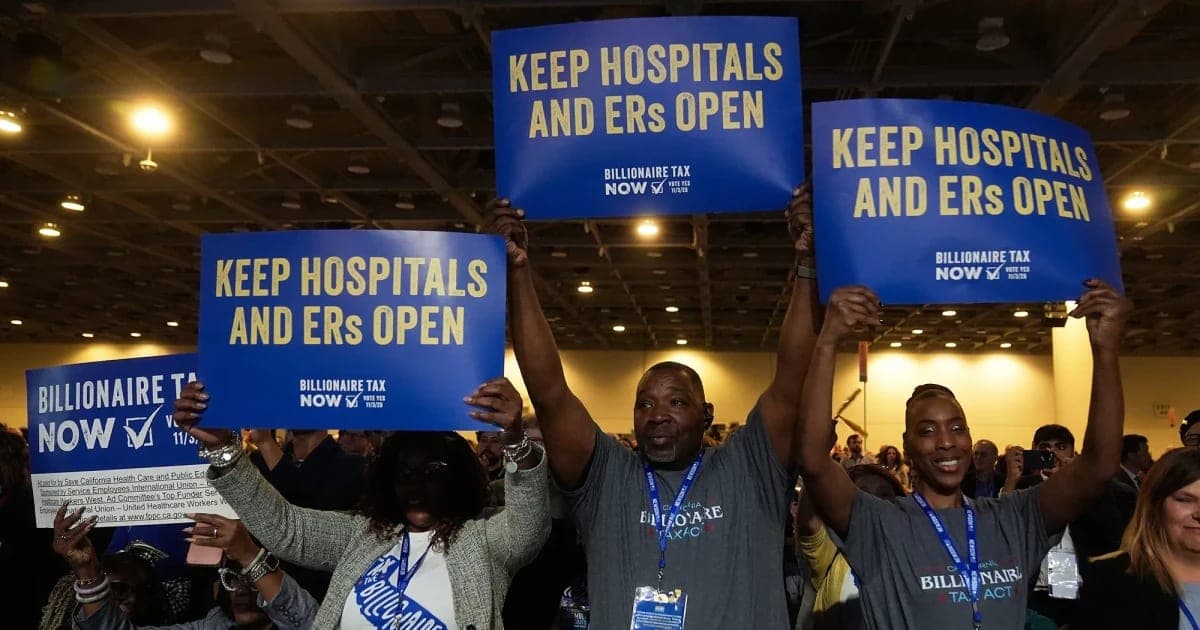
California billionaire tax is a no-brainer for progressive Democrats, right? Wrong
People supporting California's proposed billionaire tax hold signs at the 2026 California Democratic Party State Convention in San Francisco on Feb. 21, 2026.(Jeff Chiu / AP Photo) A union-backed proposal to tax California’s billionaires to fund health care has put some progressive lawmakers — and their labor allies — in a quandary. Taxing the rich to backfill Trump-induced federal funding cuts might sound like a no-brainer policy for the party’s left flank, which counts wealth inequality among its top issues. But despite a strong show of support from prominent national figures, including Sen. Bernie Sanders of Vermont and liberal economist Robert Reich, the “2026 California Billionaire Tax Act” has become a hot potato for labor leaders. The proposed initiative would levy a one-time tax of 5% on any resident of California whose net worth exceeds $1 billion, which applies to around 200 people, according to Forbes. That money would plug an estimated $100 billion hole left by federal cuts to Medi-Cal and other social service programs. Publicly, prominent labor and progressive players have largely kept quiet, unlike Gov. Gavin Newsom who has aired his disdain loud and clear. Yet in private, some union leaders and their allies in the Legislature rail against the measure. Of the critics who spoke with CalMatters for this story — three union leaders and five members of the Legislative Progressive Caucus — only one lawmaker would criticize the measure openly. Critics question its feasibility and whether the state even knows how to accurately appraise a billionaire’s total wealth, a crucial step to evaluating how much tax they would owe. They fear long-term revenue loss by driving wealthy people out of California. And some resent that the union sponsoring the initiative, SEIU-United Healthcare Workers West, designed the measure to predominantly benefit its members rather than boost the state’s general fund, where it could go to all budget needs. “It's not that taxing billionaires in itself is wrong,” said Keely Martin Bosler, formerly the top state budget officer to Newsom and former Gov. Jerry Brown. She is now a Democratic consultant who has advised several of California’s most powerful labor groups, including the Service Employees International Union of California, the parent union of SEIU-UHW. “The way in which this tax specifically is constructed is problematic.” Many progressive state lawmakers and Capitol heavyweights, such as Sen. Scott Wiener of San Francisco and the powerful California Labor Federation, have sidestepped the question of whether they’d support it, declining for now to take a position on an initiative that has yet to officially qualify for the ballot. “The Labor Federation won’t take it up for an endorsement until July,” said Lorena Gonzalez, the organization’s president, in a text message. Yet if the tax lands on the November ballot, as it appears on track to do, progressive critics will be saddled with the tricky optics of opposing — or at least not supporting — a measure that embodies one of their base’s core tenets: taxing the rich. Even the mere threat the measure could qualify for the ballot has already spurred a torrent of opposition spending — more than $50 million in total so far — from billionaires such as Google co-founder Sergey Brin and cryptocurrency mogul Chris Larsen. Brin’s group, known as “Building a Better California,” has also spawned three new competing ballot measures designed to undermine the billionaires’ tax. Critics fear that if billionaires like Brin become even bigger perennial spenders in California politics, they could neuter the progressive agenda by bankrolling more business-friendly candidates and ousting left-leaning, labor-aligned legislators. But the measure’s proponents say they are undeterred by the secretive detractors and challenge their critics to put their names behind their words. Dave Regan speaks to the SEIU-UHW Leadership Assembly in 2013.(Steve Yeater / Courtesy of SEIU-UHW) “What we have is a group of so-called leaders who are not reflecting the attitudes of their own constituents,” said Dave Regan, president of SEIU-UHW and the de facto leader of the billionaire tax measure. “That’s why they want to be anonymous.” Regan said he’s confident the initiative will amass enough signatures to qualify for the ballot before the end of April. Then, he said, “We believe a lot of those people are going to come around and change because this makes sense, because the public is supportive, because their own members are supportive.” The case for, and against, the billionaires’ tax So far, polling has shown the billionaire tax is relatively popular with voters. Recent surveys show just over half of Californians surveyed said they’re inclined to vote for it. Critics point out that California’s existing state tax structure is entirely based on income, rather than net worth. The state would have to appraise each person’s assets, including real estate, art, automobiles and private and public businesses. The billionaires could pay in installments, handing over 1% of their wealth annually for five years. Bosler said that with income tax filings, the Franchise Tax Board can use data from federal tax returns to verify its own analysis. Since there’s no federal wealth tax, California would be forging uncharted territory with no tax compliance support from any other source or agency — a risky move that could invite legal challenges. “The state is not a miracle worker, like, they're not going to suddenly be able to do all of this like perfectly,” said Bosler. “I mean they will do their best, but I just think this is expertise that they have built up over 50-plus years. Like, none of this is in their wheelhouse at this point.” But champions of the tax argue it is the only real solution on the table so far to save hospitals, health care jobs and, ultimately, patient lives they say are at risk due to federal funding cuts to Medi-Cal and food assistance programs. Supporters note that the tax is not intended to solve California’s structural budget problems. “It’s one-time funding to fill what we hope is a one-time hole,” said Brian Galle, a tax law professor at UC Berkeley who helped craft the measure. Galle said only around 200 people would be subjected to the tax, so the extra burden on the Franchise Tax Board wouldn’t be too great. “It's not like FTB is going to get a blizzard of tens of thousands of new returns that they're going to have to figure out a whole new data system for cracking,” said Galle. Why some progressives aren’t on board Those who have qualms with the initiative have largely kept their criticisms private. One liberal state legislator, who spoke on the condition of anonymity, said the infighting among the unions puts progressive lawmakers in a difficult position. While he empathizes with the urgency that health care workers feel, he and other Democrats are not convinced the policy could withstand legal challenges and worry about the wealthy employing savvy accounting maneuvers to skirt the tax altogether. Some organizations that are synonymous with progressive politics in California, such as the Working Families Party, also haven’t taken a position, even as other unions such as the Teamsters and AFSCME California support it. Even the powerhouse labor union SEIU California is choosing not to take a position on the measure, which is spearheaded by one of its local affiliates, SEIU-United Healthcare Workers West. Assembly Speaker Robert Rivas, right, speaks with Assemblymember Chris Ward at the state Capitol in Sacramento on Sept. 12, 2025.(Fred Greaves / CalMatters) Assemblymember Chris Ward, a member of the progressive caucus, called the measure a “well-meaning effort by UHW,” but criticized the proposal for being just a one-time tax primarily benefiting the health care sector rather than boosting the state’s overall revenues. Regan said SEIU-UHW made the tax one-time to nullify the argument that it would push billionaires out of the state. Ward noted that he and his colleagues are considering “superior” bills, such as one that would close a corporate tax loop to generate $3 billion per year, and another that would create a new tax on corporations that pay workers so little that they qualify for Medi-Cal and nutrition assistance. Regan argued these measures would only make California more unaffordable, since businesses would pass their increased costs along to consumers. Ward, the sole state lawmaker who would candidly share his concerns about the initiative with CalMatters, said he and his colleagues have heard pushback from “a number of other labor organizations that don't support that initiative,” primarily because its members would not directly benefit from any of the revenue. Uniting labor, he said, is the key to any successful revenue solution. “There's a need to look at a wealth tax for a more broad range, including health care workers but other purposes that are state priorities,” Ward said, “and that will be left off of the table if this is the only question we're seeing.” CalMatters' Nadia Lathan contributed to this story. This article was originally published on CalMatters and was republished under the Creative Commons Attribution-NonCommercial-NoDerivatives license.
Colleges are trying to boost student voting. A Trump probe freezes data for that work
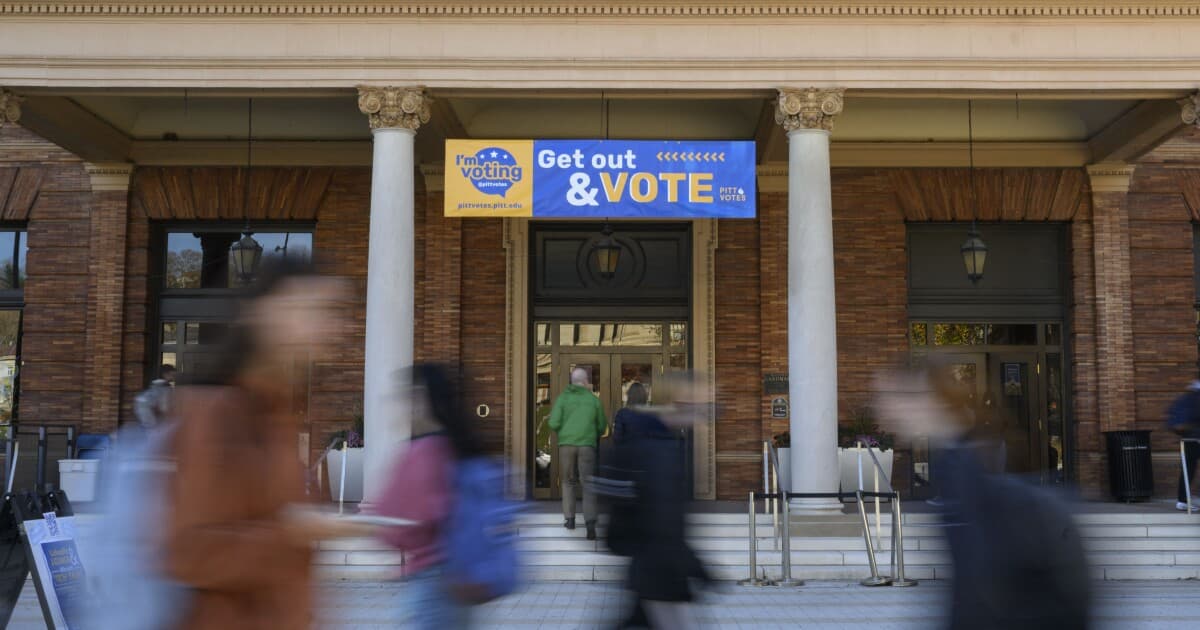
Students walk past a polling site at the University of Pittsburgh during the 2022 midterm election in Pittsburgh.(Angela Weiss / Getty Images) After the 2022 midterm election, a gap appeared to be shrinking on U.S. college campuses. The turnout rate for student voters at community colleges was catching up with the rate at public four-year institutions, data suggested. What was a gap of 9 percentage points for the 2020 election had shrunk to just 3 in 2022. "This told us that we needed to be doing more to support community colleges in their efforts to engage their students," says Clarissa Unger, executive director of the Students Learn Students Vote Coalition, a nonpartisan network focused on boosting civic engagement on campuses. "We would love to be able to see the 2024 data to see if those extra efforts to support community colleges did help [fully] close that gap," Unger adds. But that data is now on ice. In March, researchers at Tufts University announced that they've halted releasing statistics from the go-to source of school-level data on student voter registration and turnout — the National Study of Learning, Voting and Engagement. And the key source of student information needed to produce NSLVE reports, the National Student Clearinghouse, pulled out of working on the study going forward, after a more than decade-long partnership. It's all part of the fallout from an extraordinary investigation into the study by the Trump administration's Education Department. In a press release touting it as a move to "protect" the integrity of U.S. elections, Trump officials said they launched the probe in February to look into unspecified "reports" that NSLVE is in violation of a federal student data privacy law. Many privacy experts, however, are skeptical of the accusations, which echo claims first raised by right-wing election activists. Both Tufts University and the National Student Clearinghouse maintain they have not violated the privacy law. A Tufts statement emphasizes that NSLVE, which started in 2013, is a nonpartisan study "that seeks to understand whether students vote, not who they vote for." Still, school administrators and other student voting advocates tell NPR they're already feeling the impact of the Trump administration's investigation in a midterm election year. The loss of data from new NSLVE reports has left the over 1,000 colleges and universities that participate in the study in the dark, as they try to figure out how to increase turnout among the voting-age cohort that is least likely to cast ballots in the United States. A focus of right-wing election activists became an Education Department probe So far, the Education Department has not identified the source of what it described as "multiple reports alleging that the process of compiling NSLVE data involves illegally sharing college students' data with third parties to influence elections." The department's press office declined to comment to NPR. But Cleta Mitchell — a Republican election lawyer who took part in President Donald Trump's failed attempt to overturn the 2020 election — revealed a backstory during an online meeting of right-wing election activists in March. In 2023, a fellow activist named Heather Honey, Mitchell explained, posted online a document she wrote about NSLVE. It claims that colleges and universities appear to violate the Family Educational Rights and Privacy Act when they give the National Student Clearinghouse permission to share their student enrollment records for the study. The document also raises suspicion about Catalist, a Democratic-aligned data firm that was once involved with the study. The firm compiles public voter records from states and previously gave them to the clearinghouse to match with student information. Tufts has maintained that its study is designed to comply with the privacy law. Last year, Honey was appointed as the deputy assistant secretary for elections integrity at the Department of Homeland Security. Heather Honey leaves the federal courthouse in Harrisburg, Pa., in 2024. The right-wing election activist wrote a document criticizing the National Study of Learning, Voting and Engagement before she was appointed deputy assistant secretary for elections integrity at the Department of Homeland Security.(Mark Scolforo / AP) "One of the things that she did was send over her report and a proposal to the Department of Education — to Linda McMahon, the secretary of education — to say, 'You've got to stop this,' " Mitchell said in a recording of the meeting uploaded by a group called Pure Integrity Michigan Elections. Mitchell went on to describe the National Student Clearinghouse's decision to stop its work on NSLVE as "100% the result of the work" of Honey and activists in Michigan. "And so that's a real victory lap and one that I think we ought to celebrate," Mitchell added. Mitchell and Catalist did not respond to NPR's inquiries. Honey referred questions to DHS' public affairs office, which said in an unsigned statement to NPR: "Heather Honey has not had involvement with the Department of Education's investigation. Her 2023 report is PUBLIC." Brendan Fischer, who tracks the far-right election activist movement, sees Mitchell's comments as the latest connection between the activists and the Trump administration. "This really shows the power and influence that a network of election conspiracy theorists are having over government policy and over the way that elections are run and civic participation is studied," says Fischer, the director of strategic investigations at the Campaign Legal Center, a nonpartisan voting rights group. Since the 2020 election, Mitchell and other activists have built a grassroots network that's often attacked efforts to encourage voting among populations that they perceive support the Democratic Party. During the March meeting of Michigan activists, Mitchell criticized efforts to boost student participation in elections as attempts to "really gin up the Democratic turnout on college campuses." On the same day as Mitchell's comments, another opponent of NSLVE publicly hailed the end of the National Student Clearinghouse's involvement with the study — the America First Policy Institute, a right-wing think tank set up by former members of the first Trump administration, including McMahon, the current education secretary. "AFPI is encouraged that students are finally being protected," said Anna Pingel, a campaign director at the think tank, in a statement that called the development "an important step toward ensuring that sensitive student data is not exploited for political purposes." The statement also said that AFPI sent a letter to the Education Department earlier this year with concerns about NSLVE and potential violations of student data privacy protections. Fischer at the Campaign Legal Center — whose attorneys have filed multiple lawsuits against the Trump administration — points out that Trump officials are investigating NSLVE at the same time the administration faces multiple legal challenges to its murky handling of people's data, including state voter registration, Social Security and IRS records. "There is a certain irony in the Trump administration repeatedly violating privacy laws and then turning around and shutting down this program studying college student participation in democracy, by arguing that it may have violated federal privacy law," Fischer says. Colleges face tough decisions about whether and how to promote student voting The Education Department in February sent a guidance letter to colleges and universities that advises school administrators to hold off on using "any NSLVE report or data this year" until the department's investigation is complete. The letter mentions the "number of enforcement options" the department could use against schools that are found to violate privacy law, including withholding or clawing back federal funding. Amanda Fuchs Miller, who served as deputy assistant secretary for higher education programs at the Education Department during the Biden administration, sees the move as a "scare tactic." "It's very unusual to send out a letter like that when there are no findings and nobody is found to have done anything wrong," Miller says. "A lot of these schools are small schools, community colleges, under-resourced institutions that may not have a general counsel's office to figure out what this means. And if they get this letter and they think it's putting them at risk, their Title IV funds at risk, their federal financial aid for students at risk, this [study] would be the first to go, which would be an understandable immediate reaction if you don't know what it really means." Jackson State University students sign up to vote in Jackson, Miss., on National Voter Registration Day in 2023.(Rogelio V. Solis / AP) Before the current Trump administration, the department has historically kept its data privacy investigations off the public's radar to try to encourage schools to more quickly correct any violations, explains Amelia Vance, a student data privacy expert who leads the Public Interest Privacy Center. "It's really unusual to have these investigations talked about, announced, confirmed across the board," Vance says. And if there are indeed any violations, the department could try to find ways to allow for the study to continue because, Vance adds, "the way the law was written, it gives a ton of discretion to the Department of Ed in order to allow for flexibility." But for now, Melissa Michelson — dean of arts and sciences at Menlo College, a Hispanic-serving and Asian American, Native American and Pacific Islander-serving institution in California's Silicon Valley that has participated in NSLVE — says many school administrators are bracing for potential tough decisions. "I'm a political scientist and I believe strongly that everybody should vote," says Michelson, whose research focuses on voter mobilization. "But if I have to choose between being financially responsible and ensuring that Menlo College can stay open because our students can receive Pell Grants or continuing to participate in NSLVE and getting this data to inform our civic engagement coalition, I'm going to pick financial responsibility every time." And in the middle of a midterm election year, schools that do decide to carry out their plans to mobilize student voters will be forging ahead with out-of-date data. "That's troubling because for most schools, this is an iterative learning process," Michelson says. "You do something in one year, you get your data back and you see, 'Hey, what looks different? Did we get better in getting out the vote among our male first-year students? How are we doing with those business majors?' Without feedback from what they did in 2024, it makes it more challenging for schools to decide what to do in 2026." The NSLVE investigation is not the first time colleges have struggled with Trump administration guidance on student voter registration Miller, the former Biden official, notes that many college administrators were already having a hard time interpreting earlier guidance from the Trump administration on student voter registration. Last August, the Education Department issued a letter saying that to avoid "aiding and abetting voter fraud," schools "may limit the list of recipients" when distributing mail voter registration forms so students who schools have reason to believe aren't eligible to vote aren't included. Federal law, however, requires certain higher education institutions participating in federal student aid programs to "make a good faith effort" to distribute forms "to each student enrolled in a degree or certificate program and physically in attendance at the institution, and to make such forms widely available to students at the institution." The same letter also said schools cannot use federal work-study funding to employ students to help register voters or assist at the polls. But the department's Federal Student Aid Handbook does not include that restriction for students employed by schools for on-campus work. "This has caused lots of confusion for schools and a chilling effect in doing critical work that promotes voting among college students," Miller says. A group of Senate Democrats led by Sen. Cory Booker of New Jersey has asked the Education Department to reconsider its August guidance, which they say "undermines decades of bipartisan recognition that encouraging voter registration is a core public interest function of institutions of higher education." Edited by Benjamin Swasey Copyright 2026 NPR