1 story credited to ecoRI News
Latest story Mar 23, 2026 · on ChamberLight since Apr 2026
A story can appear as several articles (copies of the same piece), so counts of stories and of articles differ.
Scores for ecoRI News
Writing quality not enough rated stories yet: 1 of 10. How it is measured
Scores last checked Sep 25, 2026.
Stories ChamberLight collected, by month
Stories credited to ecoRI News, by publication date. ChamberLight collects articles that mention the officials it tracks, so this shows its own coverage of this source, not how much the source publishes.
- Stories from ecoRI News
- Shaded: ChamberLight collected no stories, or almost none, from any outlet (a gap in its collection, not in the outlet’s publishing)
Show as a table
| Month | Stories | All outlets |
|---|---|---|
| March 2026 | 1 | 521 |
| April 2026 | 0 | 4,538 |
| May 2026 | 0 | none collected |
| June 2026 | 0 | none collected |
| July 2026 | 0 | none collected |
| August 2026 | 0 | 1 (collection gap) |
| September 2026 | 0 | 1,320 |
Top topics
Share of this source’s stories tagged with each topic. A story can carry several topics, so the shares do not add up to 100%.
- Budget/Spending1
100% of 1 stories · 31% across all outlets
- Environment/Climate1
100% of 1 stories · 5% across all outlets
- Infrastructure1
100% of 1 stories · 8% across all outlets
The thin mark on each bar is the topic’s share across all outlets.
Who they cover
Party of the officials these stories are mainly about, across all 2 officials named. A story counts once for each official it is mainly about, so the split is over 2 story–official pairs, from 1 story.
- Democrat50% · 1 pair
- Republican50% · 1 pair
Most covered
Stories mainly about each official, and their share of the source’s 1 story.
Article tone
ChamberLight’s article analysis assigns each story a tone toward the official it covers. It describes the coverage of that official, not ecoRI News’s stance, and reader votes do not change it. 1 story.
- Good Look
- 0 (0%)
- Mixed
- 1 (100%)
- Informational
- 0 (0%)
- Bad Look
- 0 (0%)
Challenges to these scores
No one has challenged a score on this page yet. Anyone can; editors publish every outcome here.
Articles served from ecori.org
2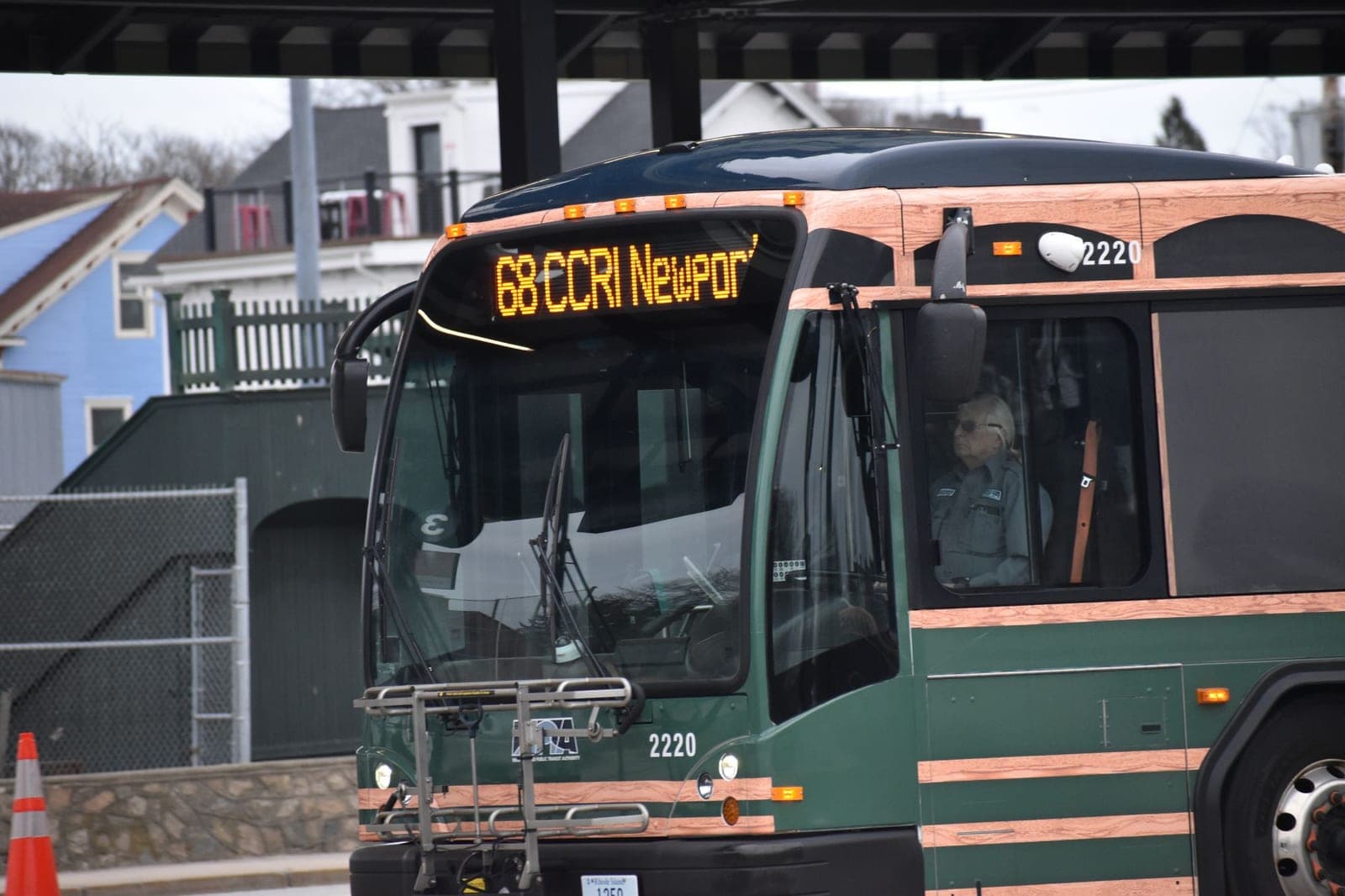
RIPTA Planned to Electrify Aquidneck Island, Then Trump Stepped In
PROVIDENCE — The Rhode Island Public Transit Authority planned to introduce battery-electric buses to operate on Aquidneck Island this spring, but federal funding for the project is being held up by the Trump administration. When President Donald Trump took office, he inherited an “unprecedented backlog” of unobligated U.S. Department of Transportation grants. One of those grants belongs to RIPTA, and there’s no clear indication if and when the funds will be released, according to the transit agency’s CEO, Christopher Durand. Nearly four years ago, RIPTA announced it would end diesel-powered buses rolling along Aquidneck Island’s streets, following the USDOT’s award of $22.37 million in federal funding through the Biden administration’s Rebuilding American Infrastructure with Sustainability and Equity grant program. The money was supposed to help introduce 25 electric buses and charging infrastructure in Newport. The Rebuilding American Infrastructure with Sustainability and Equity grant program aimed to support transportation planning and capital projects with local or regional impact in underserved communities. The Trump administration has since renamed the transportation department’s grant program and said it’s working to accelerate the distribution of the funds by ripping out “burdensome DEI, Green New Scam, and social justice requirements that Congress deliberately did not mandate.” A 2025 news release added: “This includes social cost of carbon accounting, pointless greenhouse gas emission reporting and discriminatory DEI language.” RIPTA has been moving toward a green fleet for more than two decades. With the help of a $10 million allocation from the state’s Volkswagen settlement funds, the agency began replacing older diesel buses slated for retirement with all-electric buses in 2018. It added 14 battery-electric buses to its most frequently used route, the R-Line, which connects Providence and Pawtucket. Electrifying Aquidneck Island is the agency’s third phase of its bus electrification pilot program, which aims to convert its fleet to zero- or near-zero-emission vehicles. RIPTA said adding electric buses in Newport and parts of South County will eliminate harmful air pollutants, such as carbon dioxide and nitrogen oxides, from buses. The agency said the USDOT grant would help it advance a major part of its Rhode Island Transit Master Plan and enable it to support the state in meeting its 2030 target under the Act on Climate. Durand told Rhode Island House members in a recent subcommittee finance meeting that he believes the grant is one of two in the country that haven’t been released yet. He added that the 2022 grant was set to expire last year, but Sen. Jack Reed, D-R.I., extended its expiration date by five years. “There is hope — and there’s fear,” he told the committee. In 2025, the Federal Transit Administration awarded RIPTA $25 million under the Low- or No-Emission grant to support the agency’s transition to a “modernized hybrid fleet” by purchasing 25 hybrid buses. In a statement sent to ecoRI News, Reed’s office said: “A strong public transportation network is vital for Rhode Islanders and our economy. Senator Reed continues to deliver federal transit funding to match the state’s priorities. He wants to ensure federal funds are geared toward helping RIPTA offer reliable, affordable, and sustainable transportation options that reduce congestion and pollution while enhancing service and mobility.” RIPTA officials postponed purchasing the hybrid buses because they haven’t received federal funds to build new charging infrastructure, according to Rep. Terri Cortvriend, D-Portsmouth, who sits on the House Finance Committee and is the chair of the House Finance Subcommittee on Environment and Transportation. “It’s very frustrating,” Cortvriend recently told ecoRI News. “We have to deal with the Trump presidency, and right now we have no leverage in Congress either.” USDOT didn’t respond to a request for comment. The post RIPTA Planned to Electrify Aquidneck Island, Then Trump Stepped In appeared first on ecoRI News.
RIPTA Planned to Electrify Aquidneck Island, Then Trump Stepped In
PROVIDENCE — The Rhode Island Public Transit Authority planned to introduce battery-electric buses to operate on Aquidneck Island this spring, but federal funding for the project is being held up by the Trump administration. When President Donald Trump took office, he inherited an “unprecedented backlog” of unobligated U.S. Department of Transportation grants. One of those grants belongs to RIPTA, and there’s no clear indication if and when the funds will be released, according to the transit agency’s CEO, Christopher Durand. Nearly four years ago, RIPTA announced it would end diesel-powered buses rolling along Aquidneck Island’s streets, following the USDOT’s award of $22.37 million in federal funding through the Biden administration’s Rebuilding American Infrastructure with Sustainability and Equity grant program. The money was supposed to help introduce 25 electric buses and charging infrastructure in Newport. The Rebuilding American Infrastructure with Sustainability and Equity grant program aimed to support transportation planning and capital projects with local or regional impact in underserved communities. The Trump administration has since renamed the transportation department’s grant program and said it’s working to accelerate the distribution of the funds by ripping out “burdensome DEI, Green New Scam, and social justice requirements that Congress deliberately did not mandate.” A 2025 news release added: “This includes social cost of carbon accounting, pointless greenhouse gas emission reporting and discriminatory DEI language.” RIPTA has been moving toward a green fleet for more than two decades. With the help of a $10 million allocation from the state’s Volkswagen settlement funds, the agency began replacing older diesel buses slated for retirement with all-electric buses in 2018. It added 14 battery-electric buses to its most frequently used route, the R-Line, which connects Providence and Pawtucket. Electrifying Aquidneck Island is the agency’s third phase of its bus electrification pilot program, which aims to convert its fleet to zero- or near-zero-emission vehicles. RIPTA said adding electric buses in Newport and parts of South County will eliminate harmful air pollutants, such as carbon dioxide and nitrogen oxides, from buses. The agency said the USDOT grant would help it advance a major part of its Rhode Island Transit Master Plan and enable it to support the state in meeting its 2030 target under the Act on Climate. Durand told Rhode Island House members in a recent subcommittee finance meeting that he believes the grant is one of two in the country that haven’t been released yet. He added that the 2022 grant was set to expire last year, but Sen. Jack Reed, D-R.I., extended its expiration date by five years. “There is hope — and there’s fear,” he told the committee. In 2025, the Federal Transit Administration awarded RIPTA $25 million under the Low- or No-Emission grant to support the agency’s transition to a “modernized hybrid fleet” by purchasing 25 hybrid buses. In a statement sent to ecoRI News, Reed’s office said: “A strong public transportation network is vital for Rhode Islanders and our economy. Senator Reed continues to deliver federal transit funding to match the state’s priorities. He wants to ensure federal funds are geared toward helping RIPTA offer reliable, affordable, and sustainable transportation options that reduce congestion and pollution while enhancing service and mobility.” RIPTA officials postponed purchasing the hybrid buses because they haven’t received federal funds to build new charging infrastructure, according to Rep. Terri Cortvriend, D-Portsmouth, who sits on the House Finance Committee and is the chair of the House Finance Subcommittee on Environment and Transportation. “It’s very frustrating,” Cortvriend recently told ecoRI News. “We have to deal with the Trump presidency, and right now we have no leverage in Congress either.” USDOT didn’t respond to a request for comment. The post RIPTA Planned to Electrify Aquidneck Island, Then Trump Stepped In appeared first on ecoRI News.