3 stories credited to Democracy Docket
Latest story Apr 17, 2026 · on ChamberLight since Apr 2026
A story can appear as several articles (copies of the same piece), so counts of stories and of articles differ.
Scores for Democracy Docket
Writing quality not enough rated stories yet: 3 of 10. How it is measured
Scores last checked Sep 25, 2026.
Stories ChamberLight collected, by month
Stories credited to Democracy Docket, by publication date. ChamberLight collects articles that mention the officials it tracks, so this shows its own coverage of this source, not how much the source publishes.
- Stories from Democracy Docket
- Shaded: ChamberLight collected no stories, or almost none, from any outlet (a gap in its collection, not in the outlet’s publishing)
Show as a table
| Month | Stories | All outlets |
|---|---|---|
| April 2026 | 3 | 3,707 |
| May 2026 | 0 | none collected |
| June 2026 | 0 | none collected |
| July 2026 | 0 | none collected |
| August 2026 | 0 | 1 (collection gap) |
| September 2026 | 0 | 1,320 |
Top topics
Share of this source’s stories tagged with each topic. A story can carry several topics, so the shares do not add up to 100%.
- Ethics/Corruption3
100% of 3 stories · 58% across all outlets
- Voting Rights3
100% of 3 stories · 19% across all outlets
- Immigration2
67% of 3 stories · 13% across all outlets
- Infrastructure1
33% of 3 stories · 8% across all outlets
The thin mark on each bar is the topic’s share across all outlets.
Who they cover
Party of the officials these stories are mainly about, across all 8 officials named. A story counts once for each official it is mainly about, so the split is over 8 story–official pairs, from 3 stories.
- Democrat63% · 5 pairs
- Republican25% · 2 pairs
- Party not recorded13% · 1 pair
Most covered
Stories mainly about each official, and their share of the source’s 3 stories.
Article tone
ChamberLight’s article analysis assigns each story a tone toward the official it covers. It describes the coverage of that official, not Democracy Docket’s stance, and reader votes do not change it. 3 stories.
- Good Look
- 0 (0%)
- Mixed
- 2 (67%)
- Informational
- 0 (0%)
- Bad Look
- 1 (33%)
Challenges to these scores
No one has challenged a score on this page yet. Anyone can; editors publish every outcome here.
Articles served from democracydocket.com
8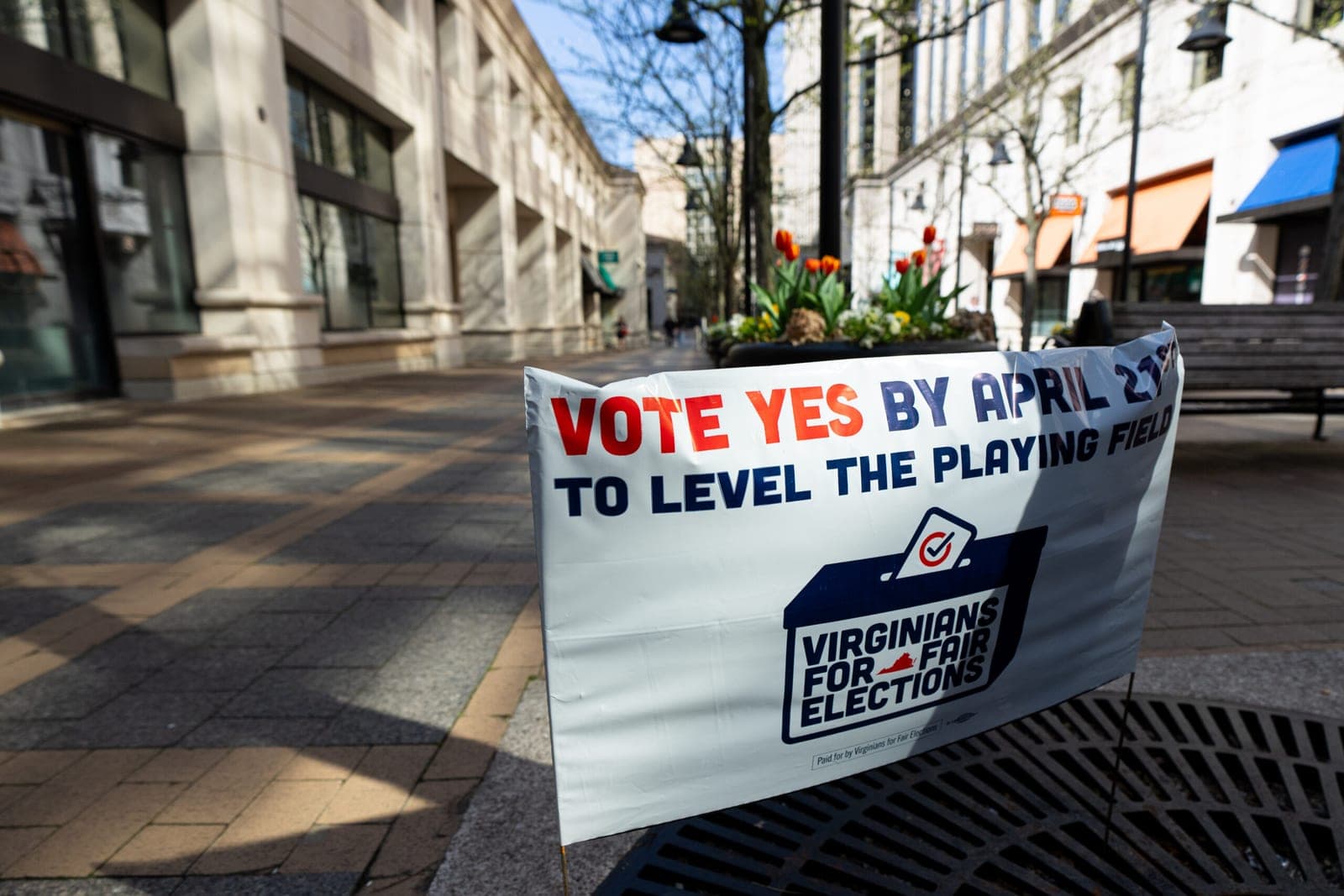
Democrats rally national firepower in final push for ‘yes’ vote on Virginia redistricting referendum
With just days until Virginians decide whether to approve a new redistricting plan, top Democratic leaders and influential voices gathered in a high-profile livestream to make their closing argument — framing next Tuesday’s vote as a decisive stand against Republican gerrymanders pushed by President Donald Trump. The event underscored the immense stakes: control of the U.S. House, the ability to check Trump’s agenda and a broader fight over Democrats response to aggressive GOP map-drawing in states like Texas and Florida. “Republicans were trying to gerrymander the national congressional map so they could rig the midterm elections and hold on to power,” House Minority Leader Hakeem Jeffries (D-N.Y.) said. “This is a critical step forward for the people of the Commonwealth of Virginia. But it has national and international implications. We can cut Donald Trump’s presidency in half, legislatively. But that’s going to require us to win back the House.” SIGN UP TODAY Get updates straight to your inbox — for free Join 350,000 readers who rely on our daily and weekly newsletters for the latest in voting, elections and democracy. The urgency echoed across speakers, many of whom tied the referendum directly to Republican-led redistricting efforts in other states. U.S. Sen. Mark Warner (D-Va.) pointed to earlier GOP map changes as the catalyst for the current push. “We in Virginia have always supported bipartisan redistricting, but not when the other side pummels us with unfair practices,” Warner said. “So we in Virginia have the chance to level the playing field.” That phrase — “level the playing field” — became the central message of the event, repeated by speakers as a rallying cry. Virginia Gov. Abigail Spanberger also emphasized that the proposal is designed as a temporary countermeasure to actions taken by Republicans elsewhere. “As we have seen states take action, Virginia has the ability to do something responsive. A ‘yes’ vote means that we are taking that responsive step to what we have seen other states do,” she said. “In a temporary manner, we have put forth new maps.”Virginia is taking the temporary, responsive and responsible step of pushing back against what other states have done in trying to stack the deck for Donald Trump in those congressional elections. And in a temporary manner, we have put forth new maps.” Spanberger highlighted that the state’s independent redistricting system would return after the next census — an attempt to r But the message from some speakers went further with the sentiment that Democrats must “fight fire with fire” — reflecting a broader strategic shift within the party, as leaders increasingly argue that unilateral adherence to redistricting norms is no longer viable. “Well, this is simple,” Rep. Bobby Scott (D-Va.) said during the event. “We’re doing exactly what they’re doing.” California Gov. Gavin Newsom, whose state recently passed its own redistricting response measure in a landslide, framed the moment in stark terms. “We can’t be exhausted by these redistricting fights. They’re foundational,” Newsom said. “It’s the architecture. It’s the foundation on which everything else is built. We’ve got to save our republic so we can have the kitchen table, so that we can start debating those kitchen table issues once again.” Newsom also pointed directly to Florida, where Republican Gov. Ron DeSantis is preparing a new round of redistricting, warning that Republicans are continuing to escalate. “I should remind folks, Florida’s maps are already gerrymandered. Like, the maps in existence are a gerrymander that was too extreme for the legislature, but was shoehorned through by DeSantis,” he added. “This new map would be an extreme gerrymander on top of the existing extreme gerrymander.” Back in Virginia, state leaders focused on mobilizing voters — particularly in the face of what they described as targeted misinformation. State Sen. Louise Lucas (D) stressed that deceptive messaging campaigns by Republicans and allied groups are designed to confuse voters about what the referendum does. “A lie that’s left standing becomes truth in the mind of some people,” Lucas said. “And so that’s precisely the reason why the Republicans continue to tell lies and spread propaganda.” Virginia House Speaker Don Scott (D) echoed those concerns, saying misinformation efforts have specifically targeted Black voters. “They are being deceitful,” Scott said. “They are lying straight up and straight down.” Despite those challenges, speakers repeatedly pointed to growing momentum — including high early voting turnout and reports of bipartisan support — as signs the message is breaking through. The broader pitch was clear: this is not a typical off-year vote, but a pivotal moment in a national struggle over democracy and fair representation. For Democratic leaders, that response is urgent — especially as redistricting battles unfold in states like Florida, where new GOP maps could further tilt the balance of power. With the House majority hanging on a handful of seats, even small shifts could have outsized consequences. “This could be the difference of three seats,” Rep. Suhas Subramanyam (D-Va.) said. “This could be the election.” For supporters of the referendum, Virginia voters now face a defining choice of whether to accept a political map shaped by one side — or to intervene to rebalance the system before it is locked in for the rest of the decade. The post Democrats rally national firepower in final push for ‘yes’ vote on Virginia redistricting referendum appeared first on Democracy Docket.
Democrats rally national firepower in final push for ‘yes’ vote on Virginia redistricting referendum
With just days until Virginians decide whether to approve a new redistricting plan, top Democratic leaders and influential voices gathered in a high-profile livestream to make their closing argument — framing next Tuesday’s vote as a decisive stand against Republican gerrymanders pushed by President Donald Trump. The event underscored the immense stakes: control of the U.S. House, the ability to check Trump’s agenda and a broader fight over Democrats response to aggressive GOP map-drawing in states like Texas and Florida. “Republicans were trying to gerrymander the national congressional map so they could rig the midterm elections and hold on to power,” House Minority Leader Hakeem Jeffries (D-N.Y.) said. “This is a critical step forward for the people of the Commonwealth of Virginia. But it has national and international implications. We can cut Donald Trump’s presidency in half, legislatively. But that’s going to require us to win back the House.” SIGN UP TODAY Get updates straight to your inbox — for free Join 350,000 readers who rely on our daily and weekly newsletters for the latest in voting, elections and democracy. The urgency echoed across speakers, many of whom tied the referendum directly to Republican-led redistricting efforts in other states. U.S. Sen. Mark Warner (D-Va.) pointed to earlier GOP map changes as the catalyst for the current push. “We in Virginia have always supported bipartisan redistricting, but not when the other side pummels us with unfair practices,” Warner said. “So we in Virginia have the chance to level the playing field.” That phrase — “level the playing field” — became the central message of the event, repeated by speakers as a rallying cry. Virginia Gov. Abigail Spanberger also emphasized that the proposal is designed as a temporary countermeasure to actions taken by Republicans elsewhere. “As we have seen states take action, Virginia has the ability to do something responsive. A ‘yes’ vote means that we are taking that responsive step to what we have seen other states do,” she said. “In a temporary manner, we have put forth new maps.”Virginia is taking the temporary, responsive and responsible step of pushing back against what other states have done in trying to stack the deck for Donald Trump in those congressional elections. And in a temporary manner, we have put forth new maps.” Spanberger highlighted that the state’s independent redistricting system would return after the next census — an attempt to r But the message from some speakers went further with the sentiment that Democrats must “fight fire with fire” — reflecting a broader strategic shift within the party, as leaders increasingly argue that unilateral adherence to redistricting norms is no longer viable. “Well, this is simple,” Rep. Bobby Scott (D-Va.) said during the event. “We’re doing exactly what they’re doing.” California Gov. Gavin Newsom, whose state recently passed its own redistricting response measure in a landslide, framed the moment in stark terms. “We can’t be exhausted by these redistricting fights. They’re foundational,” Newsom said. “It’s the architecture. It’s the foundation on which everything else is built. We’ve got to save our republic so we can have the kitchen table, so that we can start debating those kitchen table issues once again.” Newsom also pointed directly to Florida, where Republican Gov. Ron DeSantis is preparing a new round of redistricting, warning that Republicans are continuing to escalate. “I should remind folks, Florida’s maps are already gerrymandered. Like, the maps in existence are a gerrymander that was too extreme for the legislature, but was shoehorned through by DeSantis,” he added. “This new map would be an extreme gerrymander on top of the existing extreme gerrymander.” Back in Virginia, state leaders focused on mobilizing voters — particularly in the face of what they described as targeted misinformation. State Sen. Louise Lucas (D) stressed that deceptive messaging campaigns by Republicans and allied groups are designed to confuse voters about what the referendum does. “A lie that’s left standing becomes truth in the mind of some people,” Lucas said. “And so that’s precisely the reason why the Republicans continue to tell lies and spread propaganda.” Virginia House Speaker Don Scott (D) echoed those concerns, saying misinformation efforts have specifically targeted Black voters. “They are being deceitful,” Scott said. “They are lying straight up and straight down.” Despite those challenges, speakers repeatedly pointed to growing momentum — including high early voting turnout and reports of bipartisan support — as signs the message is breaking through. The broader pitch was clear: this is not a typical off-year vote, but a pivotal moment in a national struggle over democracy and fair representation. For Democratic leaders, that response is urgent — especially as redistricting battles unfold in states like Florida, where new GOP maps could further tilt the balance of power. With the House majority hanging on a handful of seats, even small shifts could have outsized consequences. “This could be the difference of three seats,” Rep. Suhas Subramanyam (D-Va.) said. “This could be the election.” For supporters of the referendum, Virginia voters now face a defining choice of whether to accept a political map shaped by one side — or to intervene to rebalance the system before it is locked in for the rest of the decade. The post Democrats rally national firepower in final push for ‘yes’ vote on Virginia redistricting referendum appeared first on Democracy Docket.
Democrats rally national firepower in final push for ‘yes’ vote on Virginia redistricting referendum
With just days until Virginians decide whether to approve a new redistricting plan, top Democratic leaders and influential voices gathered in a high-profile livestream to make their closing argument — framing next Tuesday’s vote as a decisive stand against Republican gerrymanders pushed by President Donald Trump. The event underscored the immense stakes: control of the U.S. House, the ability to check Trump’s agenda and a broader fight over Democrats response to aggressive GOP map-drawing in states like Texas and Florida. “Republicans were trying to gerrymander the national congressional map so they could rig the midterm elections and hold on to power,” House Minority Leader Hakeem Jeffries (D-N.Y.) said. “This is a critical step forward for the people of the Commonwealth of Virginia. But it has national and international implications. We can cut Donald Trump’s presidency in half, legislatively. But that’s going to require us to win back the House.” SIGN UP TODAY Get updates straight to your inbox — for free Join 350,000 readers who rely on our daily and weekly newsletters for the latest in voting, elections and democracy. The urgency echoed across speakers, many of whom tied the referendum directly to Republican-led redistricting efforts in other states. U.S. Sen. Mark Warner (D-Va.) pointed to earlier GOP map changes as the catalyst for the current push. “We in Virginia have always supported bipartisan redistricting, but not when the other side pummels us with unfair practices,” Warner said. “So we in Virginia have the chance to level the playing field.” That phrase — “level the playing field” — became the central message of the event, repeated by speakers as a rallying cry. Virginia Gov. Abigail Spanberger also emphasized that the proposal is designed as a temporary countermeasure to actions taken by Republicans elsewhere. “As we have seen states take action, Virginia has the ability to do something responsive. A ‘yes’ vote means that we are taking that responsive step to what we have seen other states do,” she said. “In a temporary manner, we have put forth new maps.”Virginia is taking the temporary, responsive and responsible step of pushing back against what other states have done in trying to stack the deck for Donald Trump in those congressional elections. And in a temporary manner, we have put forth new maps.” Spanberger highlighted that the state’s independent redistricting system would return after the next census — an attempt to r But the message from some speakers went further with the sentiment that Democrats must “fight fire with fire” — reflecting a broader strategic shift within the party, as leaders increasingly argue that unilateral adherence to redistricting norms is no longer viable. “Well, this is simple,” Rep. Bobby Scott (D-Va.) said during the event. “We’re doing exactly what they’re doing.” California Gov. Gavin Newsom, whose state recently passed its own redistricting response measure in a landslide, framed the moment in stark terms. “We can’t be exhausted by these redistricting fights. They’re foundational,” Newsom said. “It’s the architecture. It’s the foundation on which everything else is built. We’ve got to save our republic so we can have the kitchen table, so that we can start debating those kitchen table issues once again.” Newsom also pointed directly to Florida, where Republican Gov. Ron DeSantis is preparing a new round of redistricting, warning that Republicans are continuing to escalate. “I should remind folks, Florida’s maps are already gerrymandered. Like, the maps in existence are a gerrymander that was too extreme for the legislature, but was shoehorned through by DeSantis,” he added. “This new map would be an extreme gerrymander on top of the existing extreme gerrymander.” Back in Virginia, state leaders focused on mobilizing voters — particularly in the face of what they described as targeted misinformation. State Sen. Louise Lucas (D) stressed that deceptive messaging campaigns by Republicans and allied groups are designed to confuse voters about what the referendum does. “A lie that’s left standing becomes truth in the mind of some people,” Lucas said. “And so that’s precisely the reason why the Republicans continue to tell lies and spread propaganda.” Virginia House Speaker Don Scott (D) echoed those concerns, saying misinformation efforts have specifically targeted Black voters. “They are being deceitful,” Scott said. “They are lying straight up and straight down.” Despite those challenges, speakers repeatedly pointed to growing momentum — including high early voting turnout and reports of bipartisan support — as signs the message is breaking through. The broader pitch was clear: this is not a typical off-year vote, but a pivotal moment in a national struggle over democracy and fair representation. For Democratic leaders, that response is urgent — especially as redistricting battles unfold in states like Florida, where new GOP maps could further tilt the balance of power. With the House majority hanging on a handful of seats, even small shifts could have outsized consequences. “This could be the difference of three seats,” Rep. Suhas Subramanyam (D-Va.) said. “This could be the election.” For supporters of the referendum, Virginia voters now face a defining choice of whether to accept a political map shaped by one side — or to intervene to rebalance the system before it is locked in for the rest of the decade. The post Democrats rally national firepower in final push for ‘yes’ vote on Virginia redistricting referendum appeared first on Democracy Docket.
Democrats rally national firepower in final push for ‘yes’ vote on Virginia redistricting referendum
With just days until Virginians decide whether to approve a new redistricting plan, top Democratic leaders and influential voices gathered in a high-profile livestream to make their closing argument — framing next Tuesday’s vote as a decisive stand against Republican gerrymanders pushed by President Donald Trump. The event underscored the immense stakes: control of the U.S. House, the ability to check Trump’s agenda and a broader fight over Democrats response to aggressive GOP map-drawing in states like Texas and Florida. “Republicans were trying to gerrymander the national congressional map so they could rig the midterm elections and hold on to power,” House Minority Leader Hakeem Jeffries (D-N.Y.) said. “This is a critical step forward for the people of the Commonwealth of Virginia. But it has national and international implications. We can cut Donald Trump’s presidency in half, legislatively. But that’s going to require us to win back the House.” SIGN UP TODAY Get updates straight to your inbox — for free Join 350,000 readers who rely on our daily and weekly newsletters for the latest in voting, elections and democracy. The urgency echoed across speakers, many of whom tied the referendum directly to Republican-led redistricting efforts in other states. U.S. Sen. Mark Warner (D-Va.) pointed to earlier GOP map changes as the catalyst for the current push. “We in Virginia have always supported bipartisan redistricting, but not when the other side pummels us with unfair practices,” Warner said. “So we in Virginia have the chance to level the playing field.” That phrase — “level the playing field” — became the central message of the event, repeated by speakers as a rallying cry. Virginia Gov. Abigail Spanberger also emphasized that the proposal is designed as a temporary countermeasure to actions taken by Republicans elsewhere. “As we have seen states take action, Virginia has the ability to do something responsive. A ‘yes’ vote means that we are taking that responsive step to what we have seen other states do,” she said. “In a temporary manner, we have put forth new maps.”Virginia is taking the temporary, responsive and responsible step of pushing back against what other states have done in trying to stack the deck for Donald Trump in those congressional elections. And in a temporary manner, we have put forth new maps.” Spanberger highlighted that the state’s independent redistricting system would return after the next census — an attempt to r But the message from some speakers went further with the sentiment that Democrats must “fight fire with fire” — reflecting a broader strategic shift within the party, as leaders increasingly argue that unilateral adherence to redistricting norms is no longer viable. “Well, this is simple,” Rep. Bobby Scott (D-Va.) said during the event. “We’re doing exactly what they’re doing.” California Gov. Gavin Newsom, whose state recently passed its own redistricting response measure in a landslide, framed the moment in stark terms. “We can’t be exhausted by these redistricting fights. They’re foundational,” Newsom said. “It’s the architecture. It’s the foundation on which everything else is built. We’ve got to save our republic so we can have the kitchen table, so that we can start debating those kitchen table issues once again.” Newsom also pointed directly to Florida, where Republican Gov. Ron DeSantis is preparing a new round of redistricting, warning that Republicans are continuing to escalate. “I should remind folks, Florida’s maps are already gerrymandered. Like, the maps in existence are a gerrymander that was too extreme for the legislature, but was shoehorned through by DeSantis,” he added. “This new map would be an extreme gerrymander on top of the existing extreme gerrymander.” Back in Virginia, state leaders focused on mobilizing voters — particularly in the face of what they described as targeted misinformation. State Sen. Louise Lucas (D) stressed that deceptive messaging campaigns by Republicans and allied groups are designed to confuse voters about what the referendum does. “A lie that’s left standing becomes truth in the mind of some people,” Lucas said. “And so that’s precisely the reason why the Republicans continue to tell lies and spread propaganda.” Virginia House Speaker Don Scott (D) echoed those concerns, saying misinformation efforts have specifically targeted Black voters. “They are being deceitful,” Scott said. “They are lying straight up and straight down.” Despite those challenges, speakers repeatedly pointed to growing momentum — including high early voting turnout and reports of bipartisan support — as signs the message is breaking through. The broader pitch was clear: this is not a typical off-year vote, but a pivotal moment in a national struggle over democracy and fair representation. For Democratic leaders, that response is urgent — especially as redistricting battles unfold in states like Florida, where new GOP maps could further tilt the balance of power. With the House majority hanging on a handful of seats, even small shifts could have outsized consequences. “This could be the difference of three seats,” Rep. Suhas Subramanyam (D-Va.) said. “This could be the election.” For supporters of the referendum, Virginia voters now face a defining choice of whether to accept a political map shaped by one side — or to intervene to rebalance the system before it is locked in for the rest of the decade. The post Democrats rally national firepower in final push for ‘yes’ vote on Virginia redistricting referendum appeared first on Democracy Docket.
Democrats rally national firepower in final push for ‘yes’ vote on Virginia redistricting referendum
With just days until Virginians decide whether to approve a new redistricting plan, top Democratic leaders and influential voices gathered in a high-profile livestream to make their closing argument — framing next Tuesday’s vote as a decisive stand against Republican gerrymanders pushed by President Donald Trump. The event underscored the immense stakes: control of the U.S. House, the ability to check Trump’s agenda and a broader fight over Democrats response to aggressive GOP map-drawing in states like Texas and Florida. “Republicans were trying to gerrymander the national congressional map so they could rig the midterm elections and hold on to power,” House Minority Leader Hakeem Jeffries (D-N.Y.) said. “This is a critical step forward for the people of the Commonwealth of Virginia. But it has national and international implications. We can cut Donald Trump’s presidency in half, legislatively. But that’s going to require us to win back the House.” SIGN UP TODAY Get updates straight to your inbox — for free Join 350,000 readers who rely on our daily and weekly newsletters for the latest in voting, elections and democracy. The urgency echoed across speakers, many of whom tied the referendum directly to Republican-led redistricting efforts in other states. U.S. Sen. Mark Warner (D-Va.) pointed to earlier GOP map changes as the catalyst for the current push. “We in Virginia have always supported bipartisan redistricting, but not when the other side pummels us with unfair practices,” Warner said. “So we in Virginia have the chance to level the playing field.” That phrase — “level the playing field” — became the central message of the event, repeated by speakers as a rallying cry. Virginia Gov. Abigail Spanberger also emphasized that the proposal is designed as a temporary countermeasure to actions taken by Republicans elsewhere. “As we have seen states take action, Virginia has the ability to do something responsive. A ‘yes’ vote means that we are taking that responsive step to what we have seen other states do,” she said. “In a temporary manner, we have put forth new maps.”Virginia is taking the temporary, responsive and responsible step of pushing back against what other states have done in trying to stack the deck for Donald Trump in those congressional elections. And in a temporary manner, we have put forth new maps.” Spanberger highlighted that the state’s independent redistricting system would return after the next census — an attempt to r But the message from some speakers went further with the sentiment that Democrats must “fight fire with fire” — reflecting a broader strategic shift within the party, as leaders increasingly argue that unilateral adherence to redistricting norms is no longer viable. “Well, this is simple,” Rep. Bobby Scott (D-Va.) said during the event. “We’re doing exactly what they’re doing.” California Gov. Gavin Newsom, whose state recently passed its own redistricting response measure in a landslide, framed the moment in stark terms. “We can’t be exhausted by these redistricting fights. They’re foundational,” Newsom said. “It’s the architecture. It’s the foundation on which everything else is built. We’ve got to save our republic so we can have the kitchen table, so that we can start debating those kitchen table issues once again.” Newsom also pointed directly to Florida, where Republican Gov. Ron DeSantis is preparing a new round of redistricting, warning that Republicans are continuing to escalate. “I should remind folks, Florida’s maps are already gerrymandered. Like, the maps in existence are a gerrymander that was too extreme for the legislature, but was shoehorned through by DeSantis,” he added. “This new map would be an extreme gerrymander on top of the existing extreme gerrymander.” Back in Virginia, state leaders focused on mobilizing voters — particularly in the face of what they described as targeted misinformation. State Sen. Louise Lucas (D) stressed that deceptive messaging campaigns by Republicans and allied groups are designed to confuse voters about what the referendum does. “A lie that’s left standing becomes truth in the mind of some people,” Lucas said. “And so that’s precisely the reason why the Republicans continue to tell lies and spread propaganda.” Virginia House Speaker Don Scott (D) echoed those concerns, saying misinformation efforts have specifically targeted Black voters. “They are being deceitful,” Scott said. “They are lying straight up and straight down.” Despite those challenges, speakers repeatedly pointed to growing momentum — including high early voting turnout and reports of bipartisan support — as signs the message is breaking through. The broader pitch was clear: this is not a typical off-year vote, but a pivotal moment in a national struggle over democracy and fair representation. For Democratic leaders, that response is urgent — especially as redistricting battles unfold in states like Florida, where new GOP maps could further tilt the balance of power. With the House majority hanging on a handful of seats, even small shifts could have outsized consequences. “This could be the difference of three seats,” Rep. Suhas Subramanyam (D-Va.) said. “This could be the election.” For supporters of the referendum, Virginia voters now face a defining choice of whether to accept a political map shaped by one side — or to intervene to rebalance the system before it is locked in for the rest of the decade. The post Democrats rally national firepower in final push for ‘yes’ vote on Virginia redistricting referendum appeared first on Democracy Docket.

Election officials rebut GOP voting claims at House hearing
At a House Administration Committee hearing Thursday, Republicans repeatedly raised hypothetical specters of coordinated voter fraud while state election officials gently reiterated, again and again, that elections and voter registration rolls are already safe, secure, and accurate. House Administration Chair Bryan Steil (R-Wisc.) opened the hearing by pointing to recent examples of noncitizens voting — a Mexican national who was elected mayor of a small town Kansas as a Republican, an Iowa school administrator registered to vote in Maryland, and a noncitizen charged in Minnesota for voting in 2024. “Only eligible voters should be casting ballots in our elections,” Steil said, arguing that is why his MEGA Act should be enacted. “One illegal vote is too many.” Like the SAVE America Act, which the House passed in February but has since stalled in the Senate, the MEGA Act would require voters to show documentary proof of citizenship at registration and a photo ID when they vote. It would also direct election officials to conduct monthly voter roll purges to remove ineligible voters utilizing the Department of Homeland Security’s (DHS) Systematic Alien Verification for Entitlements (SAVE) program. The MEGA Act would also prevent states from counting ballots that arrive after Election Day and ban universal mail voting. Both proposals are solutions in search of a problem. Noncitizen voting is vanishingly rare, as is voting fraud in general, including ballots sent by mail. And the proposals would place burdens on voting that would prevent eligible citizens from casting ballots. Kansas once had a law requiring documentary proof of citizenship to register that the U.S. Supreme Court struck down in 2018 because it had blocked 31,000 eligible voters. SIGN UP TODAY Get updates straight to your inbox — for free Join 350,000 readers who rely on our daily and weekly newsletters for the latest in voting, elections and democracy. Kansas Secretary of State Scott Schwab (R) testified that his state voluntarily used the SAVE program last year, uncovering seven potential noncitizens on the rolls, two of which were later charged with illegal voting. Kansas’ experience suggests that enacting the MEGA or SAVE Act would prevent thousands of eligible voters in every state from voting, all to prevent a handful of noncitizens from casting ballots. House Administration ranking member Joe Morelle (D-N.Y.) suggested the real aim of Thursday’s hearing wasn’t to ensure well-maintained voter rolls but to undermine voter confidence. “American citizens should know — I want to speak to them first — you should know your elections are secure. Your vote will count. Your vote is your power. It is your right,” said Morelle. “Please, please, please, use it. The people lying about the security of our elections want to take your power away by discouraging you from voting at all.” In his testimony, Minnesota Secretary of State Steve Simon (D) noted the numerous checks and doublechecks his office makes on its voter registration rolls, while still making it easy to vote with options like same-day registration, leading to Minnesota consistently leading the nation in voter participation levels. Steil interrogated Simon, pressing him on the recent charges filed against a noncitizen for illegal voting there. “The individual was sent, according to the reports, was sent voter registration material following obtaining a driver’s license, which is required under federal law that the state of Minnesota. Is that correct?” Steil pressed. “Actually, no, Mr. Chair,” Simon responded. Not only is Minnesota one of six states exempt from the National Voter Registration Act because it lets voters register on election day, but “that’s not how the system works,” Simon added. “And I would just say, as to the news report you’re flagging, this individual is reported to have said things that just aren’t true.” Simon explained that Minnesota has an automatic voter registration system, but it’s only eligible for people who have already provided state officials documentary proof of citizenship. Kansas also used the SAVE database to identify and remove thousands of voters who died outside the state from the rolls, Schwab said. But he then emphasized that his office has never uncovered an example of a ballot being cast in a deceased voter’s name. Rep. Barry Loudermilk (R-Ga.) questioned Schwab if the state would catch double voting — when a voter casts ballots in two states during the same election cycle. Schwab said if Kansas were a member of Electronic Registration Information Center (ERIC), then “we absolutely would,” Schwab said, “But even if [not], there’s a good chance we would discover it.” Kansas created and ran a similar system, Interstate CrossCheck, but it was shut down in 2018 after a federal audit discovered data privacy vulnerabilities led some voters to sue after their social security numbers were exposed. Rep. Mary Miller (R-Ill.) ended the hearing by pushing a false conspiracy theory. “I remind everybody that under Joe Biden, the border was open. We allowed unvetted people to come over the border — you know, people that would not be eligible to have come over — pour over our border, up to possibly 20 million people,” she said. “Why? Why would Joe Biden, [DHS Sec. Alejandro] Mayorkas and the Democrats have allowed this? It is about votes.” Led by President Donald Trump, Republicans have repeatedly inflated the number of illegal migrants that entered the country during Biden’s administration and the total number living here today. Estimates by the Pew Research Center and Factcheck.org suggest the real number of unauthorized immigrants is close to 14 million, of which around 5 million, at most, entered during the Biden administration. There is no evidence of noncitizens voting in large numbers. The post Election officials rebut GOP voting claims at House hearing appeared first on Democracy Docket.
Election officials rebut GOP voting claims at House hearing
At a House Administration Committee hearing Thursday, Republicans repeatedly raised hypothetical specters of coordinated voter fraud while state election officials gently reiterated, again and again, that elections and voter registration rolls are already safe, secure, and accurate. House Administration Chair Bryan Steil (R-Wisc.) opened the hearing by pointing to recent examples of noncitizens voting — a Mexican national who was elected mayor of a small town Kansas as a Republican, an Iowa school administrator registered to vote in Maryland, and a noncitizen charged in Minnesota for voting in 2024. “Only eligible voters should be casting ballots in our elections,” Steil said, arguing that is why his MEGA Act should be enacted. “One illegal vote is too many.” Like the SAVE America Act, which the House passed in February but has since stalled in the Senate, the MEGA Act would require voters to show documentary proof of citizenship at registration and a photo ID when they vote. It would also direct election officials to conduct monthly voter roll purges to remove ineligible voters utilizing the Department of Homeland Security’s (DHS) Systematic Alien Verification for Entitlements (SAVE) program. The MEGA Act would also prevent states from counting ballots that arrive after Election Day and ban universal mail voting. Both proposals are solutions in search of a problem. Noncitizen voting is vanishingly rare, as is voting fraud in general, including ballots sent by mail. And the proposals would place burdens on voting that would prevent eligible citizens from casting ballots. Kansas once had a law requiring documentary proof of citizenship to register that the U.S. Supreme Court struck down in 2018 because it had blocked 31,000 eligible voters. SIGN UP TODAY Get updates straight to your inbox — for free Join 350,000 readers who rely on our daily and weekly newsletters for the latest in voting, elections and democracy. Kansas Secretary of State Scott Schwab (R) testified that his state voluntarily used the SAVE program last year, uncovering seven potential noncitizens on the rolls, two of which were later charged with illegal voting. Kansas’ experience suggests that enacting the MEGA or SAVE Act would prevent thousands of eligible voters in every state from voting, all to prevent a handful of noncitizens from casting ballots. House Administration ranking member Joe Morelle (D-N.Y.) suggested the real aim of Thursday’s hearing wasn’t to ensure well-maintained voter rolls but to undermine voter confidence. “American citizens should know — I want to speak to them first — you should know your elections are secure. Your vote will count. Your vote is your power. It is your right,” said Morelle. “Please, please, please, use it. The people lying about the security of our elections want to take your power away by discouraging you from voting at all.” In his testimony, Minnesota Secretary of State Steve Simon (D) noted the numerous checks and doublechecks his office makes on its voter registration rolls, while still making it easy to vote with options like same-day registration, leading to Minnesota consistently leading the nation in voter participation levels. Steil interrogated Simon, pressing him on the recent charges filed against a noncitizen for illegal voting there. “The individual was sent, according to the reports, was sent voter registration material following obtaining a driver’s license, which is required under federal law that the state of Minnesota. Is that correct?” Steil pressed. “Actually, no, Mr. Chair,” Simon responded. Not only is Minnesota one of six states exempt from the National Voter Registration Act because it lets voters register on election day, but “that’s not how the system works,” Simon added. “And I would just say, as to the news report you’re flagging, this individual is reported to have said things that just aren’t true.” Simon explained that Minnesota has an automatic voter registration system, but it’s only eligible for people who have already provided state officials documentary proof of citizenship. Kansas also used the SAVE database to identify and remove thousands of voters who died outside the state from the rolls, Schwab said. But he then emphasized that his office has never uncovered an example of a ballot being cast in a deceased voter’s name. Rep. Barry Loudermilk (R-Ga.) questioned Schwab if the state would catch double voting — when a voter casts ballots in two states during the same election cycle. Schwab said if Kansas were a member of Electronic Registration Information Center (ERIC), then “we absolutely would,” Schwab said, “But even if [not], there’s a good chance we would discover it.” Kansas created and ran a similar system, Interstate CrossCheck, but it was shut down in 2018 after a federal audit discovered data privacy vulnerabilities led some voters to sue after their social security numbers were exposed. Rep. Mary Miller (R-Ill.) ended the hearing by pushing a false conspiracy theory. “I remind everybody that under Joe Biden, the border was open. We allowed unvetted people to come over the border — you know, people that would not be eligible to have come over — pour over our border, up to possibly 20 million people,” she said. “Why? Why would Joe Biden, [DHS Sec. Alejandro] Mayorkas and the Democrats have allowed this? It is about votes.” Led by President Donald Trump, Republicans have repeatedly inflated the number of illegal migrants that entered the country during Biden’s administration and the total number living here today. Estimates by the Pew Research Center and Factcheck.org suggest the real number of unauthorized immigrants is close to 14 million, of which around 5 million, at most, entered during the Biden administration. There is no evidence of noncitizens voting in large numbers. The post Election officials rebut GOP voting claims at House hearing appeared first on Democracy Docket.

As SAVE America Act stalls, GOP states are quietly enacting their own proof of citizenship laws
President Donald Trump’s effort to push his restrictive anti-voting bill through Congress has so far failed. Trump said he won’t pass anything else until the SAVE America Act – a voting bill that could disenfranchise millions of Americans and poses barriers for students, the disability community, married women and Americans overseas – is set in stone. The president has insisted, despite data revealing it’s not true, that the United States has a widespread voter fraud issue. It’s one he’s determined to fix. The problem? Voting experts say Trump and his Republican envoys are seeking a flawed solution to a non-issue. While the bill introduced March 17 remains stalled in the Senate, some state leaders have posted about, proposed and even enacted statewide proof of citizenship laws to vote. This isn’t new. Some states have had proof of citizenship voting laws for years. But now a flood of other states are following suit. Anti-voting groups across the nation are also pressuring states to pass new restrictive voting laws. Catherine Engelbrecht, the founder of True the Vote, described the right-wing conspiracy theory group’s focus during a livestream Wednesday. “If the SAVE America Act isn’t going to pass then I’m going to use every tool at my disposal to try and get states to react to something,” Engelbrecht said. Co-host Meg Denning read multiple excerpts from the Bible during the livestream followed by a promise to take the issue of proof of citizenship for voting “to the courts.” Meanwhile, Democratic leaders worry about states’ momentum in enacting these laws. “Republicans in state legislatures are wasting no time in passing copycat SAVE America Act legislation, making sure voter suppression moves forward even with Congress in gridlock,” Democratic Legislative Campaign Committee President Heather Williams wrote in a statement April 3. Ten states have laws – four of which passed in the second Trump administration – that require proof of citizenship when registering to vote. Florida, Mississippi, South Dakota and Utah all enacted proof of citizenship voting bills in the past two weeks. In 12 other states, bills are moving through state legislatures, with lawsuits following. Although Vermont is a deep blue state, voting rights advocates there say it’s not immune. “Even if the president doesn’t get his way and get the SAVE [America] ACT through, or doesn’t issue it as an executive order which will have to be challenged in court at the state level, many of the changes from the SAVE ACT are already happening in parts of the country,” said Marguerite Adelman, the president of the League of Women Voters of Vermont. Here’s a state-by-state breakdown, with data from the Voting Rights Lab’s Election Policy Tracker. Florida Republican Gov. Ron DeSantis signed Florida’s law enacting proof of citizenship requirements when registering to vote April 1. The Florida provisions would go into effect in 2027. Florida residents would need the Department of Highway Safety and Motor Vehicles to verify citizenship, only able to cast “provisional ballots” without this verification. Student ID, retirement center ID and neighborhood association ID are examples provided in HB 991 as identification forms that don’t make the cut. But voting rights groups in Florida have already started to sue. Mississippi Mississippi’s SHIELD Act – which would take effect July 1 – passed in the state senate and was signed by Gov. Tate Reeves (R) April 1. According to the law, all registered voters will be automatically enrolled in a state-run system managing elections. The law also creates a partnership between the state and the United States Citizenship and Immigration Services Systemic Alien Verification for Entitlement (SAVE) system. Senate Elections Committee Chairman Sen. Jeremy England (R) said the legislation does not address whether information about non-citizens would be turned over to the authorities, according to local reporting from the Senate floor Feb. 5. England said the state has found around 15 non-citizens. That’s out of 1.7 million people who are registered to vote in Mississippi. South Dakota Republican Gov. Larry Rhoden signed South Dakota’s proof of citizenship bill March 26. This law takes effect immediately, meaning new voters looking to cast their ballot in the June 2 primary and in the general midterm election must provide documentation proving their citizenship. While a reported 273 non-citizens registered to vote across the state, according to the Secretary of State’s office, just one voted in the 2016 general election. Utah Meanwhile in Utah, only one non-citizen was found to be registered and not a single non-citizen has voted in a Utah election, according to Lt. Gov. Deidre Henderson’s (R) review. Despite this, Utah’s HB0209, requiring proof of citizenship to vote, was signed into law March 25. The bill provides an exception for federal-only ballots, which would then cancel out if the national SAVE America Act – which faces long odds as it stalls in the Senate – passes. ‘That doesn’t mean that the seeds aren’t there:’ Bills in limbo While still working through legislative chambers, other states are on the verge of passing their own SAVE America Act-adjacent bills. Five states have proof of citizenship bills passed in one or both chambers and eight states have bills introduced. Even in states without bills introduced, Republican state and federal representatives have pushed for state versions of the SAVE America Act in their legislatures. U.S. Sen. Dave McCormick (R-PA) touted Trump’s vision to “nationalize the voting” in his own call for nationwide voter identification in advance of the 2026 midterm elections. But like Adelman of the League of Women Voters noted, Blue states like New York, Michigan and Rhode Island have also seen proposed legislation for proof of citizenship requirements over the past year. “It got introduced but it didn’t make crossover in Montpelier and it didn’t really get a hearing,” Adelman said. “But that doesn’t mean that the seeds aren’t there – even here in Vermont.” Editor’s note: A previous version of this article included a map that incorrectly marked Illinois as a Republican-led state. The map has been changed to reflect that Illinois is a Democratic-led state. The post As SAVE America Act stalls, GOP states are quietly enacting their own proof of citizenship laws appeared first on Democracy Docket.