9 stories credited to Bitcoinist
Latest story Apr 17, 2026 · on ChamberLight since Apr 2026
A story can appear as several articles (copies of the same piece), so counts of stories and of articles differ.
Scores for Bitcoinist
Writing quality not enough rated stories yet: 3 of 10. How it is measured
Scores last checked Sep 25, 2026.
Stories ChamberLight collected, by month
Stories credited to Bitcoinist, by publication date. ChamberLight collects articles that mention the officials it tracks, so this shows its own coverage of this source, not how much the source publishes.
- Stories from Bitcoinist
- Shaded: ChamberLight collected no stories, or almost none, from any outlet (a gap in its collection, not in the outlet’s publishing)
Show as a table
| Month | Stories | All outlets |
|---|---|---|
| February 2026 | 3 | 98 (collection gap) |
| March 2026 | 4 | 1,094 |
| April 2026 | 2 | 4,538 |
| May 2026 | 0 | none collected |
| June 2026 | 0 | none collected |
| July 2026 | 0 | none collected |
| August 2026 | 0 | 1 (collection gap) |
| September 2026 | 0 | 1,320 |
Top topics
Share of this source’s stories tagged with each topic. A story can carry several topics, so the shares do not add up to 100%.
- Economy9
100% of 9 stories · 26% across all outlets
- Technology/Privacy9
100% of 9 stories · 10% across all outlets
- Ethics/Corruption3
33% of 9 stories · 58% across all outlets
- Criminal Justice2
22% of 9 stories · 19% across all outlets
- Taxes2
22% of 9 stories · 5% across all outlets
- Foreign Policy1
11% of 9 stories · 29% across all outlets
The thin mark on each bar is the topic’s share across all outlets.
Who they cover
Party of the officials these stories are mainly about, across all 9 officials named. A story counts once for each official it is mainly about, so the split is over 14 story–official pairs, from 9 stories.
- Republican57% · 8 pairs
- Democrat36% · 5 pairs
- Party not recorded7% · 1 pair
Most covered
Stories mainly about each official, and their share of the source’s 9 stories.
Article tone
ChamberLight’s article analysis assigns each story a tone toward the official it covers. It describes the coverage of that official, not Bitcoinist’s stance, and reader votes do not change it. 9 stories.
- Good Look
- 4 (44%)
- Mixed
- 4 (44%)
- Informational
- 0 (0%)
- Bad Look
- 1 (11%)
Challenges to these scores
No one has challenged a score on this page yet. Anyone can; editors publish every outcome here.
Articles served from bitcoinist.com
14
X Money’s Crypto Ambitions Draw Fire From Senator Over Security Fears
A promise of 6% returns on deposits from a crypto-linked payments platform is raising red flags in Washington — and one senator wants answers. Warren Zeroes In On The Numbers The math doesn’t add up, according to Sen. Elizabeth Warren. With the federal funds rate sitting between 3.5% and 3.75%, X Money’s advertised 6% yield on deposits struck the Massachusetts Democrat as suspicious enough to put in writing. In a letter sent Tuesday to Elon Musk, Warren asked how that return was even possible — and what risks customers might be taking on without knowing it. X Money is a payments feature being built into the X social media platform. A limited beta preview has already gone out, giving Warren enough to work with. She named Cross River Bank, X Money’s listed partner, as a point of concern. The bank has previously faced enforcement action from the Federal Deposit Insurance Corporation. Warren questioned whether the 6% yield was being funded through risky investments, aggressive data collection, or other undisclosed practices. National Security On The Table The letter didn’t stop at interest rates. Warren told Musk that X Money’s expected move into stablecoins and cryptocurrency could threaten the broader financial system and US national security. Warren is a longtime critic of both the crypto industry and Musk personally, and the letter reflects both of those positions. ELON MUSK’S 𝕏 JUST ANNOUNCED THEY WILL SOON LAUNCH A #BITCOIN AND CRYPTO PRODUCT… Elon Musk’s is about to launch 𝕏 MONEY? This will be HUGE for Crypto! pic.twitter.com/bfKKEUU3mo — Crypto Rover (@cryptorover) April 14, 2026 At the center of her concern is a provision in the Guiding and Establishing National Innovation for US Stablecoins Act — better known as the GENIUS Act. That legislation allows private companies, including non-bank entities, to issue their own dollar-backed tokens. Warren questioned whether X intends to use that opening to launch its own stablecoin. Based on reports, the law’s framework has drawn pushback from Democratic lawmakers who see it as too permissive toward tech companies looking to enter financial services. Deposit Insurance Left Out Of The Picture Warren also pressed Musk on what ordinary users would be told about federal deposit protections — or the lack of them. FDIC Chair Travis Hill confirmed in March that stablecoin deposits held through platforms like X Money would not be covered by federal insurance under the GENIUS Act. Hill noted the law doesn’t explicitly block pass-through insurance coverage, which would extend FDIC protection to individual users up to $250,000 in the event of a company failure. But he said allowing that would contradict the framework’s broader intent. Warren’s letter asked whether X Money customers would be clearly informed that their funds carry no federal backstop. It’s a basic consumer question — one that hasn’t been publicly answered. Musk has not yet responded to the letter. Featured image from IndieHackers, chart from TradingView
Crypto-Backed Super PAC Launches Midterm Election Endorsements Push
Tether’s top government affairs official is now running one of the most well-funded political operations in the crypto world. Jesse Spiro, who serves as head of government affairs for the stablecoin giant, was named chair of Fellowship PAC earlier this month — a crypto-aligned super PAC that says it has more than $100 million ready to spend on the 2026 US midterm elections. First Spending On Record The group’s opening move was a $300,000 ad buy backing Clay Fuller, a Republican who won a special election to fill the Georgia 14th Congressional District seat left open after Marjorie Taylor Greene stepped down. That spending was formally reported to the Federal Election Commission and disbursed this week, roughly a month before Georgia’s Republican primary on May 19. Fellowship did not stop there. The PAC posted a list of endorsements to its account on X, backing Republican candidates in five states. The list includes Alan Wilson for South Carolina governor, Blake Miguez for Louisiana’s 5th Congressional District, Mike Collins for a Georgia Senate seat, Julia Letlow for a Louisiana Senate seat, Pete Ricketts for Nebraska’s Senate race, and Nate Morris in Kentucky’s Senate contest. A Familiar Playbook The crypto industry has done this before. During the 2024 election cycle, Fairshake PAC — another crypto-backed group — poured more than $130 million into congressional races across the country. Reports indicate the spending may have shaped outcomes in battleground contests, including the Ohio Senate race. Fellowship appears to be following a similar strategy heading into 2026. Super PACs are allowed by federal law to accept unlimited donations from individuals, corporations, labor unions, and other PACs, as long as the spending remains independent from any candidate’s official campaign. Fellowship filed its statement of organization in 2025. Its financial backers have not been publicly identified — a legal but notable feature of how these groups operate. Legislation Still Waiting While money flows into midterm races, a major crypto bill sits unresolved in the Senate. The CLARITY Act, passed by the House of Representatives last July, was designed to be one of the most far-reaching pieces of legislation affecting the crypto and banking sectors. It has since run into resistance over questions involving ethics provisions, stablecoin yield rules, and tokenized equities. Reports say the Senate Banking Committee was considering a review session on the bill, but no date had been placed on the committee’s official calendar as of Monday. A second Senate panel would also need to clear the legislation before it could advance to a full chamber vote. For now, the bill’s path forward remains uncertain — and the midterms may determine whether it ever gets one. Featured image from Ivan Marc/Shutterstock, chart from TradingView
Crypto Rules Are Changing—But Congress Still Decides The Endgame
Republican senators huddled with a White House crypto adviser Thursday in a closed-door session that participants called “very productive” — a sign that Washington’s push to rewrite the rules of digital asset oversight may be gaining real momentum. Stablecoin Sticking Point Nears Resolution A spokesperson for Wyoming Sen. Cynthia Lummis confirmed the meeting with White House crypto adviser Patrick Witt, saying lawmakers are now “99% of the way there on stablecoin yield” — the thorny issue that has held up a broader market structure bill in the Senate Banking Committee for months. Concerns over how stablecoin yield should be treated across the crypto and banking industries had effectively frozen progress. Based on reports from Lummis’ office, negotiations on the digital assets portion of the bill are also in good shape. The bill, known as the CLARITY Act, cleared the House of Representatives back in July 2025. As of Thursday, it had not been scheduled for a markup hearing in the Senate Banking Committee. The Senate Agriculture Committee had already advanced its own version of the legislation in January. SEC Draws A New Line On What Counts As A Security The closed-door meeting came the same day SEC Chair Paul Atkins delivered prepared remarks at the Practising Law Institute in which he outlined a sharp departure from how his agency has handled crypto in the past. Gone, he said, is the “regulation by enforcement” approach that defined the previous administration’s posture toward digital assets. Earlier in the week, the agency published an interpretive notice laying out which crypto assets it considers securities and which it does not. The answer, under the new framework, is that most cryptocurrencies are not securities. Only one category remains under SEC oversight: traditional securities that have been converted into token form. Digital commodities, digital tools, non-fungible tokens, and stablecoins were all identified as falling outside the agency’s reach. Atkins was direct about the limits of what the agency had done. The interpretation, he said, is a “beginning, not an end.” A Bridge Until Congress Acts The SEC’s move follows a memorandum of understanding signed last week between the agency and the Commodity Futures Trading Commission. Under the expected market structure legislation, the CFTC would take on a larger role in regulating and overseeing digital assets — a shift the SEC appears willing to accept. Atkins framed the interpretive notice as a necessary bridge while Congress works toward a permanent statutory framework. Administrative interpretations can be revised or reversed. A law cannot be undone as easily. That distinction is why the Thursday meeting between senators and the White House carries weight beyond the usual Washington optics. For an industry that spent years under threat of enforcement action, the week’s developments represent a visible change in direction from the country’s top securities regulator. Featured image from Unsplash, chart from TradingView

Tax Policy, Not Technology, Is Blocking Bitcoin Payments, Advocates Say
Using Bitcoin to buy groceries or pay a bill sounds simple. Under current US tax law, it is anything but. Every transaction — no matter how small — triggers a taxable event that must be reported to the IRS, forcing users to calculate capital gains on purchases as minor as a cup of coffee. That legal reality has kept Bitcoin largely in the hands of investors rather than in everyday wallets, and a Washington advocacy group says Congress has only a few months left to fix it. A Shrinking Window For Action The Bitcoin Policy Institute (BPI) has been working the halls of Capitol Hill, meeting with 19 offices across the House and Senate over the past three months. The group is pushing for a de minimis tax exemption — a rule that would allow small Bitcoin transactions under a set dollar amount to bypass capital gains reporting entirely. Based on BPI’s own timeline, the window to pass such a measure runs from now through August 2026. After that, midterm election pressures are expected to crowd out any serious movement on complex tax legislation. Senator Cynthia Lummis of Wyoming has been the loudest voice in Congress on this issue. She introduced a standalone bill in July 2025 that would exempt crypto transactions of $300 or less, with a $5,000 annual cap. The bill stalled. And with Lummis set to leave the Senate in January 2027, the BPI warns that her departure could remove the issue’s most committed champion from the legislative arena for years. Two Bills, One Goal — But No Clear Path The legislative picture is complicated by competing proposals. While the Lummis bill targeted Bitcoin and broader crypto transactions, a separate House bill introduced by Representatives Max Miller and Steven Horsford focused exclusively on dollar-pegged stablecoins. The existence of two bills with different scopes has muddied the path forward, even as BPI reports that bipartisan support for some form of exemption remains intact. Pierre Rochard, a board member at Bitcoin treasury firm Strive, put the stakes plainly: “The number one impediment to Bitcoin payments adoption is tax policy, not scaling technology.” The Burden Of Buying With Bitcoin That line cuts to the heart of what advocates are fighting. The current tax treatment effectively punishes anyone who tries to spend Bitcoin rather than hold it. Every purchase requires tracking the asset’s value at the time of acquisition and again at the point of sale — a level of record-keeping that makes routine transactions impractical for most people. A de minimis exemption already exists in US law for foreign currency transactions, giving supporters a legal precedent to point to. Whether Congress acts on it before the political calendar closes the door remains an open question — one that, according to the BPI, may not come around again for a long time. Featured image from Unsplash, chart from TradingView
Binance Claps Back At Senator Blumenthal’s Allegations, Denouncing False Claims
Binance has formally responded to US Senator Richard Blumenthal (D-CT) following a congressional letter in which the lawmaker cited media reports alleging the company enabled large-scale violations of US and international sanctions involving Iran. In an open letter published Friday, Binance rejected the claims and accused the senator of relying on what it described as false and defamatory reporting. Binance Denies Enabling Iranian Money Laundering Senator Blumenthal’s inquiry referenced articles published in February 2026 by The New York Times, Fortune, and The Wall Street Journal. Those reports, according to the senator, suggested Binance had disregarded warnings designed to prevent Iranian money laundering schemes and had allowed approximately $1.7 billion in transfers connected to Iran. In its response, Binance said it takes its legal and regulatory responsibilities seriously and shares the senator’s stated interest in maintaining a safe trading platform. However, the company disputed the accuracy of the reports cited in the letter, calling them demonstrably false and defamatory in several significant respects. Binance emphasized that it maintains strict Know Your Customer (KYC) and compliance procedures and expressly prohibits users residing in or located in Iran from accessing its platform. The exchange also responded to claims, repeated in the senator’s letter and attributed to The Wall Street Journal, that Binance compliance had identified 2,000 accounts associated with Iranian entities despite its stated ban on Iranian users. Binance flatly denied making any such determination. The company said it enforces mandatory identity verification for all customers and does not knowingly onboard users with incomplete or inaccurate documentation. It suggested the claim may stem from its ongoing efforts to strengthen controls related to the use of virtual private networks (VPNs). The firm reiterated that any attempt to circumvent eligibility requirements through VPN usage violates its terms of service. Employee Departures Not Linked To Iran Probe In addition to compliance concerns, the senator’s letter referenced media reports about the treatment of certain employees involved in the Hexa Whale and Blessed Trust investigations. Binance said those reports contained significant inaccuracies and rejected suggestions that employees were dismissed for escalating compliance concerns. While declining to disclose specific personnel details due to privacy considerations, the company acknowledged that some compliance staff and contractors have recently departed, most through voluntary resignations. Binance reiterated that its compliance framework is continuously evolving and strengthening. The company said that when credible risk information arises, it investigates thoroughly, removes accounts when necessary, and reports to appropriate authorities. With respect to the matters raised in Blumenthal’s letter, Binance argued that its compliance systems functioned as intended. The exchange pledged to continue cooperating with law enforcement and advancing what it described as its broader mission of building core infrastructure for the global crypto ecosystem. Featured image from OpenArt, chart from TradingView.com

Lummis Says Lawmakers Eye Bitcoin Payments Without Capital Gains Tax
Sen. Cynthia Lummis said US lawmakers are actively exploring how Bitcoin can be used for everyday payments without automatically triggering capital gains tax, framing the issue as a key obstacle to treating the asset as a true medium of exchange. Speaking on CNBC’s Squawk Box on March 5, the Wyoming Republican said discussions are underway in both the House and Senate around a potential de minimis exemption, with the figure currently being considered landing “right around $300.” Congress Eyes Tax-Free Bitcoin Payments Lummis described that threshold as only part of the broader tax problem. The bigger question, she suggested, is not simply where to set a small-transaction exemption, but how Congress should distinguish between a disposal of Bitcoin as an investment asset and the use of Bitcoin as money. “It’s called the de minimis exemption. And the number that is being looked at by House Ways and Means and Senate Finance is right around $300 as a de minimis exemption,” Lummis said, and added: “But the challenge is trying to figure out how you can use Bitcoin as a means of exchange without paying a capital gains tax on it. So we’re trying to figure out how to weigh the appropriate way to decide when a sale of, for example, a Bitcoin should be subject to capital gains and when it should be allowed to be used as a simple means of exchange. The same way we use the US dollar.” That distinction matters. Under the current framework, spending appreciated Bitcoin can create a taxable event, even when the transaction looks economically similar to an ordinary purchase made in dollars. For crypto advocates, that has long been one of the main reasons Bitcoin has struggled to function cleanly as a payments rail in the US, despite its growing acceptance as a store of value and institutional asset. The exchange on CNBC made clear that Lummis sees the issue less as a niche crypto tax tweak and more as a structural inconsistency in how digital assets are treated. When host Joe Kernen joked that, by similar logic, consumers should be able to claim capital losses as the dollar steadily loses purchasing power, Lummis agreed and leaned into the comparison. “It’s right because it’s by design the US dollar loses value at 2% or more every year,” she said. “So you’re right. If we did the same thing with the US dollar, all taxpayers would be getting a capital loss annually.” However, Lummis did not outline a final legislative path, and she did not claim consensus has been reached. At press time, Bitcoin traded at $70,786.

Crypto Policy Turning Point: Blockchain Devs Could Gain Legal Shield
Building software has never been against the law. But in recent years, some crypto and blockchain developers have found themselves facing federal criminal charges simply for creating tools that others used to move cryptocurrency — even when those developers never held a single dollar of anyone’s money. A new bill introduced in the US House of Representatives is aimed squarely at closing that gap. A Bipartisan Push To Protect Developers Representatives Scott Fitzgerald, Ben Cline, and Zoe Lofgren announced Thursday that they are sponsoring the Promoting Innovation in Blockchain Development Act. The legislation targets a specific section of federal law — Section 1960 — which currently prohibits the operation of unlicensed money transmitting businesses. The bill would tighten the definition so that the law applies only to those who actually hold or control other people’s digital assets. Developers who write code, maintain networks, or build platforms without ever touching user funds would be explicitly excluded from that category. New bipartisan bill protects US software developers from unfair criminal prosecution@RepFitzgerald, @RepBenCline, @RepZoeLofgren introduced ‘Promoting Innovation in Blockchain Development Act of 2026’ to protect engineers—who write code but do not control other people’s… pic.twitter.com/NCO3UTgVjC — DeFi Education Fund (@fund_defi) February 26, 2026 The bill drew quick support from two prominent crypto advocacy groups. The Blockchain Association called it a critical step toward encouraging more US-based developers to build at home rather than abroad. The DeFi Education Fund (DEF) went further, saying the legislation would allow software builders to “construct neutral technology here at home without worrying about being criminally prosecuted as if they are a financial intermediary.” We applaud the bipartisan Promoting Innovation in Blockchain Development Act of 2026 introduced today by @RepFitzgerald, @RepBenCline, and @RepZoeLofgren. The targeted fixes in this bill will help to strengthen US leadership in the infrastructure of the future by creating a… — Jump Crypto (@jump_) February 26, 2026 Both organizations have long argued that existing law has been applied too broadly against developers who had no direct role in how their tools were used. Real Prosecutions Behind The Push For Change The urgency behind this bill is not theoretical. Reports say the cases of Tornado Cash developer Roman Storm and the founders of Samourai Wallet have become rallying points for the crypto developer community. Storm was convicted in August 2025 on charges of running an unlicensed money transmitting business — a verdict that sent shockwaves through the industry. Samourai Wallet co-founders Keonne Rodriguez and Will Lonergan Hill pleaded guilty to similar charges and were later handed prison sentences of five and four years respectively. In both cases, the developers built tools used by others to transfer funds, but did not themselves hold or manage those assets. Storm had yet to be sentenced as of Thursday and still faces unresolved charges tied to two separate counts. Whether the new legislation, if it becomes law, would have any bearing on cases already filed remains an open question. The bill appears to be written with future prosecutions in mind rather than those already underway. The Senate Is Already Working On Its Own Version The House bill does not exist in isolation. Reports say US Senators Cynthia Lummis and Ron Wyden introduced their own developer protection measure in January — the Blockchain Regulatory Certainty Act — which takes a similar position: that writing code or keeping a network running does not make someone a money transmitter under federal law. Featured image from Unsplash, chart from TradingView
Crypto Policy Turning Point: Blockchain Devs Could Gain Legal Shield
Building software has never been against the law. But in recent years, some crypto and blockchain developers have found themselves facing federal criminal charges simply for creating tools that others used to move cryptocurrency — even when those developers never held a single dollar of anyone’s money. A new bill introduced in the US House of Representatives is aimed squarely at closing that gap. A Bipartisan Push To Protect Developers Representatives Scott Fitzgerald, Ben Cline, and Zoe Lofgren announced Thursday that they are sponsoring the Promoting Innovation in Blockchain Development Act. The legislation targets a specific section of federal law — Section 1960 — which currently prohibits the operation of unlicensed money transmitting businesses. The bill would tighten the definition so that the law applies only to those who actually hold or control other people’s digital assets. Developers who write code, maintain networks, or build platforms without ever touching user funds would be explicitly excluded from that category. New bipartisan bill protects US software developers from unfair criminal prosecution@RepFitzgerald, @RepBenCline, @RepZoeLofgren introduced ‘Promoting Innovation in Blockchain Development Act of 2026’ to protect engineers—who write code but do not control other people’s… pic.twitter.com/NCO3UTgVjC — DeFi Education Fund (@fund_defi) February 26, 2026 The bill drew quick support from two prominent crypto advocacy groups. The Blockchain Association called it a critical step toward encouraging more US-based developers to build at home rather than abroad. The DeFi Education Fund (DEF) went further, saying the legislation would allow software builders to “construct neutral technology here at home without worrying about being criminally prosecuted as if they are a financial intermediary.” We applaud the bipartisan Promoting Innovation in Blockchain Development Act of 2026 introduced today by @RepFitzgerald, @RepBenCline, and @RepZoeLofgren. The targeted fixes in this bill will help to strengthen US leadership in the infrastructure of the future by creating a… — Jump Crypto (@jump_) February 26, 2026 Both organizations have long argued that existing law has been applied too broadly against developers who had no direct role in how their tools were used. Real Prosecutions Behind The Push For Change The urgency behind this bill is not theoretical. Reports say the cases of Tornado Cash developer Roman Storm and the founders of Samourai Wallet have become rallying points for the crypto developer community. Storm was convicted in August 2025 on charges of running an unlicensed money transmitting business — a verdict that sent shockwaves through the industry. Samourai Wallet co-founders Keonne Rodriguez and Will Lonergan Hill pleaded guilty to similar charges and were later handed prison sentences of five and four years respectively. In both cases, the developers built tools used by others to transfer funds, but did not themselves hold or manage those assets. Storm had yet to be sentenced as of Thursday and still faces unresolved charges tied to two separate counts. Whether the new legislation, if it becomes law, would have any bearing on cases already filed remains an open question. The bill appears to be written with future prosecutions in mind rather than those already underway. The Senate Is Already Working On Its Own Version The House bill does not exist in isolation. Reports say US Senators Cynthia Lummis and Ron Wyden introduced their own developer protection measure in January — the Blockchain Regulatory Certainty Act — which takes a similar position: that writing code or keeping a network running does not make someone a money transmitter under federal law. Featured image from Unsplash, chart from TradingView
Crypto Policy Turning Point: Blockchain Devs Could Gain Legal Shield
Building software has never been against the law. But in recent years, some crypto and blockchain developers have found themselves facing federal criminal charges simply for creating tools that others used to move cryptocurrency — even when those developers never held a single dollar of anyone’s money. A new bill introduced in the US House of Representatives is aimed squarely at closing that gap. A Bipartisan Push To Protect Developers Representatives Scott Fitzgerald, Ben Cline, and Zoe Lofgren announced Thursday that they are sponsoring the Promoting Innovation in Blockchain Development Act. The legislation targets a specific section of federal law — Section 1960 — which currently prohibits the operation of unlicensed money transmitting businesses. The bill would tighten the definition so that the law applies only to those who actually hold or control other people’s digital assets. Developers who write code, maintain networks, or build platforms without ever touching user funds would be explicitly excluded from that category. New bipartisan bill protects US software developers from unfair criminal prosecution@RepFitzgerald, @RepBenCline, @RepZoeLofgren introduced ‘Promoting Innovation in Blockchain Development Act of 2026’ to protect engineers—who write code but do not control other people’s… pic.twitter.com/NCO3UTgVjC — DeFi Education Fund (@fund_defi) February 26, 2026 The bill drew quick support from two prominent crypto advocacy groups. The Blockchain Association called it a critical step toward encouraging more US-based developers to build at home rather than abroad. The DeFi Education Fund (DEF) went further, saying the legislation would allow software builders to “construct neutral technology here at home without worrying about being criminally prosecuted as if they are a financial intermediary.” We applaud the bipartisan Promoting Innovation in Blockchain Development Act of 2026 introduced today by @RepFitzgerald, @RepBenCline, and @RepZoeLofgren. The targeted fixes in this bill will help to strengthen US leadership in the infrastructure of the future by creating a… — Jump Crypto (@jump_) February 26, 2026 Both organizations have long argued that existing law has been applied too broadly against developers who had no direct role in how their tools were used. Real Prosecutions Behind The Push For Change The urgency behind this bill is not theoretical. Reports say the cases of Tornado Cash developer Roman Storm and the founders of Samourai Wallet have become rallying points for the crypto developer community. Storm was convicted in August 2025 on charges of running an unlicensed money transmitting business — a verdict that sent shockwaves through the industry. Samourai Wallet co-founders Keonne Rodriguez and Will Lonergan Hill pleaded guilty to similar charges and were later handed prison sentences of five and four years respectively. In both cases, the developers built tools used by others to transfer funds, but did not themselves hold or manage those assets. Storm had yet to be sentenced as of Thursday and still faces unresolved charges tied to two separate counts. Whether the new legislation, if it becomes law, would have any bearing on cases already filed remains an open question. The bill appears to be written with future prosecutions in mind rather than those already underway. The Senate Is Already Working On Its Own Version The House bill does not exist in isolation. Reports say US Senators Cynthia Lummis and Ron Wyden introduced their own developer protection measure in January — the Blockchain Regulatory Certainty Act — which takes a similar position: that writing code or keeping a network running does not make someone a money transmitter under federal law. Featured image from Unsplash, chart from TradingView

Blockchain Association Urges Congress To Keep BRCA Intact In Crypto Market Structure Bill
With a White House deadline on the anticipated CLARITY Act set for March 1, crypto policy discussions are intensifying in Washington. On Thursday afternoon, Senate Democrats are scheduled to meet to continue deliberations on the crypto market structure bill. Ahead of those talks, the Blockchain Association returned to Capitol Hill to press lawmakers on how decentralized finance (DeFi) will be treated in the latest draft from the Senate Banking Committee. Blockchain Association Lobbies For Developer Protections The industry trade group, which represents a range of crypto companies, said its advocacy efforts are focused particularly on Title III of the draft legislation and on preserving the Blockchain Regulatory Certainty Act (BRCA) as negotiations move forward. In a post on social media platform X, the organization stated that leaders from 18 member companies were meeting with 24 Senate offices across both the Banking and Agriculture Committees. According to the association, the stakes extend beyond technical regulatory language. “Today’s meetings are about whether America will keep its commitment to open innovation — and to the developers who build permissionless software,” the group wrote. It emphasized that it has consistently pushed for legislation that clearly distinguishes between developers of non-custodial software and financial intermediaries that actually take control of customer funds. As Congress works toward a comprehensive framework for digital asset markets, the association argued, policymakers must ensure that DeFi protocols are not effectively pushed out of existence through overly broad rules. Clear Line Between Custodians And Code Writers Central to the debate is the treatment of open-source developers. The group maintains that developers who publish code but do not custody or manage user assets should not be regulated as financial institutions. “Open-source developers should not be treated as financial intermediaries when they do not custody or control customer assets,” the association said, adding that the United States has a significant opportunity to lead globally in DeFi innovation if it gets the policy approach right. Summer Mersinger, the Blockchain Association’s chief executive officer, reinforced that message in a post earlier Thursday. She described developer protections as foundational to what she called the next wave of American innovation. As lawmakers advance market structure legislation, she said, it is essential to draw a clear boundary between entities that hold and control consumer funds and those that merely create and publish open-source software. New Bipartisan Crypto Bill The debate over developer liability is also unfolding in the House of Representatives. On Thursday, crypto journalist Eleanor Terrett reported that Representatives Scott Fitzgerald, Ben Cline, and Zoe Lofgren introduced the bipartisan Promoting Innovation in Blockchain Development Act of 2026. The proposed legislation is designed to protect software developers from prosecution under Section 1960 of the federal criminal code. The bill seeks to clarify that Section 1960 — originally crafted to address unlicensed money transmitters that custody customer funds — applies only to actors who actually control user assets. It would exclude developers who simply write or publish code, a distinction that the crypto industry, and especially the DeFi sector, has been advocating to incorporate into the CLARITY Act. Featured image from DALL-E, chart from TradingView.com
Blockchain Association Urges Congress To Keep BRCA Intact In Crypto Market Structure Bill
With a White House deadline on the anticipated CLARITY Act set for March 1, crypto policy discussions are intensifying in Washington. On Thursday afternoon, Senate Democrats are scheduled to meet to continue deliberations on the crypto market structure bill. Ahead of those talks, the Blockchain Association returned to Capitol Hill to press lawmakers on how decentralized finance (DeFi) will be treated in the latest draft from the Senate Banking Committee. Blockchain Association Lobbies For Developer Protections The industry trade group, which represents a range of crypto companies, said its advocacy efforts are focused particularly on Title III of the draft legislation and on preserving the Blockchain Regulatory Certainty Act (BRCA) as negotiations move forward. In a post on social media platform X, the organization stated that leaders from 18 member companies were meeting with 24 Senate offices across both the Banking and Agriculture Committees. According to the association, the stakes extend beyond technical regulatory language. “Today’s meetings are about whether America will keep its commitment to open innovation — and to the developers who build permissionless software,” the group wrote. It emphasized that it has consistently pushed for legislation that clearly distinguishes between developers of non-custodial software and financial intermediaries that actually take control of customer funds. As Congress works toward a comprehensive framework for digital asset markets, the association argued, policymakers must ensure that DeFi protocols are not effectively pushed out of existence through overly broad rules. Clear Line Between Custodians And Code Writers Central to the debate is the treatment of open-source developers. The group maintains that developers who publish code but do not custody or manage user assets should not be regulated as financial institutions. “Open-source developers should not be treated as financial intermediaries when they do not custody or control customer assets,” the association said, adding that the United States has a significant opportunity to lead globally in DeFi innovation if it gets the policy approach right. Summer Mersinger, the Blockchain Association’s chief executive officer, reinforced that message in a post earlier Thursday. She described developer protections as foundational to what she called the next wave of American innovation. As lawmakers advance market structure legislation, she said, it is essential to draw a clear boundary between entities that hold and control consumer funds and those that merely create and publish open-source software. New Bipartisan Crypto Bill The debate over developer liability is also unfolding in the House of Representatives. On Thursday, crypto journalist Eleanor Terrett reported that Representatives Scott Fitzgerald, Ben Cline, and Zoe Lofgren introduced the bipartisan Promoting Innovation in Blockchain Development Act of 2026. The proposed legislation is designed to protect software developers from prosecution under Section 1960 of the federal criminal code. The bill seeks to clarify that Section 1960 — originally crafted to address unlicensed money transmitters that custody customer funds — applies only to actors who actually control user assets. It would exclude developers who simply write or publish code, a distinction that the crypto industry, and especially the DeFi sector, has been advocating to incorporate into the CLARITY Act. Featured image from DALL-E, chart from TradingView.com
Blockchain Association Urges Congress To Keep BRCA Intact In Crypto Market Structure Bill
With a White House deadline on the anticipated CLARITY Act set for March 1, crypto policy discussions are intensifying in Washington. On Thursday afternoon, Senate Democrats are scheduled to meet to continue deliberations on the crypto market structure bill. Ahead of those talks, the Blockchain Association returned to Capitol Hill to press lawmakers on how decentralized finance (DeFi) will be treated in the latest draft from the Senate Banking Committee. Blockchain Association Lobbies For Developer Protections The industry trade group, which represents a range of crypto companies, said its advocacy efforts are focused particularly on Title III of the draft legislation and on preserving the Blockchain Regulatory Certainty Act (BRCA) as negotiations move forward. In a post on social media platform X, the organization stated that leaders from 18 member companies were meeting with 24 Senate offices across both the Banking and Agriculture Committees. According to the association, the stakes extend beyond technical regulatory language. “Today’s meetings are about whether America will keep its commitment to open innovation — and to the developers who build permissionless software,” the group wrote. It emphasized that it has consistently pushed for legislation that clearly distinguishes between developers of non-custodial software and financial intermediaries that actually take control of customer funds. As Congress works toward a comprehensive framework for digital asset markets, the association argued, policymakers must ensure that DeFi protocols are not effectively pushed out of existence through overly broad rules. Clear Line Between Custodians And Code Writers Central to the debate is the treatment of open-source developers. The group maintains that developers who publish code but do not custody or manage user assets should not be regulated as financial institutions. “Open-source developers should not be treated as financial intermediaries when they do not custody or control customer assets,” the association said, adding that the United States has a significant opportunity to lead globally in DeFi innovation if it gets the policy approach right. Summer Mersinger, the Blockchain Association’s chief executive officer, reinforced that message in a post earlier Thursday. She described developer protections as foundational to what she called the next wave of American innovation. As lawmakers advance market structure legislation, she said, it is essential to draw a clear boundary between entities that hold and control consumer funds and those that merely create and publish open-source software. New Bipartisan Crypto Bill The debate over developer liability is also unfolding in the House of Representatives. On Thursday, crypto journalist Eleanor Terrett reported that Representatives Scott Fitzgerald, Ben Cline, and Zoe Lofgren introduced the bipartisan Promoting Innovation in Blockchain Development Act of 2026. The proposed legislation is designed to protect software developers from prosecution under Section 1960 of the federal criminal code. The bill seeks to clarify that Section 1960 — originally crafted to address unlicensed money transmitters that custody customer funds — applies only to actors who actually control user assets. It would exclude developers who simply write or publish code, a distinction that the crypto industry, and especially the DeFi sector, has been advocating to incorporate into the CLARITY Act. Featured image from DALL-E, chart from TradingView.com
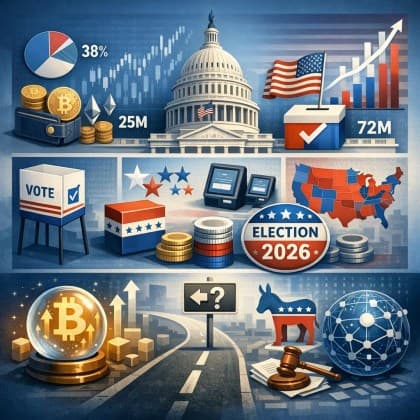
Crypto And The 2026 Elections: By The Numbers And What Lies Ahead
After emerging as a major political player in the 2024 elections, the cryptocurrency industry is once again preparing to flex its financial muscle—this time ahead of the 2026 midterms. Two years ago, crypto-focused super political action committees helped shape key races as President Donald Trump and Republican majorities in the House and Congress secured victories. Now, with digital asset prices under pressure and Congress still debating the landmark CLARITY Act, the industry is ramping up spending in an effort to protect and expand its influence in Washington. Fairshake Enters 2026 With $193M According to reporting by The Hill, Fairshake—the leading super Political Action Committee (PAC) network aligned with the crypto sector—entered 2026 with more than $193 million in cash on hand, already identifying priority races for the current cycle. It is reportedly supporting Republican Representative Barry Moore in Alabama’s Senate race and working to unseat Democratic Representative Al Green in the House. Leonard Kostovetsky, an associate professor at Baruch College and a vocal skeptic of crypto, said the strategy resembles what the industry deployed two years ago. “It’s going to be similar to the previous cycle where they will kind of flex their muscles to show the political power of the crypto industry,” he said. The industry’s political footprint expanded significantly during the 2024 election cycle, when crypto-aligned groups poured millions into competitive primaries and closely watched races. Federal filings show that Fairshake and its three affiliated organizations spent nearly $180 million during that cycle alone. Beyond elections, the industry has secured at least one significant legislative victory. Lawmakers passed the GENIUS Act, which established a regulatory framework for dollar-backed stablecoins. Yet the more comprehensive market structure legislation—widely viewed as the industry’s top priority—remains unfinished. The proposed bill would provide long-sought clarity for digital asset businesses. Although the House passed its version, the measure has stalled in the Senate. Crypto Groups Push For Regulatory Clarity As Congress debates this broader framework, crypto-affiliated political groups have wasted no time engaging in midterm contests. Defend American Jobs, one of Fairshake’s partner PACs, announced this week that it would spend $5 million to support Moore’s Senate campaign in Alabama. Meanwhile, another affiliated PAC, Protect Progress, revealed plans to invest $1.5 million to oppose Green in the Democratic primary for Texas’s newly redrawn 18th Congressional District. The group cited Green’s voting history on crypto-related measures, arguing that he has sought to “stop American innovation in its tracks.” Green voted against the GENIUS Act and the House’s CLARITY Act. Ohio-based Democratic strategist Jeff Rusnak questioned whether crypto groups should be permitted to deploy what he described as essentially “unregulated money” in federal elections. Yet, industry advocates counter that their political engagement is aimed at fostering responsible regulation rather than avoiding it. A source familiar with the Fairshake network argued that election spending has helped move policymakers toward creating clearer rules. Featured image from OpenArt, chart from TradingView.com
Crypto And The 2026 Elections: By The Numbers And What Lies Ahead
After emerging as a major political player in the 2024 elections, the cryptocurrency industry is once again preparing to flex its financial muscle—this time ahead of the 2026 midterms. Two years ago, crypto-focused super political action committees helped shape key races as President Donald Trump and Republican majorities in the House and Congress secured victories. Now, with digital asset prices under pressure and Congress still debating the landmark CLARITY Act, the industry is ramping up spending in an effort to protect and expand its influence in Washington. Fairshake Enters 2026 With $193M According to reporting by The Hill, Fairshake—the leading super Political Action Committee (PAC) network aligned with the crypto sector—entered 2026 with more than $193 million in cash on hand, already identifying priority races for the current cycle. It is reportedly supporting Republican Representative Barry Moore in Alabama’s Senate race and working to unseat Democratic Representative Al Green in the House. Leonard Kostovetsky, an associate professor at Baruch College and a vocal skeptic of crypto, said the strategy resembles what the industry deployed two years ago. “It’s going to be similar to the previous cycle where they will kind of flex their muscles to show the political power of the crypto industry,” he said. The industry’s political footprint expanded significantly during the 2024 election cycle, when crypto-aligned groups poured millions into competitive primaries and closely watched races. Federal filings show that Fairshake and its three affiliated organizations spent nearly $180 million during that cycle alone. Beyond elections, the industry has secured at least one significant legislative victory. Lawmakers passed the GENIUS Act, which established a regulatory framework for dollar-backed stablecoins. Yet the more comprehensive market structure legislation—widely viewed as the industry’s top priority—remains unfinished. The proposed bill would provide long-sought clarity for digital asset businesses. Although the House passed its version, the measure has stalled in the Senate. Crypto Groups Push For Regulatory Clarity As Congress debates this broader framework, crypto-affiliated political groups have wasted no time engaging in midterm contests. Defend American Jobs, one of Fairshake’s partner PACs, announced this week that it would spend $5 million to support Moore’s Senate campaign in Alabama. Meanwhile, another affiliated PAC, Protect Progress, revealed plans to invest $1.5 million to oppose Green in the Democratic primary for Texas’s newly redrawn 18th Congressional District. The group cited Green’s voting history on crypto-related measures, arguing that he has sought to “stop American innovation in its tracks.” Green voted against the GENIUS Act and the House’s CLARITY Act. Ohio-based Democratic strategist Jeff Rusnak questioned whether crypto groups should be permitted to deploy what he described as essentially “unregulated money” in federal elections. Yet, industry advocates counter that their political engagement is aimed at fostering responsible regulation rather than avoiding it. A source familiar with the Fairshake network argued that election spending has helped move policymakers toward creating clearer rules. Featured image from OpenArt, chart from TradingView.com