Lindsey Graham's Final Words Now Fueling New SAVE America Act Push
Thune described a possible reconciliation route, including financial incentives for states to implement voter ID.
SOURCE CHECK
TAP FOR WHYRedState is a partisan, opinion-oriented outlet, so its institutional credibility is below that of a general-interest newsroom. The named author and attribution to a New York Post interview provide some transparency, though the article is commentary rather than independent reporting of the interview.
- Source type — Opinion-oriented and partisan publication; this lowers confidence in neutral institutional framing.
- Transparency — The article attributes key statements to a New York Post interview and to Trump.
- Author attribution — A named author is identified.
The article attributes its central account to Trump and Thune and provides figures for the proposed budget blueprint. It offers limited perspectives beyond Republican proponents and does not independently establish what Graham meant or whether the proposed approach would succeed.
HOW WE SCORE ↗The article includes Thune’s caveats about reconciliation and the uncertainty of the strategy, but it presents no opposing Democratic account or substantive argument against the measure. The author’s commentary also favors passage.
- Source diversity — The quoted political sources are Trump and Thune; no opposing perspective is included.
- Counterarguments presented — The article notes procedural limits and uncertainty but does not present a substantive case against the bill.
- Opinion vs reporting — The author adds supportive commentary about the measure and its potential effects.
The article frames the SAVE America Act and Republican efforts to advance it favorably, while describing the Democratic filibuster as an obstacle. Its commentary treats possible voter-ID incentives as an improvement, indicating a right-leaning perspective.
- Framing — The reconciliation strategy is presented as a promising route to advance Republican priorities.
- Language tone — The author describes the possible changes as an improvement and stresses the importance of passing the measure.
- Source selection — The piece primarily features Republican statements and does not include a Democratic perspective.
The article argues that Lindsey Graham’s reported final conversation with Donald Trump may have pointed to a reconciliation strategy for advancing the SAVE America Act. John Thune described possible state incentives, while the House Budget Committee introduced a budget resolution that could begin the process.
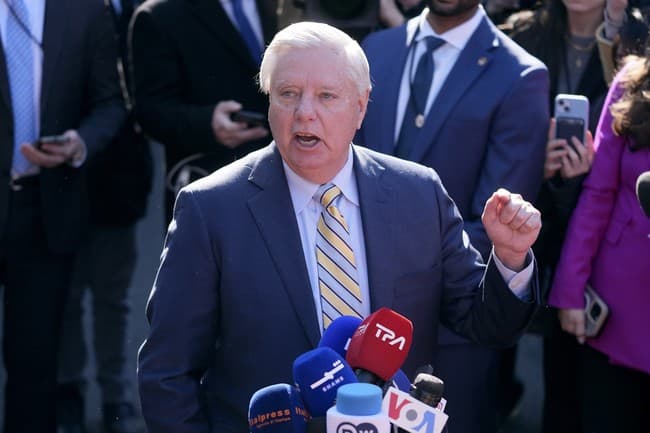
Donald Trump said that, during his final phone call with Lindsey Graham, Graham told him, “We’re all set for the SAVE America Act.” Senate Majority Leader John Thune told the New York Post he did not know exactly what Graham meant, but suggested Graham may have been discussing reconciliation as a way to advance the measure despite the Senate filibuster. Thune said financial incentives for states to implement voter ID could be one possible approach, depending on how it is structured.
The article says the House Budget Committee rolled out a budget resolution for the measure. It describes the proposed $95 billion blueprint as including $60 billion for defense, $13 billion for intelligence, $12 billion in farm aid and $10 billion in grants related to the SAVE America Act. The author presents the reconciliation approach as a possible path, while noting that the legislation would still need to become law to establish the changes fully.
Community verdict
11 VOTES
People in this story
SWIPE →
Late senator whose reported final conversation concerned the SAVE America Act
Graham's version of this story ↗
President who recounted Graham’s reported statement
Discussion · 0
Loading comments…